
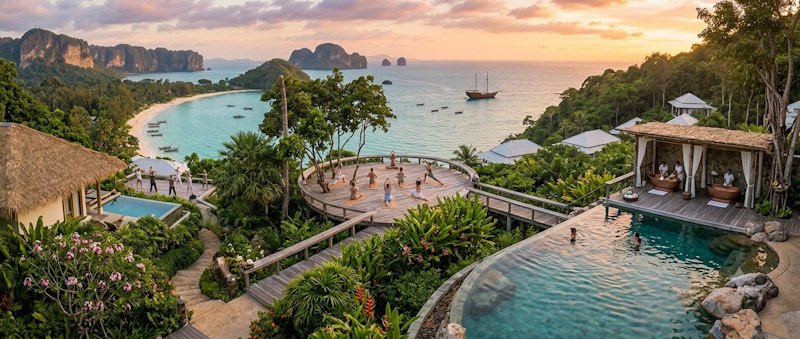
Your Complete Phuket Planning Guide – For a Wellness Trip
Everything you need to know before you book — from the best time to visit to what to pack, which area to stay in, and how much to budget.
Essential Phuket Planning Guide for Wellness Retreats
Planning a wellness trip to Phuket is genuinely exciting, but a few practical decisions made early can make the difference between a trip that transforms you and one that just exhausts you. This guide covers everything that isn’t covered in the retreat and clinic reviews — the timing, the logistics, the neighbourhoods, the visa, the budget, and the small details that experienced Phuket wellness travellers know and first-timers usually learn the hard way.
Use this page alongside the five retreat category sections to build a complete picture of what your trip will look like, then come back here once you’ve chosen a retreat to check off your planning list.
1. Best Time to Visit Phuket for a Wellness Trip
Phuket’s climate divides into two clear seasons, and which one you choose has a bigger impact on a wellness trip than on a standard beach holiday — partly because of outdoor training sessions, partly because of retreat pricing, and partly because of how the island feels when it is full versus quiet.
November to April — the dry or High season
This is when Phuket is at its most conventionally beautiful. Skies are clear, seas are calm, temperatures sit between 24°C and 32°C with lower humidity, and every yoga shala, Muay Thai camp, and detox centre operates at full capacity. If your priority is guaranteed outdoor morning sessions, post-retreat beach walks, and perfect conditions for integrating your programme with island life, this is your window.
December and January are peak season — busiest, priciest, and most requiring advance booking. Book your retreat at least 2 to 3 months ahead for this period, and 3 to 4 months for Christmas and New Year dates specifically.
March and early April offer a sweet spot: the dry season continues, crowds thin out after Chinese New Year, and prices dip slightly. Temperatures rise through April — it can reach 35°C — but that is still manageable for indoor training and retreat activities, and the heat actually enhances detox programs.
May to October — the Rainy or Monsoon season
The rainy season has an undeserved bad reputation. Rainfall in Phuket during this period almost always comes in short, heavy afternoon bursts rather than all-day downpours. Mornings are typically clear and bright, which is when most wellness programs schedule their primary sessions anyway.
The advantages for wellness travellers are significant. Retreat prices drop 20 to 40 percent from peak season rates, meaning you can often afford a higher-tier program for the same budget. The island is quieter — at popular retreats, class sizes shrink, instructor attention increases, and the overall atmosphere becomes more focused and less social. The landscape turns an intense tropical green, and the lushness of the surroundings is genuinely beautiful.
The one genuine caveat: sea swimming is rougher on the west coast during the monsoon peak (September especially). If your trip includes ocean activities, factor this in.
| Month | Weather | Retreat prices | Best for |
|---|---|---|---|
| November | Transitional — improving | Shoulder — moderate | Good balance, lush scenery |
| December–January | Peak dry, 24–29°C | Peak — highest | Best weather, book early |
| February–March | Dry, calm, clear | High but easing | Ideal overall timing |
| April | Hot, 30–35°C | Shoulder | Detox & indoor programs |
| May–June | Early monsoon, warm | Low — best value | Solo or budget retreats |
| July–August | Rainy afternoons, sunny mornings | Low | Value Muay Thai camps |
| September | Wettest month | Lowest | Avoid if sea access matters |
| October | Transitioning, clearing | Low–shoulder | Quiet island, good value |
For wellness trips specifically, November and February–March are the two best months. You get the dry season’s reliability without December–January’s prices and crowds. If budget is a priority, June to August offers genuine value with morning weather that works for most programmes.
2. Which Area of Phuket to Stay In
Phuket is larger than most first-time visitors expect — driving from the north to the south takes around 90 minutes. Where you stay determines which retreats and clinics are convenient, what your daily environment feels like, and whether you spend your free time in a calm wellness bubble or a busy tourist strip.
Rawai and Nai Harn — best for serious wellness
The far south of the island is where Phuket’s wellness scene is most concentrated. Rawai and Nai Harn are home to Phuket Cleanse, Amity Wellness, Sinbi Muay Thai, and several yoga studios. The area is quiet, local, and unpretentious — more restaurants serving healthy food than bars, more scooters than tour buses. If you are choosing a retreat in this area, staying nearby is straightforward since most retreats include accommodation or have reliable partner guesthouses within walking distance.
Kata and Karon — best for balanced wellness trips
Moving up the west coast, Kata and Karon offer a middle ground: well-developed tourist infrastructure, beautiful beaches, access to both Rawai to the south and central Phuket, and the home base of Atmanjai Wellness Center. It is a good choice if you want a wellness focus during your retreat but flexibility to explore the island on free days.
Chalong — best for Muay Thai and fitness
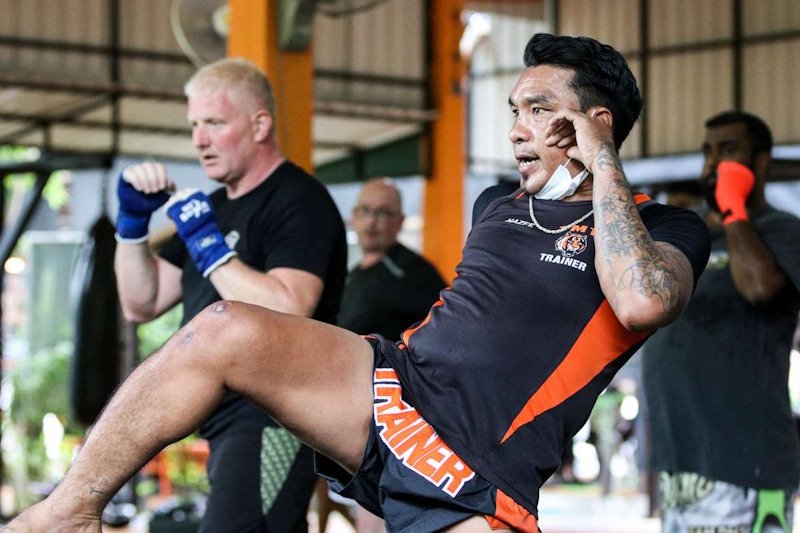
Chalong is where Tiger Muay Thai is located, along with several other training-focused gyms and fitness retreats. It is not a beach area — it sits inland near the roundabout — but its central position makes it convenient for exploring the whole island. Most training camps in this area offer on-site accommodation.
Choeng Talay, Bang Tao and Cherngtalay — More Upscale
The north-west of the island hosts Phuket’s most upscale resorts. The Cherngtalay area has a quieter, more residential feel compared to the south and offers easy access to Bang Tao Beach, one of the island’s most beautiful and least crowded stretches. If your budget extends to the upper tier of retreat, this is where the premium experience concentrates. You can find Bangtao Muay Thai & MMA here.
Patong — generally avoid for wellness
Patong is the island’s main nightlife and shopping district. It has energy, convenience, and easy access to transport and international food, but the atmosphere is at direct odds with a wellness trip. The noise, the pace, and the proximity to late-night activity make it a poor fit for retreats that require early mornings and mental quiet. Only consider Patong if a specific clinic draws you there for longevity or medical programs.
| Area | Best for | Vibe | Distance from airport |
|---|---|---|---|
| Rawai / Nai Harn | Detox, yoga, Muay Thai | Quiet, local, wellness-focused | ~45 min |
| Kata / Karon | Balanced retreat + beach | Mid-range, pleasant | ~40 min |
| Chalong | Muay Thai, fitness camps | Functional, camp-oriented | ~35 min |
| Choeng Talay / Bang Tao | Muay Thai + beach | Upscale, calm, resort-feel | ~20 min |
| Patong | Longevity clinics only | Busy, noisy, tourist hub | ~30 min |
3. Thailand Visa and Entry Requirements (2026)
For the vast majority of readers visiting from the UK, US, EU countries, Australia, Canada, and New Zealand, entering Thailand is straightforward. Here is the current picture as of mid-2026.
Visa-free entry
Citizens of 93 countries — including the UK, USA, most EU nations, Australia, Canada, and New Zealand — qualify for visa-free entry to Thailand. Most of our readers fall into this category and receive a 60-day entry stamp on arrival with no fee and no prior application required.
Important: Thailand’s Cabinet approved changes to the visa-exemption scheme in May 2026. The revised rules are expected to return the visa-free stay to 30 days for most nationalities once implemented, though an extension will remain available. Always verify the current rules at immigration.go.th before you travel, as requirements can change with little notice.
What you need at the border
- Passport valid for at least 6 months beyond your arrival date
- Completed Thailand Digital Arrival Card (TDAC) — mandatory for all visitors since May 2025. Complete it online at tdac.immigration.go.th within 72 hours before arrival. It takes around 5 minutes and is free.
- Proof of onward or return travel — immigration officers sometimes ask for this. Have your return flight booking accessible.
- Proof of funds — checks are random but immigration can ask for THB 10,000 per person (~$280). This is rarely enforced but worth knowing.
Extending your stay
If your wellness program runs longer than your initial stamp allows, you can extend at any Thai Immigration office — the main Phuket office is in Phuket Town — for 1,900 THB (~$52). This gives you an additional 30 days. Bring your passport, a TM.7 form (available at the immigration office), a passport photo, and the fee. Arrive early as queues can be long.
Travel insurance
Thailand’s public health system does not cover foreign visitors, and even Bangkok Hospital Phuket — an excellent private facility — bills at international private rates. Travel insurance covering medical evacuation and outpatient treatment is not optional for a wellness trip. Ensure your policy covers any activities you plan to do, as some standard policies exclude Muay Thai or contact sports.
4. Getting to Phuket
Flying
Phuket International Airport (HKT) receives direct flights from many European, Australian, and Asian cities, though the majority of long-haul routes connect through Bangkok (Suvarnabhumi — BKK) or Kuala Lumpur (KUL). From the UK, expect a total journey of 13 to 16 hours including connection. From Australia’s east coast, 9 to 12 hours. From the US west coast, 18 to 22 hours.
- From the UK: Thai Airways and British Airways fly via Bangkok. Budget option: fly to Bangkok with any carrier, then connect with Thai Smile, AirAsia, or Nok Air on a short domestic hop (1.5 hours, from around $25).
- From Australia: Jetstar, Scoot, and AirAsia X offer direct routes from several cities. Qantas and Singapore Airlines connect via Singapore.
- From the US: Most routes connect through Tokyo, Seoul, Hong Kong, or Taipei. No non-stop options from North America exist for Phuket specifically.
From Bangkok to Phuket
If you are routing through Bangkok, your two realistic options are a domestic flight (1.5 hours) or the overnight train to Surat Thani followed by a bus to Phuket (approximately 14 hours total). The flight is overwhelmingly the better choice for a wellness trip where you want to arrive rested.
From the airport to your retreat
Book your airport transfer in advance through your retreat. This is important for two reasons: it is safer than negotiating with unlicensed drivers on arrival, and most retreat transfers will include a brief orientation about your program schedule — a useful way to start your trip on the right foot. Expect to pay 800 to 1,500 THB ($22 to $42) for a private transfer depending on your destination. Booking Link .For more details see this post: Phuket Airport Shuttles & Transfers
If you prefer to organise your own transport, Grab (the Southeast Asian equivalent of Uber) is available throughout Phuket and is metered, tracked, and reliable. Download the app before you arrive.
5. Getting Around Phuket
Most wellness retreat guests do not need to travel much during their program — the retreat schedule keeps days structured and the best experience usually comes from staying present in one place. But for free days, excursions, and clinic visits, here is how transport works. For more details see our article about Getting Around Phuket.
Grab and Bolt (strongly recommended)
Grab is available in Phuket and is by far the safest, most transparent transport option. Fares are fixed before you confirm the ride, drivers are tracked, and you pay in-app or by cash. Use it for any journey longer than walking distance. Bolt is another taxi app I have used and it is timely, dependable, and not too expensive.
Songthaews (local shared trucks)
Phuket’s blue songthaew shared trucks run routes between the main beaches for 30 to 50 THB per person. They are slow and run infrequent schedules, but they are cheap and a perfectly fine option for daytime travel between Rawai, Kata, Karon, and Patong. Ask your retreat which routes pass nearby.
Scooter rental
Scooter rental is common in Phuket and costs around 200 to 400 THB per day. It is not something we recommend for wellness retreat visitors for two reasons. First, road safety in Thailand is genuinely serious — traffic fatality rates are among the highest in the world, and most accidents involve motorcycles. Second, if you injure yourself on a scooter, it will affect your retreat participation. Stick to Grab and songthaews, especially during a detox or yoga programme when your primary goal is physical wellbeing.
Tuk-tuks and metered taxis
Phuket’s tuk-tuks and taxis are not metered and require negotiation. Prices are significantly higher than Grab for equivalent journeys. Use them only when Grab is unavailable, and agree on a price before you get in.
6. Budget Planning for a Wellness Trip
Phuket wellness is significantly more affordable than equivalent programs in Europe, the US, or even Bali. Here is an honest breakdown of what to expect at each level.
| Budget tier | Retreat (7 days all-in) | Return flights (UK) | Extras per week |
|---|---|---|---|
| Budget | $400–$700 | $600–$900 | $100–$200 |
| Mid-range | $700–$1,400 | $700–$1,100 | $150–$300 |
| Premium | $1,400–$2,500 | $900–$1,400 | $200–$500 |
| Luxury | $2,500–$5,000+ | $1,200–$2,500 | $300–$800 |
What “all-inclusive” actually means
Most retreat packages include accommodation and meals or juices, daily wellness sessions, and workshops. They typically do not include airport transfers, additional treatments (massages, extra colonic sessions), supplements sold on-site, or spending money for excursions on free days. Budget an extra 10 to 20 percent on top of your quoted retreat price to cover these.
Money and payments
- Thailand’s currency is the Thai Baht (THB). The approximate exchange rate is 32 to 36 THB to USD 1, and 44 to 46 THB to GBP 1 (verify current rates before you travel).
- ATMs are widely available throughout Phuket. Most charge a 200 to 250 THB ($5 to $7) foreign transaction fee per withdrawal. Minimise these fees by using a travel card such as Wise or Revolut that refunds ATM fees.
- Most retreats accept card payment. Day-to-day spending at markets, songthaews, and street food stalls requires cash. Keep a few hundred baht in small notes available at all times.
- Tipping: 20 to 50 THB for massage therapists, 20 to 30 THB for restaurant meals, 10 percent for exceptional service at retreats. Not mandatory but genuinely appreciated.
7. Phuket Wellness Trip Packing List
Phuket is a tropical island. The general principle is: bring less than you think, in lighter fabrics than you own at home. Almost everything you forget can be bought cheaply on the island, and overpacking creates friction on a trip designed to simplify your life.
Clothing
- 3 to 4 sets of lightweight workout clothes suitable for yoga, training, or movement classes — quick-dry fabrics only
- 1 to 2 sets of casual daywear — linen or cotton, loose fitting
- 1 lightweight layer for air-conditioned spaces (clinics, restaurants, taxis can be very cold)
- A modest cover-up or wrap for temple visits if you plan any cultural excursions
- Comfortable sandals and one pair of closed shoes for training
- Swimwear — 2 sets so one can dry while you wear the other
Wellness and health essentials
- High-SPF sun protection — SPF 50 minimum. Available in Phuket but more expensive than at home.
- Insect repellent with DEET — essential for outdoor activities and green-season visits
- Reusable water bottle — many retreats provide filtered water refills and single-use plastic is avoidable
- Any prescription medications in original labelling with a doctor’s letter — important at Thai customs
- Basic first aid items: antihistamines, electrolyte sachets, and blister plasters
- If you wear contact lenses: bring more than you need. The heat and training environment dries them out faster than usual.
For longevity clinic visitors specifically
- Previous bloodwork results if you have them — useful baseline for your physician
- List of current medications, supplements, and any known allergies
- Fast for 10 to 12 hours before your first bloodwork appointment
- Comfortable clothes that allow easy access for IV lines (loose sleeves)
Technology
- Universal travel adapter — Thailand uses Type A, B, and C sockets
- Download Grab or Bolt before arrival — it works from the moment you land
- Buy a local SIM at the airport — AIS and DTAC offer tourist SIMs from 299 THB ($8) for unlimited data. This is significantly cheaper than roaming.
- Offline maps — download your arrival area in Google Maps or Maps.me before landing in case of connectivity issues on arrival
8. Practical Tips for a Successful Phuket Wellness Trip
Before you leave home
- Book your retreat and flights together once you have confirmed dates — many retreats will hold a booking without full payment while you finalise flights
- Book your airport transfer at the same time as your retreat — retreats fill their transfers quickly during peak season
- Complete your TDAC within 72 hours before departure at tdac.immigration.go.th
- Inform your bank you are travelling — card blocks at overseas ATMs are common and frustrating
- Reduce alcohol intake in the week before a detox programme — a gradual reduction makes the first days of your programme significantly easier
During your retreat
- Arrive one night early if possible — a night’s rest before your programme starts makes a meaningful difference to how your body engages with the first day
- Tell your retreat coordinator about any health conditions, injuries, or dietary requirements on arrival, not after the programme has started
- Embrace the schedule even when it feels uncomfortable — the early mornings, unusual meals, and structured days are where the value is
- Limit phone use during your programme. Most serious retreats encourage this, and the transformation in focus is noticeable within 48 hours
Cultural awareness
- Dress modestly at temples — shoulders and knees covered. Rawai has the Wat Nai Han temple nearby; worth a quiet visit on a free morning
- Remove shoes before entering any retreat sala, temple, or Thai home — look for shoes at the door as your signal
- The head is considered sacred in Thai culture; avoid touching people’s heads
- Songkran (Thai New Year, mid-April) means the island will be especially lively and wet. Embrace it if your timing coincides, or plan around it if you need quiet.
This page gives you the overview. The category pages go deeper — with detailed reviews, head-to-head comparisons, full price breakdowns, and specific booking recommendations.
- Yoga & Meditation Retreats in Phuket — reviews of Mangosteen, Chivitr and more
- Muay Thai Camps in Phuket — Tiger vs Sinbi, all camps ranked, pricing and training schedules
- Wellness Retreats in Phuket — all Wellness camps ranked, pricing and training schedules
- Detox & Cleanse Retreats in Phuket — Atmanjai, Amity, Phuket Cleanse compared
- Longevity & Medical Wellness in Phuket — clinics, treatments, and price comparison vs Western equivalents
- Phuket Planning Guide — visas, timing, budget, packing, and practical logistics