Getting Around Phuket 2026: The Best Transport Options Explained
Getting Around Phuket: The Best Options Explained
Phuket does not have a train, a metro, or anything resembling a comprehensive public bus network. For an island that welcomes more than ten million visitors a year, that catches a lot of first-time visitors off guard. The good news is that once you understand how people here actually get around, it stops feeling chaotic and starts feeling manageable — you just need to know which option fits which situation.
This guide covers every realistic way to get around Phuket in 2026: what each one costs, what it is genuinely good for, and where it falls short. I have lived on this island since 2022 and used every option on this list more times than I can count, so this is written from firsthand experience rather than a quick research pass.
Quick answer: For nearly everyone reading this, Grab should be your default. Use songthaews for cheap daytime hops between beaches, and only consider a scooter or rental car if you are staying more than a couple of weeks and have genuine riding or driving experience in Southeast Asia.
1. Grab Taxis— The Option Most People Should Use
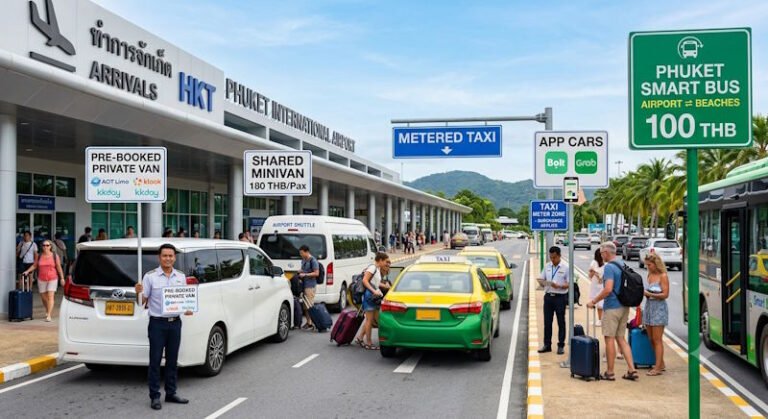
Grab is Southeast Asia’s answer to Uber, and it is by a wide margin one of the easiest ways and most reliable way to get around Phuket. Plus most cars are have air conditioning. You see the price before you book, the car is tracked by GPS the whole ride, drivers are rated, and there is no negotiation involved at any point. For a wellness trip specifically — where the last thing you want after a morning yoga session or a NAD+ drip is a haggling match with a tuk-tuk driver — this matters.
What it costs
| Route | Typical Grab price |
|---|---|
| Airport to Patong | 350–600 THB ($10–$17) |
| Short trip, under 5km | 100–200 THB ($3–$6) |
| Cross-island, e.g. Bang Tao to Rawai | 500–700 THB ($14–$20) |
| GrabBike (motorbike taxi, solo rider) | 40–60% cheaper than GrabCar |
Prices fluctuate with surge pricing during rain, rush hour, and peak tourist season. Always check the in-app price before confirming.
Where ride-hailing apps work well, and where they do not
Grab covers the whole island, but coverage and wait times vary by area. In dense zones like Patong, Kata, Karon, Bang Tao, and Phuket Town, you will typically get a car in three to five minutes even at peak times. In quieter, more spread-out areas — including parts of Rawai and Nai Harn where much of Phuket’s wellness retreat cluster sits — wait times run longer, and driver availability drops off late at night.
- Download the app and set up your payment method before you land — do not wait until you are standing at arrivals
- GrabBike (the motorbike taxis option) is significantly cheaper for solo travelers comfortable riding pillion, though it is not ideal with luggage
- Bolt, a newer ride-hailing app, has been gaining ground in Phuket and often undercuts Grab by five to ten percent on the same route — worth having installed as a backup
- For airport pickups specifically, many retreats and hotels offer a pre-booked private transfer at a similar price to Grab, with the advantage of a driver waiting for you inside the terminal with a name sign — worth it for a stress-free first impression after a long flight
2. Songthaews — The Cheapest Way to Get Around
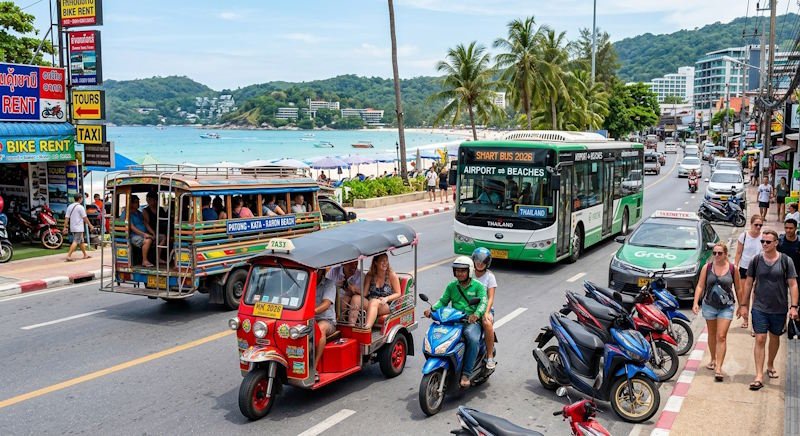
Songthaews (pronounced “song-tao,” meaning “two rows” in Thai) are shared pickup trucks fitted with two facing bench seats in the back. They run fixed routes connecting Phuket Town to the main beaches, and they are the cheapest transport on the island by a significant margin. Especiiaaly for short trips.
How they work
There is no app, no schedule, and no fixed stop in most cases. You wave one down from the side of a main road heading in your direction, climb into the back, and pay the fare — typically 25 to 50 THB ($0.70 to $1.40) — when you get off, either by handing cash to the driver or tapping a bell to signal your stop. Most songthaews run roughly 6am to 6pm and stop operating in the evening, which is the main limitation to plan around.
First-timer tip: Songthaew routes are not signposted in any way that makes sense to visitors. Ask your retreat or hotel staff which road to stand on and which color songthaew to look for — they will know the local routes instantly, even though a stranger would never work it out alone.
Who this suits
Songthaews are ideal for simple daytime trips between nearby beaches, or into Phuket Town for a market visit or errand, when you are not in a hurry and do not mind a slower, more social ride. They are not a good option late in the evening, when you have luggage, or when you have tight travel times.
3. Tuk-Tuks — Convenient but Consistently Overpriced
Tuk-tuks are everywhere in Phuket and undeniably part of the island’s character, but it is worth going in with clear eyes: Phuket’s tuk tuk pricing is set by a long-established local system that keeps fares well above what an equivalent Grab ride costs — often two to three times as much for the same distance. This is not really a scam in the traditional sense; it is closer to fixed, cartel-set local pricing that every driver adheres to, which means bargaining hard rarely gets you close to a fair rate.
- Always agree the price before you get in — Phuket’s tuk-tuks do not use meters
- They are genuinely useful for very short hops when Grab availability is poor, or as a last-resort option late at night
- For anything beyond a five to ten minute ride, opening the Grab app first will almost always save you money
4. Metered Taxis — A Reasonable Middle Ground
Phuket does technically have local taxis, though — confusingly for visitors used to other cities — most do not actually run on the meter, particularly around tourist zones, hotels, and the airport, where fixed (and inflated) rates are the norm. Airport taxi counters typically offer a fixed-fare desk, which is a reasonably safe and predictable option if you would rather not deal with an app the moment you land, even though it usually costs somewhat more than Grab for the same route.
Outside of tourist hotspots, particularly if you flag a taxi in Phuket Town, you have a better chance of getting an honest metered taxi. As a general rule, if taxi drivers refuses to use the meter and you are not at a fixed-rate counter, that is your signal to use Grab instead.
5. Scooter Rental — Freedom, With a Serious Caveat
Renting a scooter is popular among longer-stay visitors and gives you the most flexibility of any option on this list — no waiting for rides, no fixed routes, and the ability to explore at your own pace. It is also, without exaggeration, the option I am most hesitant to recommend.
Please read this before pursuing motorbike rentals: Thailand has one of the highest road fatality rates in the world, and the majority of those accidents involve motorbikes. Phuket’s roads are hilly, winding, and shared with fast-moving traffic that does not always drive defensively. If you injure yourself on a scooter, it will very likely derail the wellness program you came here for — a sprained wrist ends a Muay Thai trip, and a bad graze makes a detox or yoga retreat considerably harder to enjoy.
If you do decide to rent
- Cost: approximately 250 to 350 THB ($7–$10) per day for a standard automatic scooter
- An International Driving Permit is technically required, and increasingly enforced — riding without one can void your travel insurance entirely if you are in an accident
- Only rent if you already have genuine riding experience. Phuket’s roads are not the place to learn.
- Wear a proper helmet (rental shops often supply poor-quality ones — consider bringing your own or upgrading), and avoid riding after dark or in rain if you can help it
- Check that your travel insurance policy explicitly covers motorbike use — many standard policies exclude it or require an add-on
For most wellness retreat visitors, particularly anyone in the middle of a physical program like Muay Thai or an intensive yoga schedule, we would gently steer you toward Grab and songthaews instead. The convenience of a scooter rarely outweighs the risk for a short wellness-focused trip.
6. Rental Car — Worth It for Longer Stays and Families
A car rental makes the most sense if you are staying for an extended period, traveling with family, driving longer distances or planning to explore widely beyond your retreat. It removes the accident risk that comes with a scooter, though Phuket’s driving conditions — heavy traffic in central areas, hilly roads, and local driving habits that can catch newcomers off guard — still call for a confident, alert driver. Booking Link
| Car type | Daily rate | Notes |
|---|---|---|
| Economy | 600–1,200 THB ($17–$34) | Fine for solo or couples |
| Mid-range SUV | 1,200–2,000 THB ($34–$57) | Better for families or hilly routes |
| Luxury / 4WD | 2,000 THB+ ($57+) | Rarely necessary for retreat travel |
- Budget an additional 300 to 500 THB per day for insurance with a reasonable damage deductible — do not skip this
- Fuel runs roughly 35 to 40 THB per liter; budget 100 to 150 THB per day for typical use
- Established international rental companies (Avis, Hertz) and reputable local operators (Thai Rent A Car) are safer choices than unbranded Facebook-page rentals, even if the latter look cheaper
- Double-check the fuel type before filling up — Thailand sells both ethanol-blended “Gasohol” and pure petrol, and using the wrong one is a common and avoidable rental dispute
- It is alwyas nice to have a private car avaialble when you need it. Or for day trips.
7. Which Option Is Right for Your Trip
| Your situation | Best option |
|---|---|
| Airport to your retreat | Pre-booked transfer through your retreat, or Grab |
| Daily life within a retreat cluster (e.g. Rawai) | Grab, or walk if your retreat is close to amenities |
| Beach hopping on a free afternoon | Songthaew for budget, Grab for speed and comfort |
| Solo, short trip, comfortable on a bike | GrabBike for short hops |
| Family or group, staying 2+ weeks | Rental car from a reputable agency |
| Late at night or with luggage | Grab — avoid songthaews and scooters |
| Mid-program in a physical retreat (Muay Thai, yoga) | Grab or songthaew — avoid scooters entirely |
Frequently Asked Questions
Consider adding FAQ schema markup to these in Rank Math.
What is the best way to get around Phuket?
For most visitors, Grab is the best all-around option — transparent pricing, GPS tracking, and no negotiation required. Combine it with songthaews for cheap daytime trips between beaches, and reserve a rental car only if you are staying for an extended period or traveling with family.
Is it safe to rent a scooter in Phuket?
Thailand has one of the highest motorbike accident rates in the world, and Phuket’s hilly, winding roads add to the risk. Scooter rental should be limited to visitors with genuine prior riding experience who hold a valid International Driving Permit. For most wellness retreat visitors, particularly those in a physical program, Grab and songthaews are the safer and more sensible choice.
How much does a Grab cost from Phuket airport?
A GrabCar from Phuket International Airport to Patong typically costs 350 to 600 THB ($10 to $17). Fares to other areas of the island vary with distance — expect to pay somewhat more for destinations further south, such as Rawai or Nai Harn.
Do taxis in Phuket use meters?
Rarely, especially around tourist areas, hotels, and the airport, where fixed rates are the norm rather than metered fares. Airport taxi counters offer a fixed-fare desk that is a reasonably predictable option. Outside of tourist hotspots you have a better chance of a metered fare, but as a general rule, Grab is more reliable and usually cheaper.
What are songthaews and how do I use them?
Songthaews are shared pickup trucks that run fixed routes connecting Phuket Town to the main beach areas, costing 25 to 50 THB per ride. There is no app or fixed schedule — you flag one down from the roadside heading in your direction and pay when you get off. They typically stop running around 6pm, so plan accordingly for evening travel.
The Bottom Line
Phuket’s transport system rewards a bit of preparation. Download Grab (and Bolt as a backup) before you land, keep a little cash on hand for songthaews, and think carefully before renting a scooter — particularly if your trip is built around a physical wellness program where an injury would cost you more than it saves. For nearly everyone reading this site, that combination of Grab plus the occasional songthaew will comfortably cover everything your trip needs.