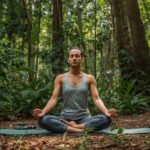
Phuket Cleanse: An Honest 2026 Review of the Disney of Wellness
Co-founder Melanie Procter used to be a Disney Imagineer, designing immersive experiences and educational theme parks across Asia. She describes Phuket Cleanse as the Disney of Wellness, and once you hear that, the entire property makes sense.
That is not a comment about theming or cartoon characters. It is about breadth and sequencing. A theme park works by giving you more things to do than you could possibly do, arranged so that you are always choosing rather than waiting, and so that the day builds. Phuket Cleanse runs on exactly that logic: a schedule presented explicitly as a buffet, an app you use to assemble your own day, and a density of classes and facilities that makes a week feel considerably longer than seven days.
For those considering a wellness getaway, this Phuket Cleanse review provides insight into what sets this retreat apart from typical detox programs.
Melanie puts it more memorably than I can: it is a buffet, not a boot camp. That distinction is the single most useful thing to understand before booking. Phuket has boot camps — places where a coach sets the schedule, the intensity is the product and the week is something you survive. This is not one. The volume on offer is high and the obligation is zero, and the two facts together are the whole model.
I stayed on 5 and 6 November 2026, in a building called the Pyramid and took many classes.
It is also the opposite of almost everything else I have reviewed in Phuket. Chivitr is eight rooms, clinical staff and deliberate solitude. Atmanjai is austere, cheap and serious. Phuket Cleanse is social, busy, and built around a long communal table where everybody eats together. Whether that sounds wonderful or exhausting is most of your answer about whether to go.
The short version
| Field | Detail |
|---|---|
| Location | Rawai, southern Phuket — a cluster of buildings on and around the main property |
| Opened | December 2011 |
| Founders | Melanie and Stanton Procter, owner-operators, both former educators |
| Capacity | Maximum 24 guests |
| Typical guest | Solo traveler, age roughly 40 to 50 |
| Repeat rate | Around 65%, with heavy word-of-mouth referral |
| Popular stay | One week |
| Pillars | Fitness, Yoga, Meditation & Consciousness, Emotional Detox, Longevity |
| Diets | Vegan, vegetarian or pescatarian and allergies set in the app |
| Cleanse | Optional — all, part, or none of your stay; start and stop at will |
| Water | Free reusable bottles in fridges throughout; app-ordered homeopathic water bar, 11 varieties |
| Rooms | Named rooms across several buildings; some share a pool between 3 rooms |
| Off-site | Hikes, beaches, Big Buddha sunrise climb and Explorer Day excursions |
| Flexibility | Multi-part thematic series; Melanie will try to add a class on request |
| Scheduling | Via their own app, which you download at check-in |
| Medical | No clinical staff on site; curated referral network — Lyfe Medical, physiotherapy, listed in the app |
| Rates | $280-$480 solo per night all-inclusive, plus 7% VAT; 25% less per person sharing |
| Best for | Solo travelers who want structure, variety and company |
| Not for | Anyone wanting quiet, privacy, or clinical supervision |
A small piece of Phuket wellness history
Phuket Cleanse opened in December 2011, and at the start it was exactly what the name says: a cleanse. Green juice and raw vegan food, and not much else. That was the standard detox model of the period, in Phuket and everywhere else — you fasted, you rested, you went home.
According to the retreat, they were the first to bring movement and exercise into the cleanse protocol. I cannot independently verify a claim like that and I would not state it as established fact, but it is worth taking seriously for one reason: look at what every detox center in Phuket does now. Atmanjai runs yoga and fitness classes alongside its juice programs. TheLifeCo has a gym. Amity programs movement. The combination that is now completely standard was, in 2011, not obvious at all — the orthodoxy then was that a fasting body should rest.
Whoever got there first, the shift happened, and Phuket Cleanse has been built around it for fifteen years. The result is a property where the cleanse is genuinely optional and the movement is the backbone, which is the reverse of how every other detox center in Rawai is organized.
The Imagineer thing, and why it explains the place
Melanie Procter’s background at Disney is not a fun biographical detail. It is the design philosophy of the whole retreat, and it shows up in three specific ways.
The question she started with
Melanie describes the founding question as: what if we built a Magic Kingdom for the whole person, where the magic is already inside you and your only job is to find it? She then did what Imagineers do — took what is potent in wellness, what is wildly effective in fitness and what is quietly transformative in consciousness work, and blended them.
That is founder language and I am quoting it as such. But the observation she draws from it is the sharpest thing anybody said to me about how retreats actually work, and it deserves repeating:
Your magic almost always surprises you. Guests in their seventies find it in Muay Thai. The yoga teacher finds it in heavy lifting. The runner finds it in a sound ceremony at dusk.
That is why the schedule is a buffet, and it reframes the whole model. I had understood the breadth as generosity — more on offer than you can do, so the week feels abundant. Her reasoning is better and more precise: the thing that will work for you is not predictable, including by you, and often especially by you. The person who arrives certain they are a yoga person and leaves having discovered deadlifts is the normal case rather than the funny exception. A prescribed program can only give you what you or a practitioner already believed you needed. A buffet lets you be wrong about yourself.
I think that is correct, and it is the most useful argument I have encountered for this format over the bespoke-program model. It is also the honest answer to anyone asking which classes to book: you do not yet know.
Breadth over prescription
Most wellness retreats hand you a program. Phuket Cleanse hands you a schedule and lets you build the day — a buffet, not a boot camp, as Melanie puts it. On a given day you might choose between strength training, HIIT, Muay Thai, a hill or jungle hike, aerial yoga, a classical yoga class, a house fusion of yoga with strength and cardio, an ocean-based aqua session, breathwork, sound therapy, a meditation, or a talk.
That is a theme park’s logic applied to a retreat. You will not do everything, and the point is that you cannot — the abundance is what makes the week feel generous rather than scheduled. This is a Phuket Cleanse review that highlights the unique experience offered.
The hybrid classes are the most interesting thing on the schedule
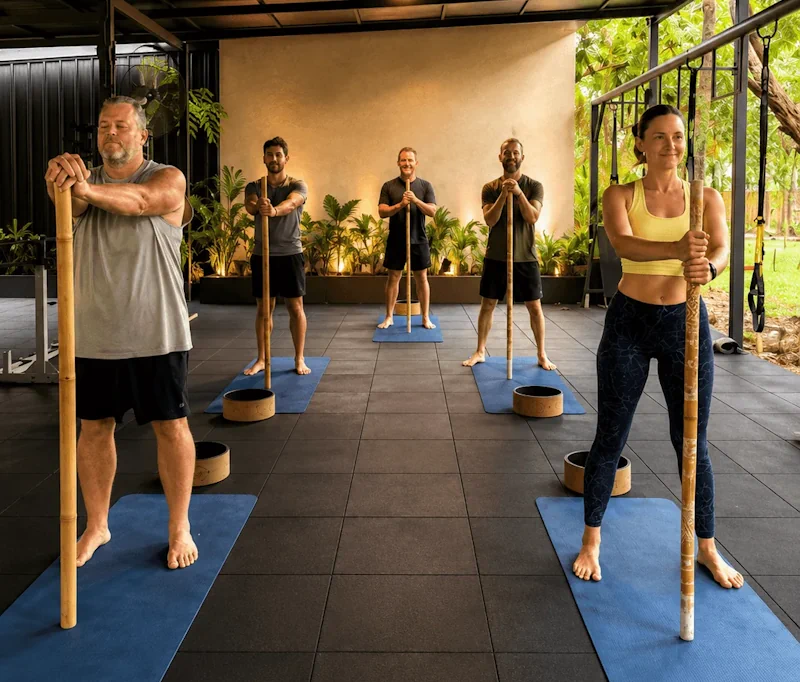
What struck me more than the number of classes is that many of them combine disciplines normally taught separately. Yoga with cardio and strength in a single session — which I took, and which is the clearest expression of the idea. Aerial yoga. Ice bath meditation, which pairs cold exposure with a guided practice rather than treating the plunge as an endurance test. Aqua sessions that move a workout into the ocean.
These are house inventions rather than standard formats, and they exist for a structural reason. A yoga studio teaches yoga, because that is what it sells and what its teachers are certified in. A retreat with the same 24 people for a week can do what a studio cannot: build a class around what a guest actually needs on a Wednesday afternoon, which is often some strength, some mobility and some breathing rather than ninety minutes of any one discipline. Blending disciplines is only possible when you control the whole week.
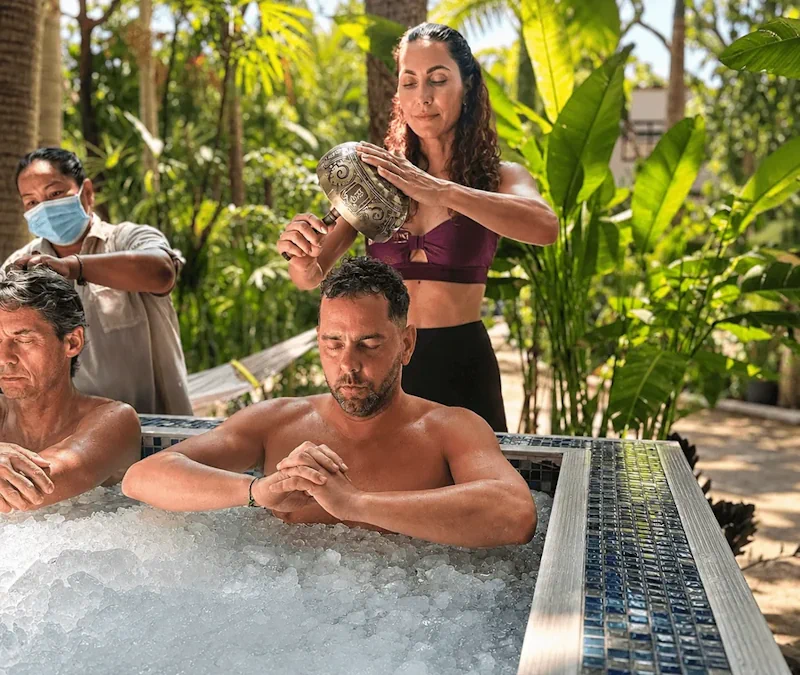
It also solves the problem that kills most fitness holidays, which is that the same class every day gets dull by Thursday. A rotating set of hybrids keeps a week interesting in a way a timetable of pure forms does not. If you have tried a wellness week before and found yourself bored halfway through, this is the specific thing that addresses it.
The day is designed, not just filled
Their published sample days have shapes: a Mix Day, a Mind Day that starts later and leans contemplative, an Explorer Day built around an excursion. Hikes have names — Black Rock, Big Buddha at sunrise, Jungle Ascent, Expansion Hike. Naming a hike is a theme park move, and it works, because a named thing is a thing you decide to do rather than a thing on a list.
Education is part of the product
Both Melanie and Stanton are former educators, and it shows in the programming. Melanie teaches classes herself on fasting, longevity, peptides, gut health, NAD+ and sleep — current topics, taught rather than sold.
I would rate this highly, and not only because teaching is the most durable part of any retreat. A founder who stands up and explains the reasoning is making herself accountable for it in a way that a treatment menu never is. It is also the single best defense against the usual failure of a wellness week, which is that you feel transformed for about three weeks and then revert. What you understand travels home; what was done to you does not.
The app, which I had not seen before
At check-in you download their app, and from then on it runs your stay. You browse the class schedule and build your own timetable, read descriptions of what each class involves, order your meals, book massages and treatments, pull up guided meditations and class handouts, and access grocery guides and a take-home program.
I have visited a lot of wellness properties in Phuket and I had not seen this anywhere else. The usual mechanism is a printed schedule at reception, a whiteboard, or asking somebody. An app sounds like a small thing and is not, for three reasons.
- It makes the buffet usable. A schedule with this many options is overwhelming on paper and manageable on a phone, and you can change your mind at 6 a.m. without finding a staff member.
- It removes the friction from extras. Booking a massage or ordering food without queuing or negotiating is a real improvement on how most retreats operate.
- It is the take-home mechanism, and the strongest one I have seen. Recipes for everything served, handouts, grocery guides, a longevity shopping list and the Age Backwards Blueprint all stay on your phone after you leave, where a folder of printouts goes in a drawer.
- It takes meal requests, so the kitchen is responsive rather than fixed.
- It carries your dietary profile. You set vegan, vegetarian or pescatarian and declare allergies once, in the app, rather than explaining yourself to a different server at every meal.
- It handles the water bar — eleven varieties of tincture-dosed water, ordered to you.
- It is also a directory. Outside service providers the retreat works with — Charlie the physiotherapist among them — are listed in the app, so booking an external specialist is as frictionless as booking a yoga class.
The honest counterpoint: A retreat is partly an exercise in putting the phone down, and a property that routes your schedule, your meals and your treatments through an app has given you a reason to pick it up all day. Whether that trade is worth it depends entirely on your relationship with your phone. If you came to Phuket specifically to escape screens, this is a genuine consideration rather than a quibble.
The rooms
I stayed in the Pyramid, which gives a sense of how the accommodation is organized: rooms are named rather than numbered, and spread across the cluster of buildings on and around the main site rather than arranged along a corridor.
The Pyramid shares a pool between three guest rooms. That arrangement is worth stating plainly, because at these rates some readers will assume a private one. It is not a private pool and the property does not claim otherwise, but it is also not a single pool shared by everybody — three rooms to a pool, at a property capped at 24 guests, means you will frequently have it to yourself. In practice the shared pool is also consistent with the rest of the model: this is a social retreat, and the pool is one more place the community forms.
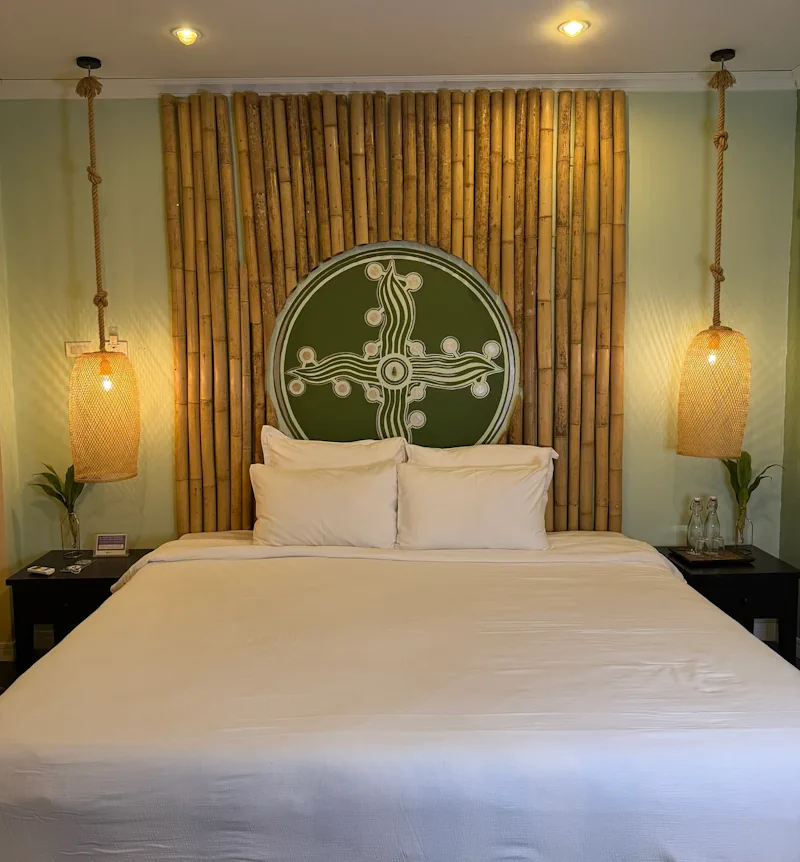
Set expectations on comfort rather than luxury. Rooms here are functional and perfectly pleasant, in buildings that were not designed as a resort, and nobody is choosing Phuket Cleanse for the thread count. If the room is the thing that makes or breaks a trip for you, Trisara and Keemala exist and cost accordingly.
What two days actually looked like
Rather than describe the menu, here is what I actually did across a two-night stay in November:
- Yoga + Strength + Cardio — the house hybrid, and the class that best explains the whole format
- Mobility Flow
- Letting Go Meditation
- Breathwork
- Aromatherapy
- Sound Bowls
- Face Yoga
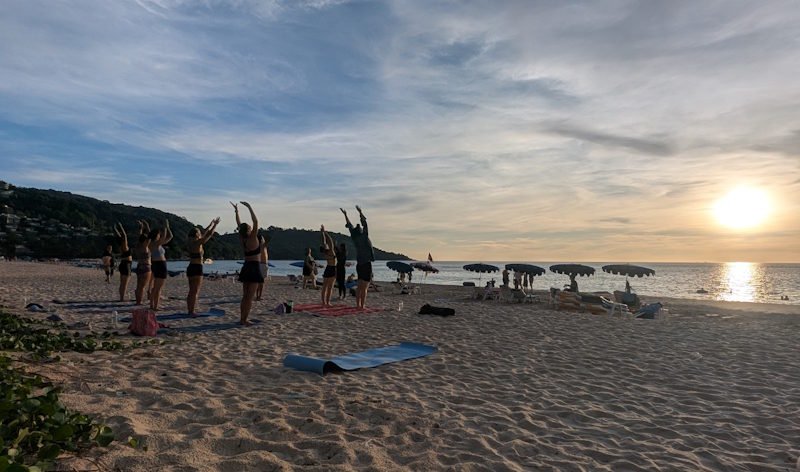
- Kata Noi beach excursion
- A lecture on fasting and longevity, taught by Melanie
Nine sessions in two days, covering strength work, mobility, two different contemplative practices, a beach trip and a lecture — and that was choosing rather than cramming. Extrapolate to a week and the scale of what is on offer becomes clear. It also shows the shape of the buffet in practice: nothing I did was the same kind of thing twice.
Face Yoga, which I had not encountered before
This is a good example of the breadth being real rather than marketing. Face Yoga does not appear on the pillar list or anywhere in the retreat’s published material I could find — it simply turned up on the schedule. Facial exercise has limited evidence behind it as an anti-aging intervention, and I would not book a retreat for it, but that is not the point. The point is that a property running classes it does not even bother to advertise has more going on than its own marketing captures, which is the opposite of the usual problem in this industry.
Mobility Flow deserves a mention too
Mobility work is the least glamorous and most useful thing on any fitness schedule, particularly for guests in the forties-to-fifties range that makes up the core of this retreat. It is also the thing most people never do at home. A schedule that includes it alongside the HIIT and the Muay Thai is a schedule designed by someone thinking about what bodies in this age range actually need, rather than what sells.
The excursions, which are not a side activity
A meaningful part of the week happens off the property: six named hikes into the hills and jungle, trips to Nai Harn and Kata Noi, a sunrise climb to the Big Buddha, a local healthy-food shopping trip, an elephant sanctuary visit, and Explorer Days built around a longer outing.
There is a point about this that is easy to miss. Phuket Cleanse is not a beautiful estate. It is a collection of functional buildings on and around a site in residential Rawai — no lake, no hillside architecture, no grounds to wander. A property like that has two options: pretend otherwise, or use the island. Phuket Cleanse uses the island, and it turns what could be a weakness into one of the better arguments for going.
Rawai is well placed for it. Nai Harn is one of the best beaches in Phuket and it is minutes away, Kata Noi — the quieter and in my view the prettier of the two Kata beaches — is a short drive north, Promthep Cape is close enough for a sunset, and the hills behind the south of the island give genuinely good hiking with sea views at the top. The named routes — Black Rock, Jungle Ascent, Expansion Hike, Big Buddha at sunrise — are real walks rather than a stroll with a guide.

Three things this gets you that a resort-bound program does not. A hike is exercise that does not feel like exercise, which matters on day five of a cleanse when a HIIT class is unappealing. Getting off site breaks the slightly institutional quality that any week of scheduled meals and classes develops. And a group that has climbed a hill together at six in the morning eats breakfast differently afterward — the excursions are a large part of why the community forms as fast as it does.
Practical note: Phuket hikes start early for good reason. The sunrise climbs are genuinely pleasant; the same route at eleven in the morning in April is punishing. Bring more water than you think, and proper shoes — jungle trails here are uneven and get slick in the wet season.
The community table, and who you will be eating with
Every meal is served at a long communal table, and this is the thing past guests talk about more than any treatment.
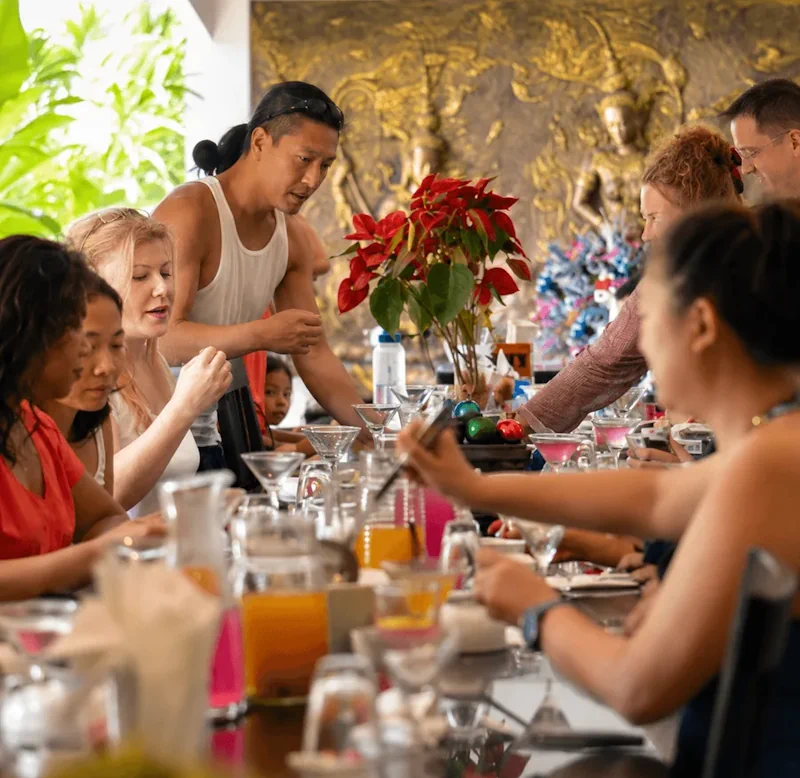
The guest profile makes it work. Most guests arrive alone, the typical age range is around 40 to 50, and capacity is capped at 24 — small enough that by day three you know everyone. A solo traveler at a resort eats alone; a solo traveler here cannot, which for most people is the point. The community is the product as much as the classes are.
The repeat numbers back that up. The retreat reports roughly 65 percent repeat guests with heavy word-of-mouth referral, and during my visit I met one guest who had been eight times over the years and another on her fourth visit this year alone. Four visits in twelve months is not a holiday pattern. It is someone who has found a place that works for them and keeps going back, which is a stronger signal than any review.
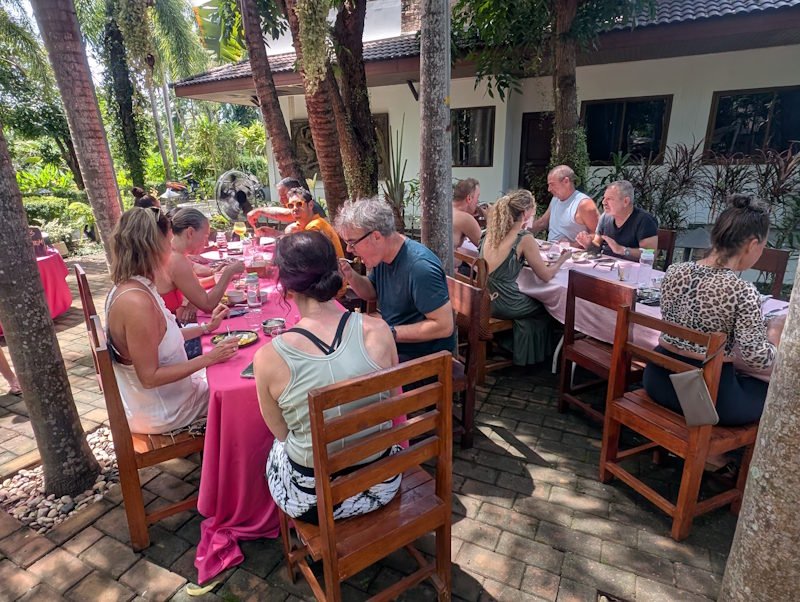
Be honest with yourself about this: If the idea of eating three meals a day for a week with the same twenty strangers makes you tense rather than curious, this is the wrong retreat and no amount of good programming will fix it. Private dining can be arranged, but the table is most of the point of coming — opting out of it every night means paying for something you are not using. Chivitr, Atmanjai or a resort-based property will suit you far better.
The five pillars, and the 65 classes inside them
I counted roughly 65 individually named classes, sessions and talks across the five pillars. That number is the single best argument for the buffet framing, so here is the inventory rather than a summary — it is not published anywhere else in one place.
Fitness — around 21 named sessions
- Strength: Evidence Based Strength, Lower Body Strength, Upper Body Strength, Functional Strength
- HIIT and conditioning: Full Body HIIT, Flow HIIT, Hot HIIT, Box & Breathe, Boundless, Calisthenics, Aquafit
- Muay Thai: a daily group class plus one private session per week
- Hikes: Boundless Hill Workout, Black Rock Hike, Big Buddha Hike, Expansion Hike, Jungle Ascent, Ocean Cape Hike
- Ocean: Phukettlebell Snorkel Fit, Oceanic Swim Fit

Yoga — around 13 named classes
- Vinyasa Flow, Hot Yoga, Restorative Yin, Yin & Sound Healing
- Yoga Mobility & Stretch, Mobility Flow & Flexibility, Balance Workshop
- Hybrids: Yoga + Strength + Cardio, Yoga Strength Fusion, Yoga Sticks & Wheels, Aerial Yoga, Kundalini Fusions, Tantra Yoga & Ice Bath Fusion
Meditation & Consciousness — around 13
- Quantum Jumping Meditation, Quantum Jumping to Exotic Worlds, Rejuvenation Code, Frequency Therapy Meditation, Intuition Meditation, Yoga Nidra
- Superhuman series: Quantum Jump Your Fitness, Superhuman Mindset Workout, Ice Bath Meditation
- Movement and creative: Rope Flow, Balance Training, Ecstatic Dance and Free Dance, Art as Meditation
Emotional Detox — around 9
- Shamanic Breathwork, Letting Go Meditation, Letting Go of Limiting Beliefs
- Soul Speak, Judgement Detox Meditation, Group Intention Meditation
- TRE (Trauma & Tension Release), TRE with Kundalini & Tantra Energy
- Singing Bowl & Sound Therapy
Longevity, or Age Backwards — around 9
- Talks on fasting and intermittent fasting, gut health, peptides, NAD+, and sleep
- How to 5X Your Endurance with Less Effort
- Longevity Diet & Peptide Therapy
- Longevity and aesthetic treatments, plus clinical consultation
- The Age Backwards Chocolate Factory visit
Multi-part series, and the answer to the obvious criticism
Alongside the standalone classes, Phuket Cleanse runs multi-part series and workshops on particular themes — Emotional Detox, Age Backwards and Tantra Energy among them.
This matters because it answers the strongest objection to the buffet model. If you can try sixty-five things, the risk is that you sample everything and go deep on nothing — a week of tasting plates rather than a meal. A series fixes that: you can commit to one theme across several sessions that build, while still dropping into whatever else appeals. Breadth and depth stop being a trade-off.
My advice to a first-timer would be to pick one series for the week and treat everything else as exploration. You get the surprise Melanie talks about and you get something that accumulates.
And the schedule is negotiable
If something you want is not on the schedule that week, tell Melanie and she will try to work it in.
I would rate this as highly as anything else in this review, because it quietly resolves the one place where Phuket Cleanse looked weaker than its competitors. I had framed this property as breadth versus Chivitr’s bespoke programming — pick from a wide menu here, have a program built for you there. That is not quite right. The menu is wide and it is also responsive: not a program designed around you in advance, but a schedule that bends toward whoever is in the building this week.
That is only possible because of the scale and the ownership. Twenty-four guests and a founder on site means a request can become a class on Thursday. At a hundred-room resort the schedule is a logistics problem set weeks out and nobody can change it for you. It is the same structural advantage the small clinical retreats have, arriving by a completely different route.
Use this: The same applies in the kitchen, where you can put in a meal request through the app. Both are underused: most guests take what is offered. If there is something you want — a discipline you have been curious about, a topic you want taught, a dish you would like again — say so early in the week rather than at checkout. The worst answer is no.
Three things the list tells you
The hybrids are not a gimmick, they are the house style.
Count them: Yoga + Strength + Cardio, Yoga Strength Fusion, Yoga Sticks & Wheels, Kundalini Fusions, Flow HIIT, Box & Breathe, Yin & Sound Healing, Tantra Yoga & Ice Bath Fusion, Phukettlebell Snorkel Fit. That last one is kettlebells and snorkeling, and Tantra Yoga & Ice Bath Fusion is exactly what it sounds like. Roughly a third of the schedule is something you could not book anywhere else because nobody else invented it.
The fitness programming is the deepest part.
Twenty-one named sessions, with four distinct strength classes, six named hikes and genuine ocean-based training, is more serious than the words “wellness retreat” suggest. Evidence Based Strength is a notable inclusion in a building that also runs Quantum Jumping — and the fact that both exist on one schedule is the clearest illustration of what this place is.
And there is a chocolate factory.
The Age Backwards Chocolate Factory is a real item on a real schedule at a detox retreat. If you needed one detail to confirm that a former Disney Imagineer built this place, that is it — a Willy Wonka reference, delivered without apology, inside the longevity pillar. It is also a reminder that the retreat is not taking itself as seriously as its treatment menu might suggest, which after a week of fasting is probably a mercy. One of my fellow guests was really looking forward to it, and changed her cleanse routine so she could enjoy it.
Where I would set expectations
The Fitness and Yoga pillars are straightforward and good. Muay Thai with a daily group class and a weekly private session is a serious offering, the hikes use genuinely good terrain, and ocean-based sessions are something most retreats cannot do.
The Meditation & Consciousness pillar is where I would be clear with readers about what is on offer. Melanie cheerfully describes adding a quantum spin to the blend, which I take as a figure of speech rather than a claim about particle physics, and the programming should be read the same way. Quantum Jumping, frequency therapy and material based on Joe Dispenza’s work are not evidence-based practices, whatever their proponents claim about quantum physics or cellular transformation. I am not telling you to skip them — guided meditation, time spent still, and group ritual have real psychological value, and plenty of people find these sessions moving and useful. I am telling you that the mechanism offered is not the mechanism operating, and that you should not book this retreat expecting a physiological result from them.
Emotional Detox sits in a similar place. Breathwork and sound sessions can be genuinely powerful experiences, and TRE has a reasonable following for tension release. Treat them as experiences rather than treatments, and go in with that framing, and you will likely enjoy them. I was not expecting it but I became emotional in my breathwork/emotional detox class and was able to let some things go that have been bothering me.
One refinement, because the buffet logic cuts in their favor here. If the thing that works for you is genuinely unpredictable — and the sound ceremony really is where some runner finds it — then having these sessions on the schedule is defensible even where the stated mechanism is not. The argument for including them is not that frequency therapy does what it claims. It is that an hour of stillness in a group, framed as something, lands for people that a yoga class does not reach, and you cannot know in advance whether you are one of them. That is a reasonable thing for a retreat to offer. It is still not a reason to believe the physics.
The food
Melanie comes from a raw food background, and that is the key to understanding the kitchen — including why the retreat started where it did. In 2011 Phuket Cleanse opened as green juice and raw vegan food and nothing else. Fifteen years later the menu has broadened considerably, but the raw food discipline is still visible in how the food is built: vegetable-forward, minimally processed, and designed so that the healthy version is the appealing one rather than the virtuous one. She incorporates local thai flavors and dishes into the mix.
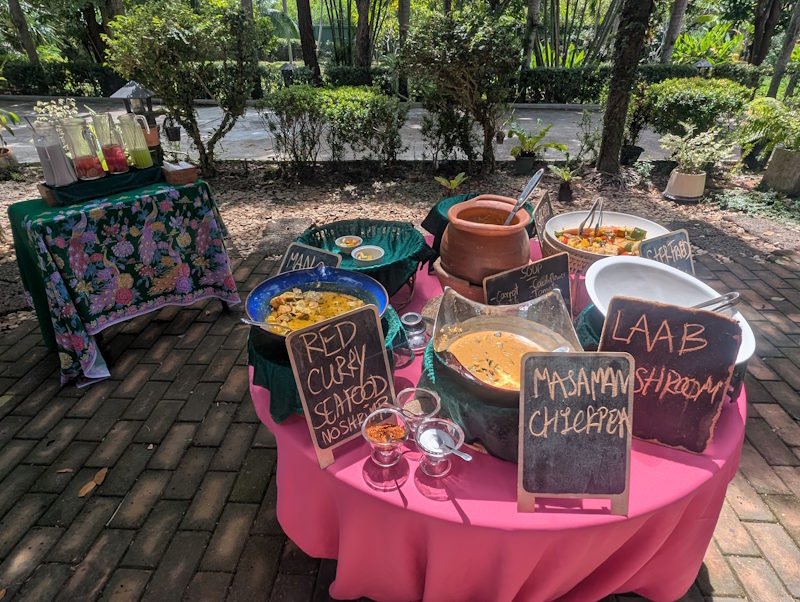
Melanie also shares the recipes for everything served, through the app. That is a more generous decision than it sounds — a kitchen is a retreat’s intellectual property, and most properties guard the thing guests most want to take home. Giving it away is consistent with a founder who is also a teacher.
That matters because raw food done badly is the worst cuisine on earth, and anyone who has eaten a joyless detox salad in a Thai retreat knows it. A kitchen run by someone who spent years in raw food has solved problems most wellness kitchens have not thought about — texture, acid, fat, how to make vegetables taste like a decision rather than a punishment.
The philosophy, which is the right one
Their framing is that a cleanse is about what you add as much as what you remove. I would endorse that without qualification. The subtractive model of detox — no sugar, no alcohol, no caffeine, no gluten, no fun — is why most people experience a cleanse as deprivation and abandon the lessons the week they get home. A kitchen organized around addition produces a different relationship with the food and, more importantly, a take-home habit that is not purely about restriction.
What you actually eat
- Breakfast is freshly prepared juices and smoothies with some fruit and maybe pancakes or an omelette
- A buffet built explicitly around gut health and the microbiome, with deliberate ingredient variety
- Salads, vegetable dishes, grain and legume dishes, plant-based mains, and fish
- Omelettes, fresh coconuts and protein shakes on request
- Meals shared at the long table, with private dining available by arrangement
Dietary preferences are set in the app rather than negotiated at the table — you select vegan, vegetarian or pescatarian, and report any food allergies, and the kitchen works from that. It is a small piece of design that removes a genuinely tiresome part of retreat life: the daily conversation with a server about what you can and cannot eat, repeated at every meal for a week, with the attendant risk that one shift does not get the message.
You can also put in a meal request through the app. That is the same instinct as Melanie adding a class you asked for — at 24 guests, with a kitchen cooking for a known number of people who have each declared what they eat, a request is a small adjustment rather than a problem. It is worth using. Most guests will accept whatever appears, and the ones who ask eat better.
The underlying dietary profile is low-carb, gluten-free, dairy-free and mostly plant-based, with protein coming from fish and eggs. Vegan, vegetarian, pescatarian and organic options are all available, and the kitchen leans vegetarian by default. Ingredients are described as local, organic and sustainable, with sourcing from local farmers and fisheries. No coffee and no alcohol are served — plan for a caffeine headache around day two, which is the week’s genuine difficulty for a lot of people.
A correction to something I assumed before looking properly: the communal table is central but not compulsory. Private dining can be arranged. I would still say the table is most of the point of coming here, and a guest who plans to eat alone every night has probably chosen the wrong retreat — but if you need a quiet evening midway through the week, you can have one.
The nutrition plans, and talking to Mel
Several nutrition plans run for different goals — detox, immunity, fitness support, weight loss, muscle building, longevity — and guests are asked to consult Melanie on arrival to pick one. Cleanses are then personalized around your goals, preferences and schedule.
Take that consultation seriously and arrive with a goal rather than a vague wish to feel better. A founder with a raw food background and fifteen years of watching guests go through this will give you a far more useful plan if you can tell her what you are actually trying to achieve. It is also, practically, the only point in the week where the food gets tailored to you — after that you are choosing from what the kitchen has made.
The cleanse is optional, and that is the best thing about it
You can do the juice cleanse for your entire stay, for part of it, or not at all. You can start on day three and stop on day five. A common pattern is three days of juice inside a seven-day stay, with full meals either side. The decision is yours and reversible at any point.
That matters more than it sounds. The usual problem with booking a detox is that you commit in advance to how your body will cope, from your kitchen table, weeks out. A seven-day fast booked optimistically is an unpleasant week if it turns out not to suit you. Here you can start, see how day two feels, and eat lunch if the answer is badly. I have not seen another Phuket property make it this easy to change your mind mid-stay, and it takes most of the risk out of the whole exercise.
How I would use it: Three days of juice in the middle of a seven-night stay, with full meals on either side. You get a real cleanse, you are eating again before you leave, and you avoid both the worst days of a longer fast and the anticlimax of traveling home mid-juice. It is also the pattern most guests seem to land on, which is usually a sign it works.
The water bar, and the thing I will praise unreservedly
Water everywhere, free, with no friction
Every room and every public space has a refrigerator stocked with prefilled water bottles that anyone can take. No asking, no charging, no queuing.
I would put this near the top of the list of things Phuket Cleanse gets right, and it sounds trivial only if you have not tried to stay hydrated on this island. You are in 32 to 34 degrees with high humidity, exercising daily, sitting in saunas and ice baths, and possibly on a juice cleanse. Dehydration is the single most common thing that goes wrong for visitors doing any of that, and it arrives as a headache, poor sleep and flattened energy that people attribute to detox symptoms when it is usually just not enough water.
The only reliable way to make people drink more is to remove every obstacle between them and a cold bottle. A fridge in every space does exactly that. It costs the property real money in a market where most hotels sell you a 60-baht bottle, and it is the sort of unglamorous operational decision that tells you more than a treatment menu does.
The bottles are reusable plastic rather than single-use, which matters at this volume. A property handing out unlimited free water could easily generate a mountain of waste on an island already struggling with it; refilling and reusing is the more expensive and more considerate way to do it.
The water bar, and what is actually in it
Through the app you can order from what they call the Phuket Cleanse Water Bar — homeopathic tinctures added to plain water, in eleven varieties: Calm, Energy, Recovery, Immunity, Gut, Men’s Vitality, Mood, Women’s Energy, Emotional Detox, Fitness and Endurance, and Anti-Aging and Longevity.
I have been consistent across this site about evidence, so I will be consistent here. Homeopathy is the clearest case of the lot: preparations are diluted to the point where no molecules of the original substance remain, and the scientific consensus is that effects beyond placebo have not been demonstrated. A homeopathic tincture for longevity is not doing what the label says.
That said, I am not going to tell you to avoid the water bar, for a reason that matters more than the pharmacology. Choosing a flavor, pressing a button and being handed a nice glass of water is a ritual that makes people drink water, and on a hot island during a fasting week, drinking more water is the actual benefit on offer. The tincture is inert. The hydration is not. If selecting Recovery after a Muay Thai session gets you through another litre, that is a real outcome arriving by an unglamorous route.
How I would frame it for yourself: Enjoy it, and do not pay for it anywhere else. It is included here and harmless. But if you leave Phuket Cleanse thinking the tinctures did something and go looking for homeopathic longevity remedies at home, you will spend money on nothing. The habit worth taking home is the water, not the drops.
What you take home, which is the best I have seen
The criticism I have made of nearly every retreat on this site is that the benefit has a half-life of about three weeks. You feel transformed, you fly home, you return to your own kitchen and your own calendar, and by the end of the month the only durable trace is a photograph. Phuket Cleanse has the most complete answer to that problem I have come across in Phuket, and it is almost entirely because of the app.
You keep the app when you leave, and with it:
- Recipes for everything served at the retreat, shared by Melanie in the app — so the meal you liked on Thursday is one you can cook
- A longevity shopping list — what to actually buy, which is the gap between knowing what you should eat and eating it
- The Age Backwards Blueprint, a structured home program
- Class handouts from the sessions you attended
- Guided meditations you already know, led by voices you already know
- Grocery guides
Pair that with the teaching — Melanie’s lectures on fasting, gut health, peptides, NAD+ and sleep — and the chain is complete in a way I have not seen anywhere else. The talks give you the reasoning. The recipes give you the method. The shopping list tells you what to put in the trolley. The blueprint gives it a structure. Each of those alone is common enough; all four together is the difference between inspiration and a Tuesday night dinner you can actually make.
Compare that with the alternatives honestly. Chivitr sends you home with a written plan and, at the 7-night tier, three months of probiotics — two real mechanisms, and more than most. But a written plan goes in a drawer, and the probiotics run out. An app on the phone you check forty times a day, containing a shopping list and a structured program, is a different class of persistence. Whether you use it is up to you, but the friction has been removed as far as it can be.
The honest caveat: No retreat can make you keep doing anything. The app improves the odds rather than solving the problem, and the Age Backwards Blueprint is only as good as the evidence behind whatever it recommends — apply the same skepticism at home that you would apply on site, particularly to anything involving peptides or supplements. But as an attempt at the hardest problem in wellness travel, this is the most serious effort I have seen from a Phuket property.
The recovery suites
Eight recovery facilities are included daily, with no upcharges and no booking queue:
- Ice bath
- Infrared sauna
- Steam room
- Red light therapy
- Magnesium float tank
- Compression therapy
- Sports massage — three sessions per seven-night stay, with more bookable in the app
- Hot Box
- Paint bar, open 24 hours
Two notes. The magnesium float tank is unusual in Phuket — Chivitr has a magnesium pool, which is a different thing — and if you have never floated it is worth doing. And the paint bar is a lovely, slightly absurd inclusion that tells you something about the place: a retreat that gives you somewhere to paint at two in the morning is thinking about the whole person rather than the body.
The retreat makes specific physiological claims for this suite, including reduced inflammation markers and faster lactic acid clearance. Those are the company’s statements rather than independently verified findings. The general picture is that cold immersion, sauna and compression have reasonable evidence for perceived recovery and soreness after exercise, and much weaker evidence for the broader health claims attached to them. Use them because they feel good after a Muay Thai session, which they do.
The medical question, and where Phuket Cleanse draws the line
This is the most important practical difference between Phuket Cleanse and the clinical retreats on this site, and it deserves a plain statement: there are no doctors or nurses on staff.
What they have instead is a curated referral network — outside specialists they know and send guests to, listed in the app alongside everything else. For longevity work, testing and medical consultation they work with Lyfe Medical Wellness. For physiotherapy and musculoskeletal problems there is Charlie, a local physiotherapist.
A personal example, and what it says about the staff
I mentioned a knee issue in passing during my stay. The staff picked it up, and rather than offering a massage or suggesting I skip a class, they referred me to Charlie a local physiotherapist. Several guests then independently told me how good their sessions with him had been — more than one described a long-standing problem being sorted in a single treatment. I have since booked an appointment myself.
Two things about that are worth separating. The guest reports are enthusiastic second-hand accounts and I have not had the session yet, so I am passing them on rather than endorsing them — one treatment resolving a lingering issue is the kind of claim that deserves skepticism even when several people make it.
The staff behavior, though, I can vouch for directly, and it is the better signal. An offhand comment about a knee produced a specific referral to a named practitioner within a day. That is attentiveness, and at a property where the guest-to-staff ratio allows it, it is probably the most reliable thing you can judge a retreat on — more reliable than any treatment menu.
The referral model, assessed
Lyfe Medical is a real physician-led clinic with locations in Rawai and Laguna, and its doctors are named with verifiable credentials — Dr. Sutthi Sawetsutthiphan, a Prince of Songkla University graduate with postgraduate anti-aging training, and Dr. Aek Sumana, a Mahidol University graduate with a dermatology diploma from Cardiff. Three registered nurses are named. As referral partners go, that is a serious one, and considerably better than a vague assurance about a doctor being available.
The honest framing is this. Referring out is an appropriate model for a fitness-led retreat with 24 guests, and arguably more honest than a property that implies clinical capability it does not have. But it is structurally different from Chivitr, which has doctors and nurses on site daily and hospital referral arrangements. If you are managing a condition, on medication, or want supervision during a fast, a referral partnership is not the same as somebody watching you, and you should choose accordingly.
Apply the usual caution to the clinic menu: Lyfe Medical offers stem cell, exosome, PRP, peptide, NAD+ and ozone therapies alongside conventional hormone assessment and health screening. As I have written elsewhere on this site, the screening and assessment side of that list has good evidence behind it and the regenerative and anti-aging side largely does not. If a longevity consultation leads toward a five-figure cell therapy, that is the point to slow down and talk to a doctor with no financial interest in the sale.
Practical planning
Where it is
Rawai, at the southern end of Phuket, around 45 minutes from the airport. The property is not a single building but a collection of them, on and near the main site, housing guest rooms, treatment rooms and class spaces. Rawai itself is residential and quiet, with Nai Harn and Promthep Cape nearby and none of the Patong noise. Atmanjai and Chivitr are both in the same area, which makes Rawai the densest wellness cluster on the island.
How long
A week is the popular choice and the one I would recommend. There is no minimum stay, but the schedule rewards a full cycle — the class rotation, the three included massages and a three-day cleanse inside a seven-day stay all assume roughly that length. Longer stays work well given the breadth of programming, and the repeat guests I met were not doing short visits.
What it costs
Rates are published in US dollars, per night, all-inclusive, across five room categories and three seasons. Note that Thai VAT of 7 percent is not included in the figures below and will be added.
| Room | Season | Solo | Shared, per person |
|---|---|---|---|
| Standard | Low (Mar 1 – Oct 31) | $280 | $210 |
| High | $320 | $240 | |
| Peak (Dec 10 – Jan 10) | $360 | $270 | |
| Standard-Plus | Low | $300 | $225 |
| High | $340 | $255 | |
| Peak | $380 | $285 | |
| Superior | Low | $320 | $240 |
| High | $360 | $270 | |
| Peak | $400 | $300 | |
| Supreme | Low | $360 | $270 |
| High | $400 | $300 | |
| Peak | $440 | $330 | |
| Supreme-Plus | Low | $400 | $300 |
| High | $440 | $330 | |
| Peak | $480 | $360 |
High season runs 1 November to 9 December and 11 January to 28 February. Peak is 10 December to 10 January. Everything else is low season.
What the numbers tell you
Sharing saves 25 percent per person, on every room and every season.
That is a bigger discount than most retreats offer and bigger than Chivitr’s equivalent. If you have someone to bring, bring them — a shared Standard room in low season is $210 each per night against $280 solo. Given that 80 percent of guests arrive alone, most people are paying the solo rate, which is worth knowing before you assume the headline price applies to you.
The room upgrade is expensive here, unlike at Chivitr.
Standard to Supreme-Plus is $280 to $400 in low season — a 43 percent premium. At Chivitr the equivalent jump was about 4 percent of the total. Moving season costs less: Standard runs $280 low to $360 peak, a 29 percent swing. So here the advice inverts. Take the cheaper room and the better dates, because you will spend almost no waking time in the room and the classes are identical whichever one you book.
The 7 percent VAT is not in the headline price.
A seven-night Standard stay in low season is $1,960 before tax and about $2,097 with it. Worth factoring in when comparing against properties that quote VAT-inclusive rates, as Chivitr does.
The discount rewards staying longer.
Their Green Season Reset code gives 15 percent off 5 nights, 20 percent off 7, and 25 percent off 10. A ten-night Standard stay in low season with the full discount works out around $2,247 including VAT — barely more than seven nights at the undiscounted rate. If the dates work, ten nights is the obvious value play, and it also happens to be the length at which this kind of retreat actually changes anything.
What is and is not included
Included:
- Three meals daily, plus unlimited elixirs and juices
- Full schedule access — every class and session
- Three massages per 7-night stay
- One private Muay Thai session per week
- All recovery facilities: sauna, ice bath, magnesium float, red light, compression, infrared
- Daily laundry
Not included:
- Thai VAT at 7 percent
- Airport transfers
- Additional massages and additional private Muay Thai sessions
- Physiotherapy
- Age Backwards treatments and off-site clinical services
- Taste of Rawai excursions, where you pay the venue directly
The inclusion list is the real argument: Three meals, every class, three massages, a private Muay Thai session and unlimited use of an eight-piece recovery suite, from $280 a night, is a genuinely strong package. Most Phuket resorts charge separately for any one of those. The things that cost extra — transfers, clinical work, extra bodywork — are the things that should cost extra.
Hosting your own retreat there
Phuket Cleanse rents out its facilities during low season for hosted retreats, and this is the part of their offering that is barely discussed anywhere. If you are a yoga teacher, personal trainer, coach, therapist or corporate wellness lead who has ever thought about running a retreat in Thailand, it is worth understanding what is actually on the table here.
What already exists, so you do not have to build it
- A kitchen that already cooks plant-forward, allergen-aware food for groups, with recipes and nutrition plans behind it
- Class spaces designed for the kind of sessions you will be running
- An eight-piece recovery suite — ice bath, infrared sauna, steam, red light, magnesium float, compression, massage, hot box
- Accommodation for up to 24 guests across several buildings
- An app that handles scheduling, meals, dietary profiles and bookings
- A referral network of local practitioners, from physiotherapy to clinical testing
- Fifteen years of knowing how to run a week like this in this climate
The reason that list matters is that the hard part of running your own retreat is never the teaching. It is the catering for twenty people with eleven dietary requirements, the transfers, the schedule, the what-happens-when-someone-pulls-a-hamstring. Renting a venue that has solved all of it leaves you doing the only thing you are actually qualified to do.
The timing, and why it works in your favor
Low season at Phuket Cleanse runs 1 March to 31 October, which is the window for hosted retreats. That is also the cheapest season on their own rate card and the quietest period on the island — so the dates that are available to you are also the dates your own guests will pay least to reach, and the hills and beaches you will be using are at their emptiest.
The honest trade is the weather. Low season means rain, usually in heavy afternoon bursts rather than all-day grey, and that needs planning around if your program depends on being outdoors. Build the hikes and the beach sessions into mornings and you will rarely lose one.
Who this actually suits
- Yoga teachers with a following who want to run a retreat without the infrastructure risk
- Personal trainers and coaches bringing a client cohort
- Corporate groups wanting a burnout-recovery or team week with real substance
- Therapists, breathwork facilitators and sound practitioners who need a venue that already understands the work
- Anyone who has run one retreat, found the logistics brutal, and wants the second one to be about the teaching
What to ask when you inquire: Minimum group size and whether they will run below it; exact dates available in the March to October window; whether you can bring your own teachers or must use theirs; whether your group can also access the standard class schedule and the recovery suite; what the rate includes and excludes; whether exclusive use of the property is possible; and what deposit and cancellation terms apply. Inquire early — a venue with 24 beds and a seven-month window does not have many slots.
What the guest reviews say
Unlike most properties I review, Phuket Cleanse has enough feedback to draw conclusions from. The headline numbers:
| Source | Score | Detail |
|---|---|---|
| TripAdvisor | 5.0 / 5 | 695 reviews; #2 of 115 specialty lodging in Rawai; 2026 Travelers’ Choice |
| Own site | 5.0 | Cites the TripAdvisor figure; 20,000+ guests since 2011 |
| Expedia | 8.0 / 10 | One review — statistically meaningless, see below |
The category breakdown is where the information is
| Category | Score | What I make of it |
|---|---|---|
| Value | 4.9 | The standout, and rare at any price point |
| Cleanliness | 4.9 | No concerns |
| Service | 4.9 | Matches what I saw — see the knee referral above |
| Location | 4.8 | Rawai is quiet and nothing is walkable |
| Sleep quality | 4.8 | Solid for a property with early starts |
| Rooms | 4.7 | The lowest score, and the honest one |
Two of those are worth dwelling on.
Value at 4.9 is the most informative number here.
Guests almost never rate value highly — it is the category where even happy people register a grumble, and at $280 to $480 a night there is plenty of room for one. A 4.9 across hundreds of reviews means people consistently felt they got more than they paid for. Given what is included — every class, three meals, three massages, a private Muay Thai session, the whole recovery suite — that is the number I would trust most in the whole set.
The contrast with Chivitr is the most useful comparison I can offer you.
Chivitr scores 3.7 on Value, its lowest category. Phuket Cleanse scores 4.9, its highest. That is not a verdict on which is the better retreat — Chivitr has doctors, nurses and eight rooms, and costs roughly twice as much for sound reasons. It is a precise statement about expectations. Guests leave Phuket Cleanse feeling they got a bargain and leave Chivitr feeling they got something excellent that cost a lot. Decide which of those you are shopping for.
Rooms at 4.7 is the honest low score.
It matches what I wrote above from my own stay: the accommodation is comfortable and functional, not luxurious, in buildings that were not designed as a resort. Reviewers use the words basic and rustic. Nobody is misled here, and the fact that Rooms is the weakest category while Value is the strongest tells you guests understood the trade they were making.
The recurring criticisms
Worth stating, because a wall of five-star reviews is not useful on its own. The complaints that come up more than once:
- Rooms described as basic or rustic
- Extras — additional treatments and therapies — considered expensive on top of the rate
- Some lectures found dull
- The juices described as repetitive by at least one guest on a longer cleanse
None of those is a reason not to go, and all four are consistent with the property rather than contradictions of it. The lecture point is the one I would weigh if education is your main draw: the talks are a real strength of the place, but the quality presumably varies by topic and by who is teaching.
How to read a 5.0 average
A perfect 5.0 across 695 reviews should make you slightly suspicious, and I would rather explain it than ignore it.
Three things are going on, none of them sinister. TripAdvisor rounds, so the true average is somewhere above 4.85 rather than literally perfect. Week-long immersive experiences generate unusually positive reviews because people who commit a week and several thousand dollars are invested in it having worked — that is true of every retreat, not just this one. And a property with roughly 60 percent repeat guests is reviewed disproportionately by people who already liked it enough to return.
What survives that discounting is still substantial: 695 reviews is a large sample, the category scores vary sensibly rather than all sitting at the maximum, and the criticisms that do appear are specific and plausible. This is a well-liked property, not a manufactured one.
Ignore the OTA listings: Expedia shows 8.0 from a single review — a guest who booked one night, found the activities were not what he expected, and asked for compensation. That is not a review of Phuket Cleanse, it is a booking mismatch. Program retreats sell badly through hotel booking sites because the product is a structured week, not a room, and people who book a night through an OTA have usually not understood what they purchased. Do not judge this kind of property by its OTA score, and do not book one through an OTA.
Who it is for
- Solo travelers, above all. Eighty percent arrive alone and the whole property is built around that.
- Anyone who wants variety rather than a prescribed program
- Anyone who gets bored easily — the hybrid classes and the excursions are specifically what keep a week from flattening out
- Hikers, and anyone who would rather earn their exercise on a hill than in a gym
- People who get bored at traditional detox retreats and want to train
- Anyone curious about cleansing but unwilling to commit a whole week to it — the flexibility here is the best in Phuket
- Guests in their forties and fifties, which is the core demographic and a comfortable one to land in
- Older guests willing to be surprised — the retreat reports guests in their seventies taking up Muay Thai, which matches what I found researching wellness retreats for the over-50s
- Anyone who learns by being taught — the talks are a real part of the value
- Retreat organizers looking for a low-season venue
Who should look elsewhere
- Anyone who wants quiet and privacy. The communal table is compulsory in practice and the schedule is busy.
- Anyone needing medical supervision, managing a condition, or on medication — Chivitr or TheLifeCo have clinical staff on site
- Couples wanting a romantic trip. This is an adults-only social retreat, not a getaway for two.
- Anyone expecting a private pool or resort-standard rooms. Pools are shared between rooms and the accommodation is comfortable rather than luxurious.
- Anyone hoping to escape screens, given that the app runs your day
- Anyone who wants a serious, austere fast at low cost — Atmanjai does that for a fraction of the price
- People uncomfortable with the consciousness and energy-work side of the programming
How it compares
| Option | Position | Choose it over Phuket Cleanse if… |
|---|---|---|
| Chivitr | Clinical, 8 rooms | You want doctors and nurses on site, solitude and a bespoke program — at roughly twice the price |
| Atmanjai | Value detox | You want a serious, traditional cleanse and price is the deciding factor |
| TheLifeCo | Clinical detox | You want supervised fasting, metabolic work and chronic condition support |
| Amity Wellness | Boutique detox | You want a smaller, quieter, more hand-held detox experience |
| Thavorn Beach Village | Resort with wellness | You are traveling with people who do not want a program at all |
One nuance worth adding to that comparison: the gap between a buffet and a bespoke program is narrower here than it first appears, because the schedule is negotiable. Chivitr designs a program around you before you arrive; Phuket Cleanse will add a class because you asked on Tuesday. Different mechanisms, both only possible at small scale.
Phuket Cleanse’s distinct position: nowhere else in Phuket combines this breadth of daily classes, a genuinely optional cleanse, an app-run schedule, a recovery suite included without upcharge, and a community model built for solo travelers. The nearest competitor on social atmosphere is not another detox center — it is a Muay Thai camp, and those do not feed you raw vegan food or teach you about peptides.
Booking
Click the link below and use code: PhuketSerenity to receive 5% off your booking.
Frequently asked questions
Do I have to do the juice cleanse?
No, and this is one of the best things about the place. You can cleanse for your whole stay, part of it, or none of it, and you can start or stop whenever you like. A common choice is three days of juice inside a seven-day stay. Being able to change your mind on day two, rather than committing weeks in advance from your kitchen table, takes most of the risk out of booking a detox.
What is the food like?
Vegetable-forward, low-carb, gluten-free, dairy-free and mostly plant-based, with protein from fish and eggs, sourced locally where possible. Breakfast is juices, smoothies, fruit; the main buffet is built around gut health. Melanie comes from a raw food background, which shows in a kitchen that makes vegetables taste deliberate rather than dutiful. No coffee and no alcohol. Several nutrition plans are available and you choose one with Melanie on arrival.
Is Phuket Cleanse good for solo travelers?
It is one of the best in Phuket for exactly that. Around 80 percent of guests arrive alone, every meal is served at a long communal table, and capacity is capped at 24, so by day three you know everybody. If you want company, this is the design. If you want to be left alone, it is the wrong retreat.
Is there a doctor on site?
No. Phuket Cleanse has no clinical staff on site and refers to Lyfe Medical Wellness, a physician-led clinic in Rawai with named, credentialed doctors, for longevity work, testing and consultation. That is an appropriate model for a fitness-led retreat and a reputable partner, but it is not the same as supervision. If you are on medication or managing a condition, Chivitr or TheLifeCo have clinical staff on the property.
What if I have an injury or a niggle?
Tell them. I mentioned a knee issue in passing and was referred to Charlie, a local physiotherapist they work with, who is listed in the app alongside their other outside providers. Several guests spoke very highly of his sessions, including a few who said a long-standing problem was dealt with in one treatment — their words rather than mine, and I had not had the session when I wrote this. Physiotherapy is charged separately from the room rate.
Can they handle dietary restrictions and allergies?
Yes, and the mechanism is better than most. You set your preference — vegan, vegetarian or pescatarian — and declare food allergies in the app, and the kitchen works from that rather than from a conversation you have to repeat at every meal. You can also submit a meal request through the app if you want something specific. The baseline food is already low-carb, gluten-free, dairy-free and mostly plant-based, so most restrictions are accommodated by default. Flag anything serious in advance as well as in the app.
Do you get anything to take home?
More than anywhere else I have reviewed in Phuket. You keep the app, which holds recipes for everything served at the retreat, a longevity shopping list, the Age Backwards Blueprint home program, class handouts, grocery guides and guided meditations. Combined with Melanie’s lectures, that covers understanding, structure and the practical gap most retreats miss — knowing what to actually buy when you get home. No retreat can make you keep going, but the friction has been removed about as far as it can be.
What is the Phuket Cleanse Water Bar?
Homeopathic tinctures added to plain water, ordered through the app, in eleven varieties from Calm and Recovery to Anti-Aging and Longevity. Honestly: homeopathic preparations are diluted past the point where any of the original substance remains, and there is no good evidence they do more than placebo. The water, however, is doing something — staying hydrated in this climate while exercising and fasting genuinely matters, and a ritual that makes you drink more of it has a real benefit even when the drops do not. Enjoy it at the retreat; do not go buying homeopathic remedies at home on the strength of it.
Is drinking water freely available?
Yes, and it is one of the best things about the place. Every room and public space has a fridge of prefilled bottles that anyone can take, free. In 33-degree heat, with daily exercise, saunas and possibly a juice cleanse, dehydration is the most common thing that goes wrong for visitors — and it usually gets blamed on detox symptoms. Removing every obstacle between guests and cold water is a smart, unglamorous decision.
What is the app for?
Everything. You download it at check-in and use it to build your class schedule, read class descriptions, order meals, book massages and treatments, access guided meditations and handouts, and take home grocery guides and a follow-on program. I have not seen another Phuket retreat do this. The only caveat is that it does hand you a reason to be on your phone all day.
Is it a boot camp?
No, and Melanie’s own phrase is the best answer: it is a buffet, not a boot camp. Nobody sets your schedule or pushes you through it. The volume of classes on offer is high and the obligation is zero — you can do five sessions a day or two and a nap, and both are normal.
What are the rooms like, and is there a private pool?
Rooms are named rather than numbered and spread across several buildings on and near the main site. I stayed in the Pyramid, which shares a pool between three rooms. Pools are shared rather than private, though with 24 guests maximum you will often have one to yourself. The accommodation is comfortable and functional rather than luxurious — this is not a resort and the rooms are not why people come.
Do you leave the property?
Regularly, and it is a real part of the week rather than an optional extra. Hikes into the hills and jungle, nearby beaches, a sunrise climb to the Big Buddha, and Explorer Days built around a longer outing. Rawai is well placed for it — Nai Harn and Promthep Cape are minutes away. Given that the property itself is a set of functional buildings rather than a scenic estate, using the island is one of the smarter things they do.
What are the hybrid classes?
Sessions that combine disciplines normally taught separately — yoga with strength and cardio in one class, aerial yoga, ice bath meditation, ocean-based aqua workouts. They are house formats rather than standard ones, and they are the main reason a week here does not get repetitive by Thursday.
What classes are actually on the schedule?
More than the website lists. Across two days I did Yoga + Strength + Cardio, Mobility Flow, Meditation, Breathwork, Sound bowl therapy, Aromotherapy, Face Yoga, a Kata Noi beach excursion and a lecture on fasting and longevity taught by Melanie. Face Yoga does not appear in their published material at all — it simply turned up on the schedule, which tells you the breadth is real rather than marketing.
Can I request a class that is not on the schedule?
Yes — tell Melanie and she will try to work it in. Most guests never ask, which is a waste of one of the better things about a 24-guest property with the founder on site. They also run multi-part series and workshops on themes such as Emotional Detox, Age Backwards and Tantra Energy, so you can go deep on one subject across the week rather than only sampling.
Which classes should I book?
Melanie’s answer is better than mine: you do not yet know. Her observation is that the thing that works for you tends to surprise you — guests in their seventies finding it in Muay Thai, a yoga teacher finding it in heavy lifting, a runner finding it in a sound ceremony. That unpredictability is the actual reason the schedule is a buffet rather than a program. Try things you would not have chosen at home.
How fit do I need to be?
Not very. The schedule runs from HIIT and Muay Thai to restorative yoga and meditation, and you choose your own day. The point of the buffet model is that a very fit guest and a deconditioned one can both fill a week well. Tell them your starting point and they will steer you.
What is the typical guest like?
Mostly solo, mostly in their forties and fifties, international, and often returning — the retreat reports around 60 percent repeat guests. On my visit I met someone on their eighth stay and someone on their fourth visit this year.
Can I run my own retreat there?
Yes — they rent out the facilities during low season, 1 March to 31 October, for hosted retreats. For a teacher or coach it means the kitchen, class spaces, recovery suite, accommodation for 24 and the scheduling app all already exist and already work together, so you do the teaching and not the logistics. It is also the cheapest and quietest season on the island, which helps your own guests. Inquire early — one property, 24 beds, seven months.
Is the consciousness programming credible?
Depends what you mean by credible. Quantum Jumping, frequency therapy and Joe Dispenza-derived material are not evidence-based in the mechanisms they claim. Guided meditation, stillness and group ritual do have genuine psychological value, and many guests find these sessions meaningful. Go for the experience, not for a physiological outcome, and you will get on fine.
The bottom line
Phuket Cleanse has been running since 2011, claims to have been the first to put movement into a cleanse protocol, and is now built on a model that the rest of the island has quietly adopted. Fifteen years in, it is run by its owners, capped at 24 guests, and roughly 65 percent of the people there have been before.
What you are buying is breadth and company. A schedule with more on it than you can do, classes that blend disciplines rather than repeating one, hikes and beaches that get you onto the island, an app that makes it all manageable, a recovery suite you can use every day without asking, a cleanse you can start and stop at will, and twenty-odd people at a long table who will know your name by Wednesday. The Disney comparison is apt and Melanie should keep using it.
It also has the best answer to the problem that defeats most retreats. You leave with the app — recipes for everything you ate, a longevity shopping list, the Age Backwards Blueprint, the handouts and the meditations — on the phone you check all day, rather than a folder that goes in a drawer. Whether you use it is your business, but nobody else in Phuket has made it this easy.
One thing that is not on any list: I mentioned a knee issue offhand and was referred to a named physiotherapist within a day. A retreat is judged better on that kind of attentiveness than on its treatment menu, and this one passed.
What you are not buying is clinical supervision, solitude, or a program designed around your particular body. Those exist in Phuket — Chivitr has the first two and charges roughly twice as much — and if that is what you need, this is the wrong booking however good the Muay Thai is.
My recommendation: book a week, do three days of the juice cleanse somewhere in the middle, go to every talk Melanie teaches, sign up for at least two classes you would never choose at home, and do not sit in the same seat at dinner twice.
Booking
Click the link below and use code: PhuketSerenity to receive 5% off your booking.
Detox Retreats
Wellness Retreats
Is a Phuket Detox Retreat Safe for You?
Guides:
Phuket Planning Guide
How to get around Phuket
Phuket Airport Shuttles & Transfers
Disclosure: Phuket Serenity may earn commission on some bookings made through links on this site. I do not own, operate or manage Phuket Cleanse or any property mentioned here, and nobody pays for placement or a favorable review. I stayed at Phuket Cleanse on 5 and 6 November 2026. Several details — the 2011 founding, the claim to have pioneered movement within cleanse protocols, the repeat-guest figure and the guest demographics — come from the retreat and I have not independently audited them; I have said so where it matters. Programs, rates and schedules change — confirm current details directly before booking.