
Mangosteen Ayurveda & Wellness Resort, Phuket: An Honest Review
Most Phuket properties that use the word Ayurveda mean they offer an oil massage. Mangosteen Ayurveda & Wellness Resort means something considerably more specific: two resident doctors holding BAMS degrees — a five and a half year Indian medical qualification in Ayurvedic medicine — who consult with you on arrival and prescribe what happens for the rest of your stay.
That is what makes it unique in Phuket. But it is not what everybody comes for, and the most important thing to understand before reading further is that you do not have to do any of it.
Roughly half of Mangosteen’s guests take the Ayurvedic path, where the doctor assesses you and prescribes your stay. The other half take the Wellness path, which is a conventional spa-and-yoga program where you choose. There is also a yoga-only retreat from three nights, and a set of leisure packages that includes a honeymoon and a golf week. Everyone gets the same villas, the same two yoga classes a day, the same pool and the same restaurant.
So the question is not whether you want to be prescribed to. It is which of four quite different holidays you are booking at the same address. The Ayurvedic side is the reason this property is worth writing about; it is not the only reason to come.
I stayed on 12 and 13 November 2026, in a Superior Jacuzzi Villa, on their Reward of Life: Yoga & Wellness program.
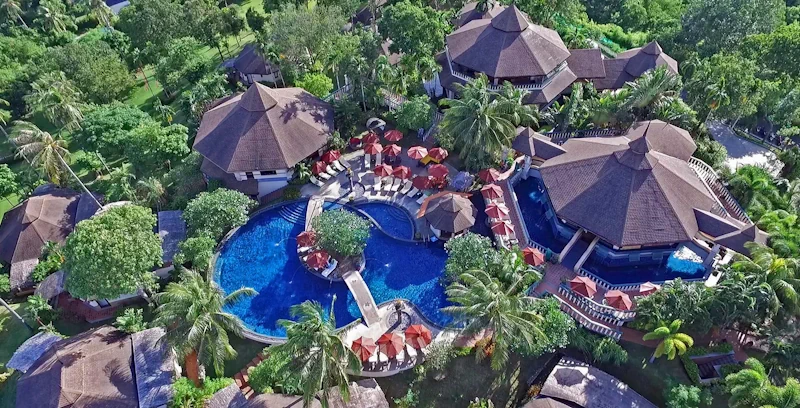
The resort has been running doctor-led Ayurveda programs in Rawai since 2003, which makes it one of the oldest wellness properties in Phuket and long predates the current boom. It is family-owned and adults-only, with 47 villas and a maximum of 70 guests.
As part of my experience at the Mangosteen Ayurveda & Wellness Resort, I discovered the depth of their commitment to holistic health and well-being.
The short version
| Field | Detail |
|---|---|
| Location | 99/4 Moo 7, T. Rawai, A. Muang, Phuket 83130 — forested hillside between Rawai and Chalong |
| Languages | English, German and French |
| Opened | Running doctor-led Ayurveda programs since 2003 |
| Owners | The von Keller family — Rose, Hajo and their daughter Earth, now Operations Manager |
| Size | 47 villas, each with its own roofed patio; maximum 70 guests |
| Objective testing | Only on Ayurveda Medic+ — blood tests at the start of the program and again at the end |
| Medical | Two resident BAMS Ayurvedic doctors — Dr Nezeem Kadavil Uthuman and Dr Megha S. Nair |
| Four ways to stay | Ayurvedic or Wellness (roughly 50/50), a yoga-only retreat from 3 nights, and leisure-led Island Escapes |
| Yoga | Two spaces: the open-air Prana Yoga Sala and the indoor Ananda room |
| Pool | 680 sqm saltwater pool, open 24 hours |
| Adults only | No children under 12 |
| Guest rating | 4.6 on TripAdvisor from 543 reviews; #3 of 69 hotels in Rawai; Travelers’ Choice 2026 |
| Best for | Genuine Ayurveda, solo women travelers, gentle structured wellness |
| Not for | Beach holidays, families, anyone wanting to pick their own treatments |
What Ayurveda actually is
Since Mangosteen is built entirely on it, this is worth doing properly rather than in a sentence — and most people booking an Ayurvedic retreat have only a vague sense of what they are signing up for.
The system
You will see Ayurveda described, including on Mangosteen’s own pages, as 5,000 years old. That figure is standard in the industry and not well supported: the classical texts the system rests on — the Charaka and Sushruta Samhitas — are generally dated to roughly two to two and a half thousand years ago, with oral antecedents before that. It is an ancient system either way, and the exaggeration is harmless, but this site does not repeat numbers it cannot stand behind.
Ayurveda is a traditional medical system originating on the Indian subcontinent roughly two to three thousand years ago. It is not a spa treatment or a massage style, though that is how the word is usually used in hospitality. In India it is a regulated profession with its own medical degree, hospitals and pharmacopoeia, practiced alongside conventional medicine.
Its core idea is that health is a state of balance, and illness a state of imbalance, between three functional principles called doshas:
| Dosha | Associated with | Imbalance traditionally presents as |
|---|---|---|
| Vata | Air and space — movement, circulation, the nervous system | Anxiety, insomnia, dryness, restlessness, irregular digestion |
| Pitta | Fire and water — metabolism, digestion, transformation | Inflammation, irritability, heat, acidity, skin problems |
| Kapha | Earth and water — structure, lubrication, stability | Sluggishness, weight gain, congestion, lethargy |
A fourth concept you will hear constantly at Mangosteen is agni, usually translated as digestive fire — the body’s capacity to process what enters it, food and experience alike. Much of Ayurvedic practice is aimed at steadying it, which is why so much of the advice concerns when and how you eat rather than only what.
Everyone is held to have a constitutional type, your prakriti, set at birth, and a current state, your vikriti. The practitioner’s job is to identify the gap between the two and close it, using diet, daily routine, herbal preparations, bodywork and — in deeper protocols — cleansing procedures.
What the treatments actually involve
- Abhyanga — a synchronised warm oil massage, often performed by two therapists working in time with each other. The signature Ayurvedic treatment and the one most guests remember.
- Shirodhara — a continuous stream of warm oil poured onto the forehead for twenty to forty minutes. Strange for the first two minutes and deeply sedating thereafter.
- Pizhichil, Kizhi and similar — oil pouring over the body, or massage with heated herbal pouches. Mangosteen makes its Ela Kizhi herbal leaf pouches on site.
- Marma therapy — pressure work on points understood as junctions of vital energy. One of the resort’s doctors specialises in it.
- Nadi Pariksha — pulse diagnosis, used to assess dosha state. The other doctor specialises in this.
- Panchakarma — literally five actions, the deep cleansing protocol. In a clinical setting this includes therapeutic purgation and medicated enemas; at a resort it is usually a gentler, oil-and-massage-led version delivered over one to four weeks.
What the evidence says, honestly
This site takes a consistent line on evidence, so here it is for Ayurveda.
The dosha framework is a traditional explanatory model, not a physiological one. There is no measurable thing in the body corresponding to vata, pitta or kapha, and the system’s theory does not map onto modern physiology. Pulse diagnosis has not performed well in the controlled studies that exist.
That said, several things here are real. Some Ayurvedic herbal preparations have genuine pharmacological activity — turmeric, ashwagandha and others have been studied with mixed but non-zero results. Massage reliably reduces perceived stress and muscle tension. A structured daily routine, an earlier bedtime, simple food, no alcohol and two hours of yoga a day will make almost anyone feel better, and none of that requires the theory to be true.
My position is the same one I take on detox and longevity programs: the week works, the explanation attached to it is traditional rather than evidential, and you can take the benefit without buying the framework. Mangosteen delivers Ayurveda more seriously than anywhere else in Phuket, and that is worth something regardless of what you make of doshas.
The doctors, and what BAMS means
There are two resident Ayurvedic doctors:
- Dr Nezeem Kadavil Uthuman — classical training with international experience, specialising in Marma therapy and Nadi Pariksha pulse diagnosis.
- Dr Megha S. Nair — over ten years of experience, specialising in Panchakarma, detox and lifestyle medicine. Also a certified yoga teacher.
Both hold BAMS — Bachelor of Ayurvedic Medicine and Surgery. It is worth understanding what that is, because it is the single most meaningful credential in this entire sector and almost nobody explains it.
BAMS is a five and a half year undergraduate medical degree awarded by Indian universities, including a year of compulsory clinical internship. It covers anatomy, physiology, pathology and pharmacology alongside the classical Ayurvedic texts. Graduates are registered medical practitioners in India. It is a genuine medical education, not a certificate from a weekend course.
That matters because the Phuket market is full of Ayurvedic-style treatments delivered by spa therapists with no medical training at all. A property with two BAMS doctors in residence is doing something structurally different from a resort whose spa menu happens to include Shirodhara.
The consultation comes first, and it decides everything
This is the structural thing that makes Mangosteen different from a spa, and it is worth being clear about how it works.
Your stay begins with a consultation with one of the Ayurvedic doctors. They assess your constitution and current state, discuss your health history and what you want from the stay, and then prescribe your program — which treatments, in what order, with what dietary approach, over how many days. You do not choose from a menu.
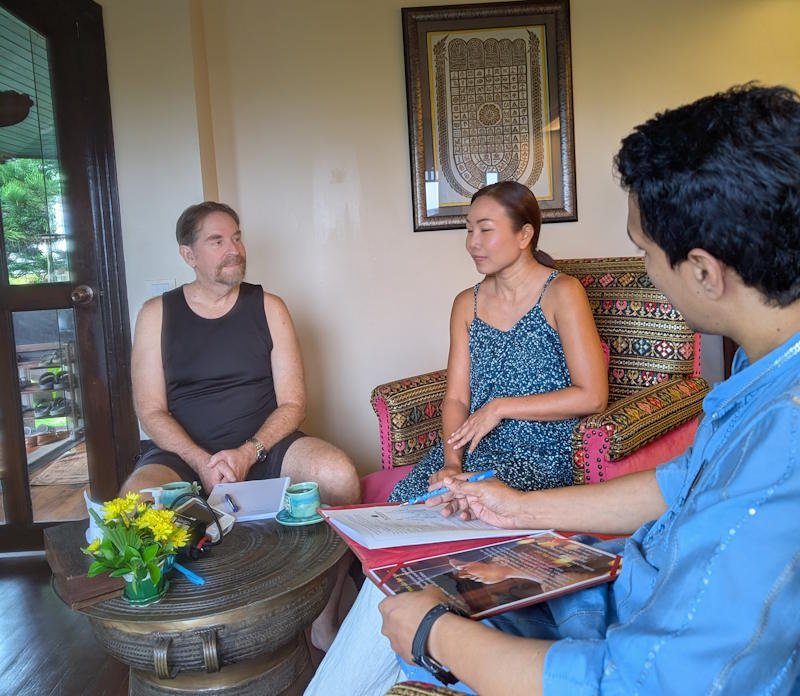
There are two honest ways to look at that, and you should know which kind of guest you are before booking.
In its favor: this is the correct order of operations and almost nobody else does it. A treatment prescribed after an assessment is a different proposition from a treatment you picked because the photograph looked relaxing. It also means the program adapts to you rather than you adapting to a package, and the doctors can and do change course mid-stay if something is not working.
Against it: you are handing over control of your week to someone else’s judgment within a framework you may not share. If you arrive wanting a deep tissue massage every afternoon and the doctor prescribes something else, you will get something else. People who like to curate their own experience sometimes find this frustrating, and it is the single most common source of mismatch between guest and property here.
Set yourself up well: Come to the consultation with a specific goal rather than a vague wish to feel better — sleep, digestion, stress, a recurring ache, energy. The more concrete you are, the more useful the prescription. And say plainly if there is something you do not want; the doctors adjust, but only if they know.
The four ways to stay
Guests choose between two main tracks — Ayurvedic or Wellness — at the Mangosteen Ayurveda & Wellness Resort, and the distinction runs through the whole stay: treatments, food, and the degree of structure. There is also a yoga-only retreat for guests who want practice and little else, and a fourth, largely invisible category the resort calls Island Escapes.
| Ayurvedic path | Wellness path | |
|---|---|---|
| Built around | A doctor’s prescription following consultation | A lighter, more flexible wellness program |
| Treatments | Classical Ayurvedic protocols — Abhyanga, Shirodhara, Kizhi, Panchakarma | Spa treatments and massage from a broader menu |
| Food | Ayurvedic menu at lunch and dinner, matched to your dosha | Wellness menu at lunch and dinner |
| Yoga | Twice daily | Twice daily |
| Suits | Anyone wanting the real thing, or addressing something specific | First-timers, shorter stays, partners of Ayurvedic guests |
The real difference between the tracks is who decides
Mangosteen never quites explain how the Wellness track differs from the Ayurvedic one beyond listing different treatments. Having read both, I think the actual distinction is philosophical, and it is worth spelling out because it determines which one will suit you.
The Ayurvedic track is prescriptive. A doctor assesses you and decides your week. The framework holds that there is a correct answer for your constitution and that a trained practitioner can identify it.
The Wellness track is explicitly not. Its stated principles include accountability — the resort’s own wording is that staff guide, but guests choose their own habits, decisions and daily practices. The other three principles are holism, balance, and being positive and proactive, with progress built from small repeated steps.
So the choice is not really between Ayurvedic treatments and spa treatments. It is between handing over the decisions and keeping them. Some people find being prescribed to an enormous relief — a week where somebody competent decides and you simply turn up. Others find it infantilizing. Knowing which you are is the most useful thing you can work out before booking, and it predicts satisfaction here better than any other factor.
The split is 50/50, which tells you something
Roughly half of Mangosteen’s guests take the Ayurvedic path and half take the Wellness path. That number is worth pausing on, because it contradicts how most people would read the menu.
The obvious assumption is that Wellness is the lite version — what you pick when you are not serious enough for the real thing. An even split says otherwise. Half the guests at a property built around Ayurvedic medicine are deliberately choosing not to do Ayurvedic medicine, and the resort has built the Wellness track properly rather than leaving it as a consolation prize. If it were an afterthought it would not hold half the business.
Practically, that means two things for you. You will not feel like a second-class guest on the Wellness path — half the dining room is doing the same thing. And the yoga classes, the pool and the restaurant are shared by both groups, so the social life of the property does not split along program lines.
The yoga-only option
There is also the Pure Yoga Retreat — the lightest way to stay here. It includes villa accommodation, meals and the two daily classes, runs year-round, and starts from three nights at THB 2,200 per person per night, making it both the cheapest program on the list and the only version of Mangosteen that works as a short break.
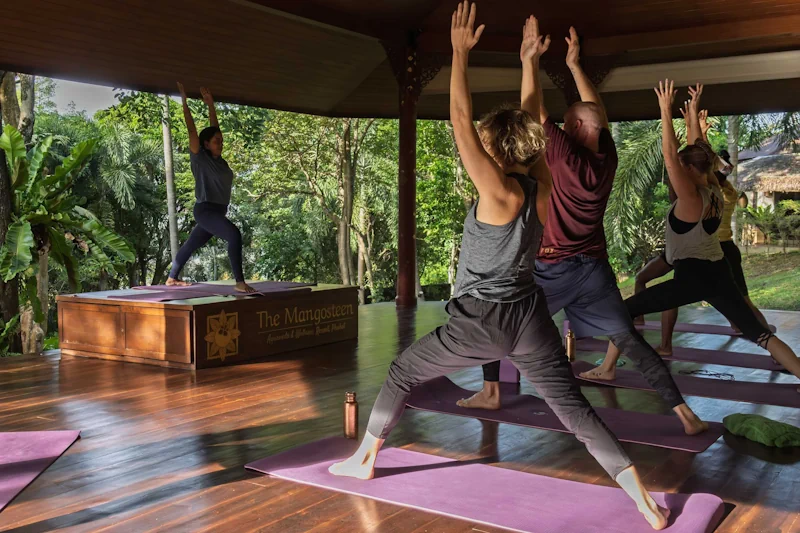
This is a genuinely good option that very few people know exists, and it suits two kinds of guest. One is someone who wants a quiet yoga week on a hillside with good teaching, two shalas and a 680 sqm pool, without paying for treatments they did not want. The other is a partner traveling with someone on a two-week Panchakarma, who wants their own reason to be there rather than simply waiting around. It is also the cheapest way to see whether the property suits you before committing to a longer program.
The two-path structure solves a real problem, and it is the reason this property works for couples and friends traveling together. One person can commit to a two-week Panchakarma while another does the Wellness track and a third just does yoga — all eating well, swimming, and turning up to the same classes. They eat at the same table and attend the same yoga classes. Nobody has to do a program they did not want, and nobody has to stay home.
My recommendation for a first visit: unless you have a specific condition you want addressed, the Wellness path for a shorter stay is the sensible way to find out whether this suits you — or the yoga retreat, if treatments are not the draw at all. The Ayurvedic path rewards a longer commitment, and a three-night Panchakarma is not really Panchakarma.
The full program list
Mangosteen runs sixteen named retreat programs, which is a lot for a 47-villa property. Rates below are per person per night, for 2027 dates. Confirm everything when you book.
Read this before the tables: The program rate is not the total. Program fees are charged separately from villa rates — you pay the program per person per night AND the villa per night on top. That is confirmed, and it is the single most important thing to understand about pricing here: it roughly doubles the cost of the shorter programs and it is not obvious from the way the rates are presented. Everything in the tables below is a program fee only.
Ayurvedic programs
| Program | Min stay | Per night | Total at minimum |
|---|---|---|---|
| Ayurveda Medic+ | 14 nights | THB 9,250 | Includes blood tests at the start and end of the program |
| AyurYoga Panchakarma | 7 nights | THB 7,200 | THB 50,400 (~$1,400) |
| AyurYoga Sampoorna | 14 nights | THB 5,500 | THB 77,000 (~$2,140) |
| Ayurveda Well-being, extended | 28 nights | THB 4,950 | THB 138,600 (~$3,850) |
| Ananda Healing: Ayurveda & Reiki | 3 nights | THB 6,050 | THB 18,150 (~$500) |
Wellness and yoga programs
| Program | Min stay | Per night | Total at minimum |
|---|---|---|---|
| Burnout Prevention | 7 nights | THB 5,350 | THB 37,450 (~$1,040) |
| Weekend Retreat | 3 nights | THB 5,450 | THB 16,350 (~$455) |
| Reward of Life: Yoga & Wellness | 2 nights | THB 3,200 | THB 6,400 (~$180) |
| Wellness Escape | 3 nights | THB 3,100 | THB 9,300 (~$260) |
| Juicing & Raw Food | 5 nights | THB 2,750 | THB 13,750 (~$380) |
| Pure Yoga Retreat | 3 nights | THB 2,200 | THB 6,600 (~$185) |
| Algotherm Slim & Firm | 7 nights | On request | |
| The Honeymooner | 7 nights | On request | |
| Lifestyle & Fun | 5 nights | On request | |
| Golf & Wellness | 5 nights | On request | |
| Local & Away | 3 nights | On request |
What a stay might actually cost
Pairing each program with the entry-level Superior Garden Villa at THB 4,300 a night, the real arithmetic looks like this:
| Program | Nights | Program fee | Villa | Total |
|---|---|---|---|---|
| Reward of Life | 2 | 6,400 | 8,600 | 15,000 |
| Pure Yoga Retreat | 3 | 6,600 | 12,900 | 19,500 |
| Wellness Escape | 3 | 9,300 | 12,900 | 22,200 |
| AyurYoga Panchakarma | 7 | 50,400 | 30,100 | 80,500 |
| AyurYoga Sampoorna | 14 | 77,000 | 60,200 | 137,200 |
| Ayurveda Medic+ | 14 | 129,500 | 60,200 | 189,700 |
In dollars, roughly: Reward of Life $420, Pure Yoga $540, a seven-night Panchakarma $2,240, and the fourteen-night Medic+ around $5,270. Those are materially different numbers from the headline rates, and they move Mangosteen from looking cheap to looking fairly priced against Chivitr — which quotes genuinely all-in and whose seven-night Deluxe comes to about $3,970.
Two caveats on those totals. They assume the cheapest villa, so a Superior Jacuzzi or a Royal adds THB 700 to THB 3,000 a night on top. And the longer programs are described as full board, so some meal cost is presumably already inside the program fee rather than being charged again — but exactly how that interacts with the villa rate is not published. Ask for one all-in number covering program, villa, meals and taxes, and compare that against other properties rather than comparing headline rates, which are not like for like.
What the pricing structure tells you
The longer you stay, the cheaper each night gets — and the gap is large.
A seven-night Panchakarma is THB 7,200 a night. The fourteen-night Sampoorna is THB 5,500. The twenty-eight-night Well-being program is THB 4,950 — nearly a third less per night than the short Panchakarma. The pricing is explicitly built to push you toward a longer stay, which is also the honest clinical position: Ayurvedic protocols are designed to run over weeks, and the resort is pricing in line with that rather than against it.
Ayurveda Medic+ is the outlier and the most medical.
At THB 9,250 a night it is comfortably the most expensive program here, and part of what the premium buys is now clear: Medic+ includes blood tests at the start of the program and again at the end, across a stay of two weeks or more.
That is the only program in Phuket Ayurveda I am aware of that measures anything objectively, and it changes what the program is. Everywhere else — here and at every competitor — you are assessed by pulse and observation, treated, and asked how you feel at the end. Blood work before and after gives you numbers that do not depend on how persuasive the week was, and it is the same reason I rate Chivitr’s gut microbiome test: a measurement you take home outlasts a feeling.
Two honest observations about it. First, confirm the exact testing interval and the stay length it requires before budgeting — the rate card lists a fourteen-night minimum, and at THB 9,250 a night plus the villa, a week either way is a great deal of money. Second, be clear-eyed about what a change in your bloods would prove. Two weeks of simple food, no alcohol, daily yoga, early nights and consistent treatment will move several common markers in most people. That is a real result and worth having. It is not evidence that the Ayurvedic framework is doing it, and nobody should sell it to you as such.
Even so, this is the most intellectually honest program on the list, because it is the only one willing to be checked. If you are going to spend five figures on an Ayurvedic stay, spending it on the version that measures you twice is the better bet.
The short programs are inexpensive enough to be a genuine trial.
Pure Yoga at THB 6,600 for three nights and Reward of Life at THB 6,400 for two are cheap by Phuket wellness standards — under $200. For a property with resident BAMS doctors and two yoga shalas, that is a low-cost way to find out whether this place suits you before committing to a fortnight.
Reward of Life, which is the one I did
Reward of Life: Yoga & Wellness is the shortest program on the list — a two-night minimum at THB 3,200 per person per night, or THB 6,400 for the pair of nights. I booked it, and it is worth explaining where it sits, because the entry-level options are easy to confuse.
Pure Yoga is cheaper per night at THB 2,200 but needs three nights, so THB 6,600 all in — marginally more than Reward of Life for an extra night and a narrower offering. Wellness Escape is THB 3,100 over three nights, so THB 9,300. Reward of Life is therefore the cheapest way into an actual program here, and the only one that works over a weekend.
For a Phuket resident, or anyone already on the island, that matters. Two nights and THB 6,400 is a weekend rather than a holiday, and it is enough to see the property, do the yoga, eat the food and decide whether the longer Ayurvedic programs are worth planning a trip around. It is the trial run I would recommend over reading any amount of marketing, including this review.
What the program includes, per night:
- Two yoga classes daily, morning and afternoon, taught by different instructors in different styles
- Breakfast buffet, plus freshly prepared lunch and dinner
- One 55-minute massage or body treatment each day — a scrub or a wrap among the options
- Complimentary beach shuttle during free time
- Access to the herbal steam sauna and the Himalayan salt infrared sauna during opening hours
On the program fee alone that is good value. A daily 55-minute treatment is THB 2,400 at menu price, so two nights gets you THB 4,800 of bodywork inside a THB 6,400 fee, with four yoga classes, all meals and the saunas effectively costing THB 1,600.
But remember the villa is charged on top. Two nights of Reward of Life in a Superior Garden Villa is THB 15,000 all in, or about THB 16,400 in the Superior Jacuzzi I booked — roughly $420 to $455 for a weekend with four yoga classes, two treatments, every meal and an ocean-view villa. Framed that way it is still a good weekend, but it is twice the number the program rate implies, and that gap is the thing to plan around.
Worth noting what is not included: no doctor consultation. If you want the BAMS assessment that makes this property distinctive, add it separately at THB 2,000 — which on a two-night stay is the best THB 2,000 you will spend here.
The treatment I had: Podi Kizhi
I had a doctor consultation so I could experience it. For my included treatment I had Podi Kizhi, on a knee. My partner had the same treatment on her back. It is a good example of how the Ayurvedic side of this property differs from a spa massage, so it is worth describing.
Podi Kizhi means herbal powder pouch. Cloth bundles are filled with a blend of dried herbs and powders, warmed, and then pressed and pounded rhythmically over the area being treated. It is not a whole-body massage — it is applied to the specific place that hurts, which is why one of us had it on a knee and the other on a back. Traditionally it is used for stiffness, joint pain and musculoskeletal complaints, and the heat plus the pressure is doing most of the perceptible work.
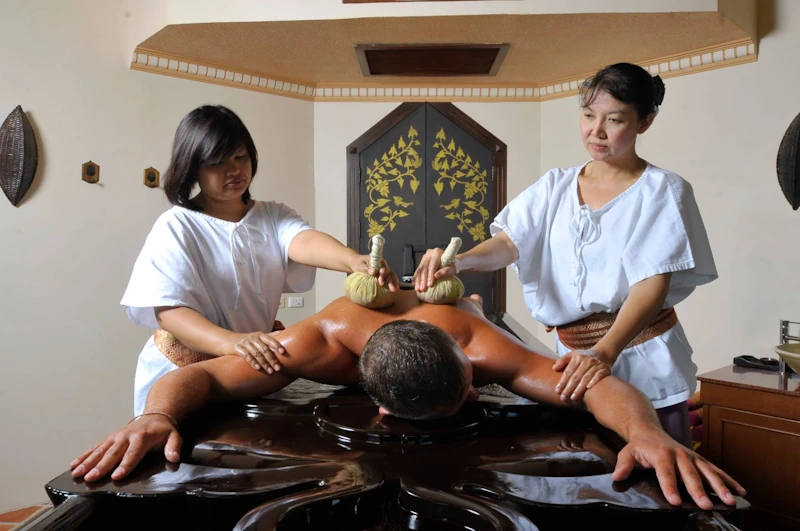
Ours finished in the herbal steam sauna, which is the traditional sequence rather than an upsell — in Ayurvedic practice, heat applied after oil or poultice work is a step in its own right, called swedana. The logic is that the treatment opens things up and the steam carries it further. Whatever you make of the reasoning, finishing a session on a sore knee in herbal steam is a sensible order of operations and it feels like one.
On the menu Podi Kizhi is THB 2,400 for 25 minutes or THB 3,500 for 55 — so a single included treatment covers most or all of the daily program fee on a short stay.
The wider point: this is what the Ayurvedic side gives you that a resort spa does not. A massage is pleasant and general. Podi Kizhi on a specific joint, chosen because that joint is the problem, is targeted — and the resort has a menu of these aimed at particular complaints, from Kati Vasti for the lower back to Greeva Vasti for the neck and Janu Vasti for the knees, each at THB 2,400 for 30 minutes. If you arrive with something that aches, say so, because there is almost certainly a treatment pointed at it.
Island Escapes: the leisure track nobody notices
Four of the sixteen programs sit in a separate category the resort calls Island Escapes, and they are not wellness programs at all. They are leisure packages built around the property: The Honeymooner over seven nights, Golf & Wellness over five, Lifestyle & Fun over five, and Local & Away over three. The resort describes them in terms of candlelit dinners, petal-strewn jacuzzi tubs, island-hopping and temple visits.— a long way from Panchakarma.
This is the part of Mangosteen that contradicts its own positioning, and in a useful way. A property known for doctor-led Ayurveda also runs a honeymoon package and a golf package. If you have been reading this review thinking it sounds worthy, that is the correction: you can stay here and simply have a nice time.
Golf & Wellness is the shrewdest of the four.
Phuket has genuinely good courses — Blue Canyon and Laguna among them — and golf trips here are usually built around late nights and large dinners. Pairing rounds with yoga, spa treatments and sattvic food at an adults-only hillside property is an obvious idea that almost nobody offers, and it opens the resort to a guest who would never search for an Ayurveda retreat.
The Honeymooner is the one to think about carefully.
Adults-only, quiet, villas with private roofed patios and jacuzzis — that part works, and the sea-view categories are genuinely romantic. But this is a hillside property forty minutes from a beach where the daily rhythm is built around yoga and treatment schedules. For a couple who want wellness together it is excellent. For a conventional honeymoon it is the wrong shape, and a beachfront resort will serve them better.
Local & Away is the most interesting for repeat visitors.
At a three-night minimum with a focus on local outings and markets, it is the version of this property aimed at someone who has already done the wellness part and wants to see the island. It also suits residents of Phuket wanting a short break without flying anywhere.
Shared inclusions across the Island Escapes are the standard resort ones — welcome drink and local sweets, daily fresh fruit in the villa, the THB 500 spa voucher, 24-hour pool and fitness room, high-speed Wi-Fi, and the shuttle to Nai Harn Beach and local markets, with a refreshment waiting when you get back.
Day passes — you do not have to stay
This is the find on that page, and almost nobody knows about it. Mangosteen sells four day passes, so you can use the property without booking a room.
| Pass | Price | What you get |
|---|---|---|
| Comprehensive Day Pass | THB 6,000 for THB 7,500 credit | Pool, fitness, restaurant, with credit spendable across spa, yoga and dining |
| Weekend Day Pass | THB 6,000, full credit | Pool, fitness, restaurant, twice-daily yoga, spa access, an Ayurveda consultation, and a 30-minute sauna |
| Wellness Day Pass | THB 2,800 | Pool, fitness, restaurant, yoga, breakfast, an Ayurveda or wellness lunch, and a 55-minute non-Ayurvedic spa treatment |
| Yoga Privilege Day Pass | THB 2,500, full credit | Pool, fitness, scheduled yoga, pay-as-you-go restaurant |
The best-value thing on this page: The Weekend Day Pass includes an Ayurveda consultation, and the THB 6,000 is returned to you as credit rather than charged as a fee. That means you can sit down with a BAMS-qualified Ayurvedic doctor, get assessed, and spend the money on treatments or lunch instead of losing it. If you are considering a two-week Ayurvedic program and want to know whether the framework is for you — or you simply live on the island and are curious — this is the cheapest serious way to find out. It is also how a skeptic should test the place before committing four figures.
The Wellness Day Pass at THB 2,800 is the straightforward option: breakfast, lunch, two yoga classes, a spa treatment and the pool for under $80, in a quiet hillside property. For anyone staying elsewhere in Rawai or Nai Harn, that is a good day out.
Seasonal offers worth timing around
- Seasonal Program Advantage: 10% off retreat programs, plus airport pickup on stays of five nights or more
- Extended Stay Advantage: a further 10% for 14+ nights in April, or 21+ nights between May and October
- Ayurveda Intensive Season: on 7+ night programs, added activities including a cooking session, a sunrise hike and an Indian head massage workshop
- Mangosteen Rewards: 3% to 10% loyalty benefits on cumulative spending from THB 200,000, with an additional returning-guest bonus they promote periodically
These run April to October, which is Phuket’s low season. Stack the two discounts on a long stay and the saving is real — a 28-night Well-being program drops from roughly THB 138,600 to about THB 112,300, which is close to a month of doctor-led Ayurveda for the price of three weeks. The trade is rain, usually in heavy afternoon bursts, and the indoor Ananda room means it does not cost you your yoga.
What every program includes
- Two 60-minute yoga sessions daily
- Breakfast
- A THB 500 spa voucher per person
- Pool and fitness room access
- Shuttle to Nai Harn Beach
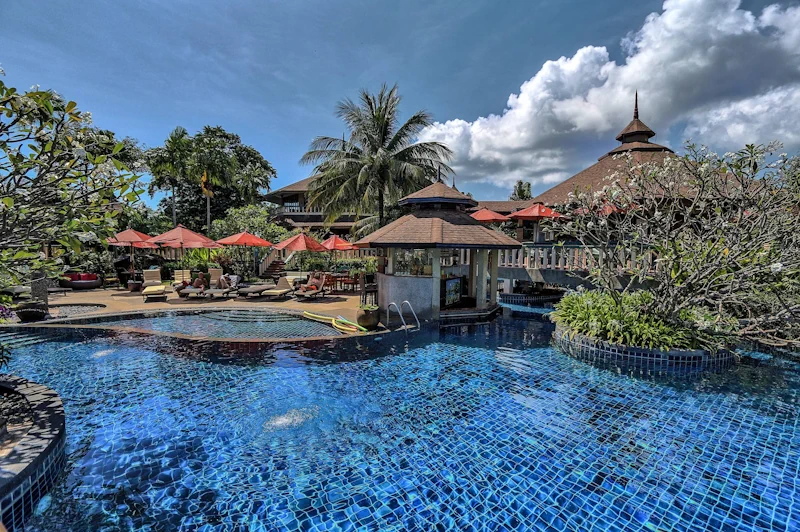
What a wellness day looks like
The Wellness track has a gentler shape than the name suggests — this is restoration rather than training, and nobody is going to push you.
- Morning sun salutations
- An afternoon stretch session
- Twice-daily guided yoga or meditation on most days
- Gentle nature walks
- A complimentary shuttle to Nai Harn Beach, for swimming and an afternoon in the casuarina shade
- Three healthy meals daily, with their Life Drinks
- Open-air fitness room and the saltwater pool, both open around the clock
The Nai Harn shuttle deserves a mention, because it answers the main objection to this property. Mangosteen is not beachfront and reviewers mark the location down for it — but Nai Harn is one of the best beaches in Phuket, the shuttle is complimentary, and an afternoon under the casuarinas between a morning yoga class and an evening treatment is a better day than most beachfront resorts deliver. The beach is 3.7 km away rather than absent.
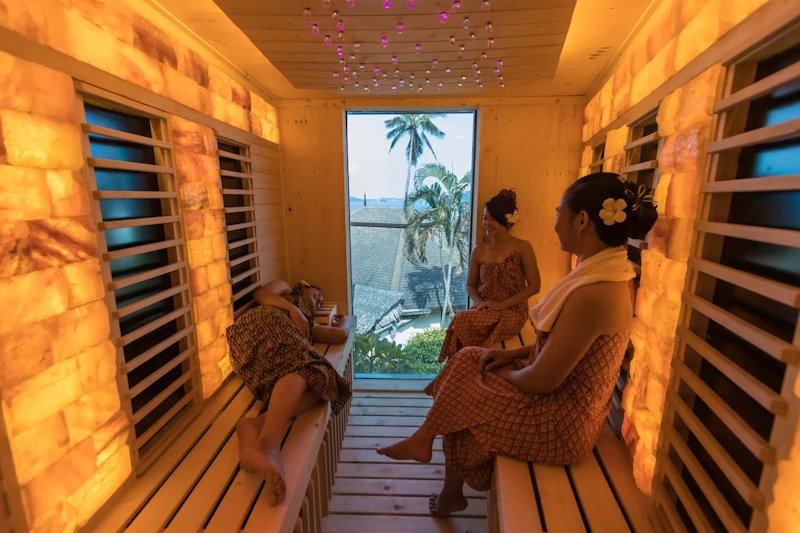
Book the sauna on arrival: The Himalayan salt infrared sauna is complimentary for retreat guests, but it runs 30-minute sessions on Mondays, Wednesdays and Fridays only, 1:00 to 3:00 p.m., for a maximum of five people, and needs booking in advance. That is six hours a week at a property holding up to 70 guests. Book it the day you arrive.
The two yoga shalas
Both paths include yoga twice a day, morning and afternoon, and the resort has two distinct spaces for it. Having two is more practical than it sounds on a tropical island.
Prana Yoga Sala — the open-air one
The main space: an open-sided teak sala set in the gardens, facing a four-metre waterfall, roofed but not enclosed, so you practice in moving air with the sound of water and the hillside around you. It is fully illuminated, which means it works for evening and night sessions rather than only in daylight. This is where the morning class belongs. Practicing outdoors at six or seven in the morning, before the heat arrives, with birds rather than air conditioning, is a materially different experience from a studio and the main reason to do yoga in Thailand at all.
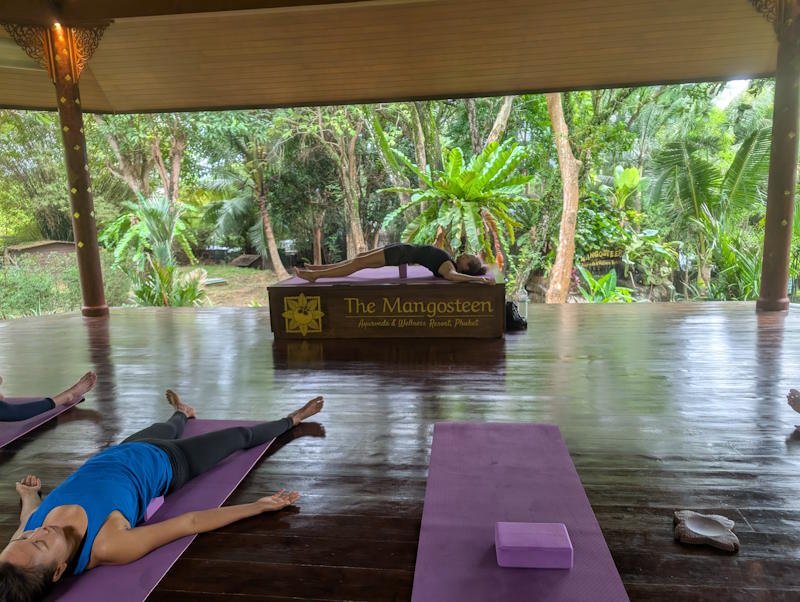
The practical note about open-air practice: the floor can be slightly humid, mats can be slippery early, and if you are new to practicing outdoors the sensory openness takes a session or two to settle into. Balance work is also marginally harder when there is a breeze and a view competing for attention — which is good training rather than a problem.
Ananda — the indoor room
A teak-floored room with an illuminated Buddha and views out toward the Phi Phi Islands. It is normally left open to the breeze but can be air-conditioned when needed, and classes move here when it rains — which settles the question: Prana is the primary space and Ananda is the weather alternative. Phuket’s rainy season runs roughly May to October and delivers heavy afternoon bursts rather than all-day drizzle, so an indoor backup is not a luxury — without it, a resort loses classes.
It is also equipped in a way a yoga room usually is not — professional audio, wireless microphones and a 65-inch display — which makes it viable for lectures, workshops and training rather than only asana. That matters for guests mainly because it means talks and sound healing happen somewhere properly set up.
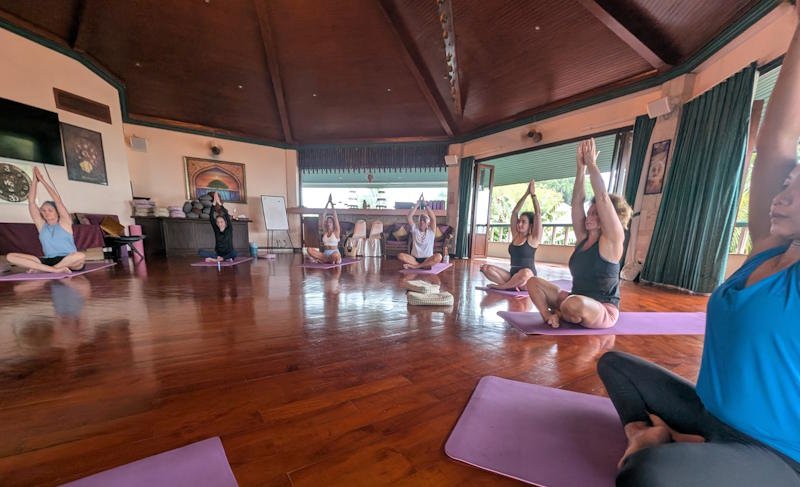
And it serves a second purpose worth knowing about. Some practices work better enclosed: breathwork and meditation are easier without wind, and yin or restorative sessions, where you hold a shape for several minutes, are more comfortable somewhere still and controlled. A property with only an open sala has to compromise on those.
What is taught
- Hatha and Hatha Stretch, with an alignment focus
- Vinyasa Flow
- Yin
- Kundalini
- Alignment and therapeutic yoga
- Breathwork and meditation, with weekly pranayama and sound healing
- Weekly Pilates, Zumba, acro yoga and Muay Thai
- Sunday meditation and breathwork, 7:30 to 8:30 a.m., led by wellness consultant Kirstin Gourlay
Beginners, and the thing no other yoga retreat here can offer
Classes are explicitly mixed-level and suitable for beginners, with teachers offering options and modifying postures on the day. Private sessions can be arranged, and the resort suggests them specifically for beginners or anyone carrying an injury. Mats and props are provided.
Here is the part worth noticing. If you arrive with an injury or a condition, the resort asks you to speak to the team before class — and guests on a therapeutic program can take it to the Ayurvedic doctor.
Think about what that means in practice. At a normal yoga retreat, a bad shoulder gets you a teacher saying take it easy on chaturanga, which is kind and is not medicine. Here it can get you a consultation with a physician who then shapes both your practice and your treatments around it. That is a structurally different offering, and for anyone coming to yoga with a body that needs working around — which describes most people over forty — it is the single best argument for choosing Mangosteen over a dedicated yoga school.
The teachers
The resort names eight yoga teachers, a large team for a property this size and the reason the schedule carries this many styles rather than one teacher repeating a format: Orlando Matos Abreu, Daosuk Dao Sethi, Kirstin Gourlay, Koong Jiraphorn, Nuya Laksanachan, Supisara Pin Nunta (also a Reiki master), Maria Curtin (who also teaches Muay Thai), Nitikarn Niti Thachina and Esmeralda P. Torres. Dr Megha S. Nair, one of the two Ayurvedic doctors, is also a certified yoga teacher.
That last detail is quietly significant: a doctor who also teaches yoga is the person best placed to connect a prescription to a practice, and it is not a combination you find often.
Classes run about an hour, are mixed-level, and teachers modify postures on the day. Mats and props are provided. Private sessions can be arranged. The teaching team is large for a 47-villa property — the resort names eight yoga teachers — which is why the schedule can carry this many styles rather than one teacher repeating a format.
Non-guests cannot drop into individual classes, but the day passes include the scheduled yoga, so a day pass is the way in if you are staying elsewhere on the island.
The villas
Forty-seven villas, each with its own roofed patio, spread across a forested hillside with views over the gardens, Chalong Bay or the slope itself. Maximum occupancy across the whole property is 70 guests.
The six villa categories
| Villa | Size | From | Notes |
|---|---|---|---|
| Superior Garden Villa | 58 m² | THB 4,300 | Entry level, garden setting, sleeps 2 |
| Superior Jacuzzi Villa | 58 m² | THB 5,000 | Same size plus a jacuzzi. Some have an ocean view — see below |
| Deluxe Jacuzzi Villa | 74 m² | THB 5,600 | Larger, sleeps 2 to 3 |
| Royal Jacuzzi Villa Garden | 94 m² | THB 6,700 | The largest single villa, garden setting |
| Royal Jacuzzi Villa Balcony | 82 m² | THB 7,300 | Outdoor jacuzzi, balcony, sea view |
| Royal Jacuzzi Suite | 180 m² | THB 18,000 | Two bedrooms, canopy bed, sea view, sleeps 2 to 4 |
Rates are per night including breakfast. These are villa prices only — if you are on a program, its fee is charged on top of these.
A money-saving thing I found out by staying
I stayed in a Superior Jacuzzi Villa, and it had an ocean view.
That is worth knowing because the resort’s own villa pages only attribute sea views to the Royal Balcony and the Royal Suite. On the published descriptions you would assume an ocean view starts at THB 7,300. It does not necessarily — at least some Superior Jacuzzi Villas at THB 5,000 have one, which is a saving of THB 2,300 a night for the same outlook.
So ask. Do not book the Royal Balcony on the assumption that it is the only way to see the water — request an ocean-view Superior Jacuzzi Villa and see what they say. Villa placement is not fully described anywhere, so asking for it specifically is the only way to find out what you can get.
What the Superior Jacuzzi Villa is actually like
The categories are not well distinguished anywhere, so here is the one I stayed in, in detail.
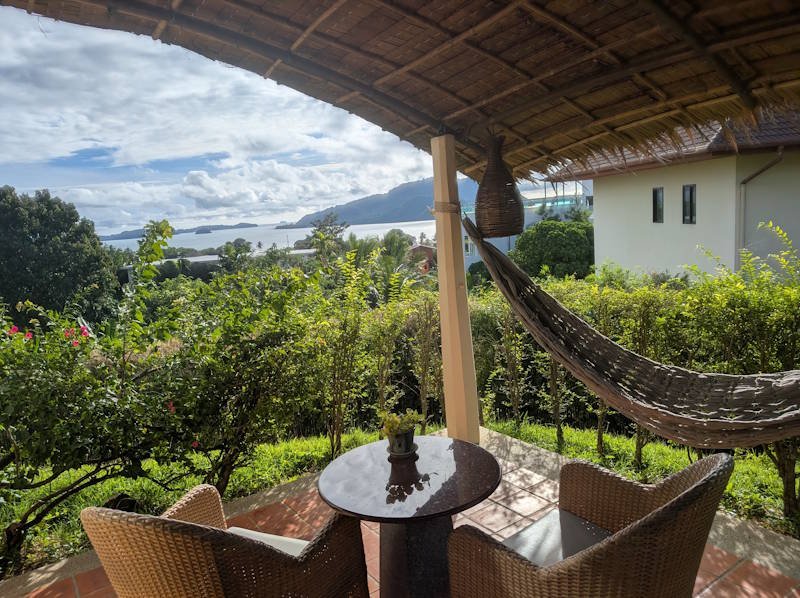
The ocean view is from the room itself and from the covered patio alongside it — not a sliver glimpsed from one corner, but the outlook from where you sit. At 58 square meters it is the smallest category above entry level, and it does not feel it: there is room for a couch as well as the bed, which matters more than square meterage because it gives you somewhere to sit that is not the bed or the terrace.
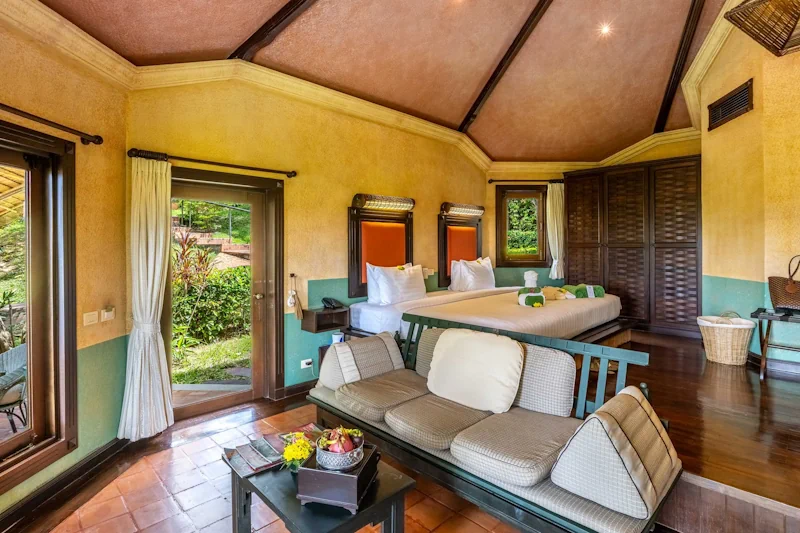
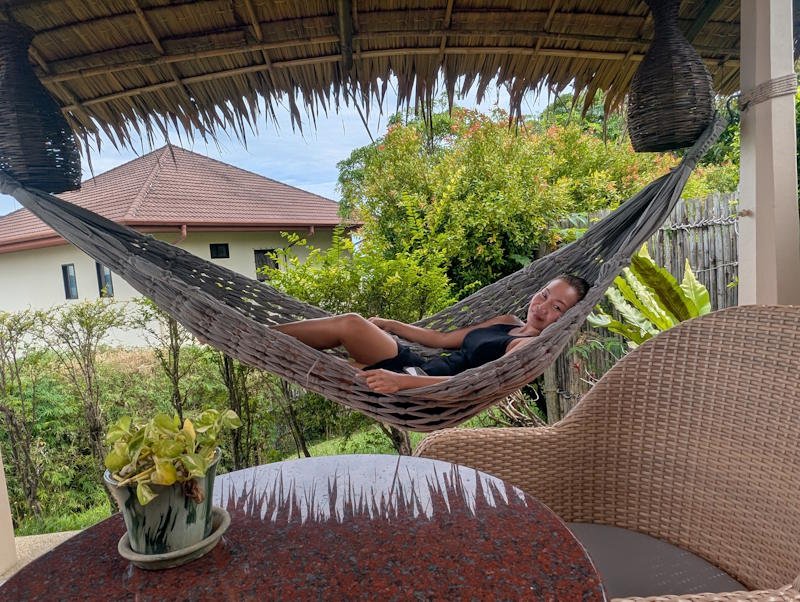
The patio is furnished as a room rather than left bare: two chairs, a table, and a hammock. That hammock is the detail I would mention to anyone choosing between categories. On a program where you have genuine gaps between treatments — and Mangosteen builds in that downtime — a shaded hammock with an ocean view is where a surprising amount of the stay happens. It is also the thing you cannot get at a beach resort, where the terrace bakes from mid-morning.
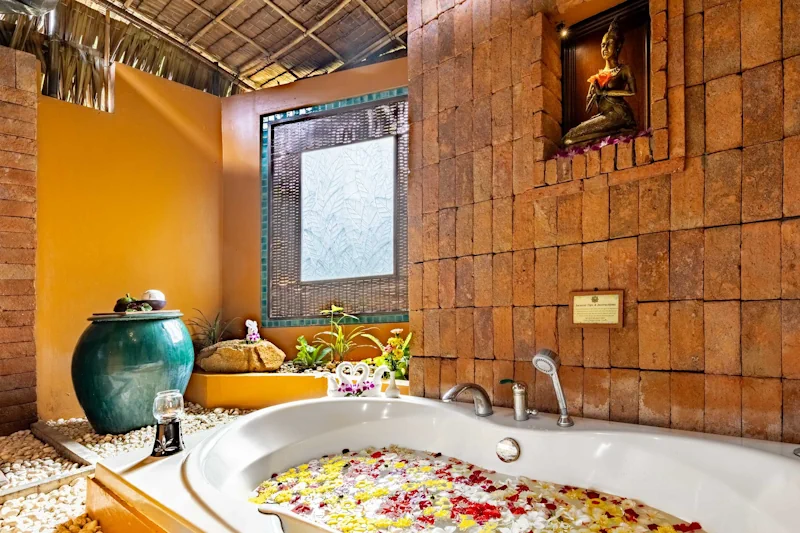
The shower and jacuzzi is outdoors under a roof but open to the air, there is no indoor alternative in this category. It is covered, which is the part that makes it work: open-air bathrooms are common in Phuket and frequently unusable in rain or at midday, and a roof over it means you use it daily rather than once for the novelty. After an oil treatment, rinsing off in warm air rather than a tiled box is a genuinely nicer end to the afternoon, and I would not want the indoor one back.
That said, know what you are booking. Some people dislike outdoor bathrooms — insects, the sense of being outside while undressed, showering in the dark, a cold morning in the rainy season — and in this villa there is no fallback. If that would bother you, ask which categories have an enclosed shower before you book rather than discovering it on arrival. It is not spelled out anywhere, and it is the kind of thing that can sour a stay for the wrong guest. Other room types do have indoor bathrooms.
The verdict: at THB 5,000 with an ocean view, a hammock, a jacuzzi, a couch and a covered outdoor shower, this is the category I would book. The two Royal tiers cost THB 1,700 to THB 2,300 more a night and the Superior Jacuzzi already has the things that change how a day feels.
What the pricing tells you
One oddity worth noticing: the Royal Jacuzzi Villa Garden is 94 m² at THB 6,700, while the Royal Jacuzzi Villa Balcony is smaller at 82 m² and costs more at THB 7,300. You are paying a premium for a smaller villa, and what you are buying is the sea view and the outdoor jacuzzi. The resort prices outlook above floor space, which tells you what guests here actually value — and reinforces the point above about asking whether a cheaper category can give you the same thing.
The jump from Superior Garden at THB 4,300 to Superior Jacuzzi at THB 5,000 buys you a jacuzzi in the same 58 m² footprint. Whether that is worth THB 700 a night depends entirely on whether you will use it; on a program with oil treatments most afternoons, a private jacuzzi is more useful than it sounds.
The roofed patio is the detail worth dwelling on, and it is the thing that makes these villas work in this climate. An unshaded terrace in Phuket is unusable from about ten in the morning until late afternoon, which means a balcony you look at rather than use. A roofed one is usable all day and through a rain shower, which turns it into an actual room.
Interiors were designed by Australian artist John Underwood, using strong colors and natural materials, with open-air bathrooms. The buildings are well insulated and roof-ventilated, and many guests report leaving the air conditioning off — unusual in Phuket and genuinely pleasant if you dislike sleeping in conditioned air. Some villas have a private Jacuzzi, and there is a two-bedroom suite.
The 680 square meter saltwater pool is open 24 hours and functions as the social center of the property. There is also a 24-hour fitness room with island views.
What every guest gets, regardless of program
The baseline inclusions here are more generous than at most Phuket properties, and several are the sort of thing that is normally charged for:
- Welcome drink, a local treat and chilled towels on arrival
- Fresh fruit and quality teas available in the restaurant all day
- Daily breakfast buffet with freshly prepared dishes and a cold-pressed juice station
- A THB 500 spa voucher per person
- The 680 sqm saltwater pool, open day and night
- Fitness room, plus an outdoor Wild Wood Gym for outdoor and group training
- The Agni & Soma Thermal Ritual — Finnish sauna paired with a cold plunge
- Complimentary scheduled shuttle to Nai Harn Beach and to local markets
- Fast Wi-Fi throughout the villas and grounds, and an internet desk at reception
- Turndown and daily cleaning, with linens changed every three days or more often on request
- 24-hour reception
- Drinking water in copper or glass bottles in your villa, with unlimited refills
Two of those deserve a comment.
The Agni & Soma Thermal Ritual is nicely thought through.
Agni is the digestive fire discussed earlier; soma is its cooling counterpart. Pairing a Finnish sauna with a cold plunge and naming it after that opposition is a neat piece of translation — contrast therapy has reasonable evidence for recovery and perceived wellbeing, and dressing it in the vocabulary of the house tradition costs nothing and makes it cohere. It is also included, which at most resorts it would not be.
The copper water bottles are not a gimmick.
Storing drinking water in copper is a long-standing Ayurvedic practice, so it fits the property. The practical benefits are the ones I would actually credit: unlimited refills in a reusable vessel means no plastic bottles accumulating in your villa, and good water in your room means you drink more of it — which on a hillside site in this climate, between oil treatments and a sauna, matters more than the metal does.
Worth knowing what is not included: spa treatments beyond the THB 500 voucher, some daily activities, and airport or island transfers, which are arranged on request. Lunch and dinner are included on retreat programs but not for room-only stays.
The hillside, honestly
Mangosteen is built on a hillside, and that has the usual consequences: level changes between villas and the main facilities, and a site you walk up and down rather than across. The views are the compensation and they are real. But if you are managing a knee, a hip, balance or simply do not want to negotiate slopes several times a day between treatments, ask specifically about villa placement when you book, and get the answer before you pay.
The food
The dining structure is more flexible than at most program-led properties, and it is one of the better-designed parts of the resort.
The six tastes, and why your plate differs from the next table
Ayurvedic cooking organizes food by six tastes — sweet, sour, salty, pungent, astringent and bitter — each held to act on the doshas differently. A balanced meal contains all six; a therapeutic one is weighted toward whichever your prescription calls for. On a detox program the kitchen leans bitter, pungent and astringent, which is why detox food tastes the way it does rather than simply being smaller portions.
The spice list tells you the same story: cumin, coriander, ginger, turmeric, fenugreek, cinnamon, cloves and cardamom. These are doing work in the system rather than only flavoring, which is why the food at an Ayurvedic property tastes different from health food elsewhere.
The food rules you will be taught
Ayurveda has strong views on food combining and timing, and you will hear them here. The main ones:
- Do not combine milk with sour fruit, yoghurt or fish
- Eat melons on their own
- Never heat honey
- Ginger with rock salt before a meal, to wake up digestion
- Warm water during the meal rather than cold
- Cumin-and-ginger buttermilk to finish
- Fill one third of the stomach with food, one third with liquid, and leave one third empty
My honest read: the food-combining rules are traditional rather than evidential — there is no good evidence that milk with sour fruit harms you — and they are also completely harmless, so follow them while you are there and take what you like home.
The one-third rule is the exception, and it is the single most useful thing you will learn here. Stopping while there is still room is portion control expressed as a physical sensation rather than a number, and it works whatever you think of the framework behind it. Most guests who change one habit after an Ayurvedic stay change this one.
Breakfast
Eggs cooked how you like them with side dishes of your choosing, or cereal and granola, alongside tropical fruit, Ayurvedic porridges and house favorites. There is a buffet element and a juice-pressing station where you build your own blends. Retreat guests also get a morning ginger shot and the daily Life Drinks — detox blends, vitamin boosters and immune-support mixes.
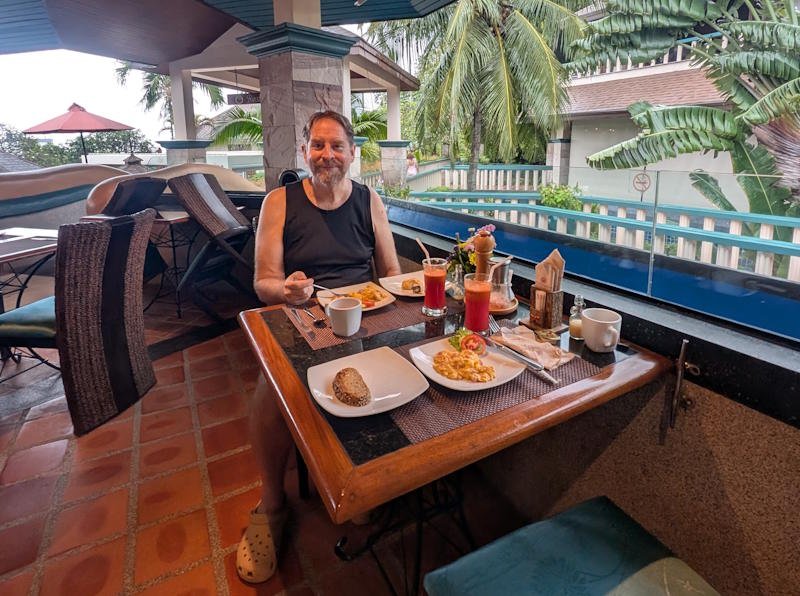
I would rate this arrangement highly. The standard wellness-resort breakfast buffet is where good intentions go to die — you eat more than you meant to because it is all sitting there. Eggs to order, with sides you actively choose, is a quietly better system for a property whose guests are mostly here to eat deliberately.
Lunch and dinner
Three options at each meal:
- The Ayurvedic menu, if you are on that path — dishes matched to your constitution and your prescription
- The Wellness menu — lighter dishes for guests on the wellness track
- The à la carte menu — the full restaurant offering, available to anyone
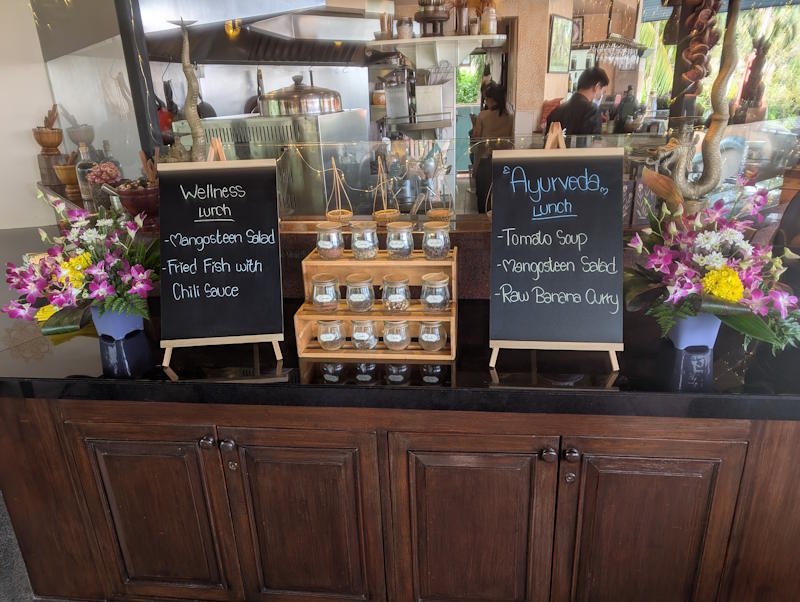
That third option is more significant than it looks. Most program retreats operate a closed food system: you eat what the program dictates, and a guest who wants something else is out of luck. Keeping an à la carte menu available means a non-participating partner eats normally, a guest on a light day can order what they feel like, and nobody is trapped. It is the dining equivalent of the two-path structure, and it is why this property works for mixed-interest travel.
Retreat menus lean sattvic — an Ayurvedic category meaning food considered light, fresh and clarifying rather than heavy or stimulating. In practice that means fresh vegetables, simple preparation, little that is fried, fermented or aggressively spiced. Vegetarian and vegan options are standard, and special diets are accommodated with advance notice, so flag anything significant when you book rather than on arrival.
The main restaurant is open-air with a show kitchen, serving Thai and Mediterranean food, and everything is cooked to order. Expect slower service than a buffet — that is the trade for food made when you ask for it. Vegan and gluten-free options are available.
Drinks
- Herbal teas available at every meal
- Ginger shots
- An Ayurvedic tea available throughout the day
The all-day Ayurvedic tea is a small thing that does real work. On a program where you are having oil treatments, sweating in a sauna and eating lightly, staying hydrated matters more than usual, and a warm drink you actually want is a better delivery mechanism than a reminder to drink water. It also gives the common areas a reason to be used, which feeds the social side below.
There is a cooking class
Mangosteen runs an Ayurveda cooking class, which is the single most transferable thing on offer and the one I would prioritize. Everything else here — the treatments, the doctor, the shalas — stays in Phuket. A method for cooking the food you have been eating all week comes home with you, and combined with the recipes and the six-tastes framework it is the most likely reason a stay here changes anything beyond the fortnight after.
Ask when it runs as soon as you arrive. On a short stay it may only happen once in your window.
The sourcing, which is unusually specific
Most wellness resorts say fresh local ingredients and stop there. Mangosteen names things, and the specificity is the best evidence that the kitchen is taken seriously:
- Produce from local farms and hydroponic growers, with some herbs and vegetables from their own kitchen garden
- Rice-bran oil for Thai dishes, and no palm oil at all
- Cold-pressed Spanish olive oil for the Mediterranean dishes
- Brown Jasmine and Riceberry rice, sourced in Phuket
- No MSG and no refined sugar
The no-palm-oil line is the one I would credit most. Palm oil is the default cooking fat across Thailand because it is cheap, and a kitchen that has deliberately switched to rice bran and imported olive oil is spending money where no guest would ever notice. Naming the rice varieties is the same signal. These are checkable claims rather than atmosphere, which is the difference between a kitchen with standards and a menu with adjectives.
Where and when you can eat
- Main open-air restaurant with a show kitchen, 7:00 a.m. to 11:00 p.m. daily
- Poolside and in-villa dining, with in-room service until 10:00 p.m.
- Pool & Lounge Bar for drinks and sunset cocktails
- An underground wine cellar with a curated list, used for private dinners
- Occasional themed dining nights
A wine cellar at an Ayurvedic resort is a contradiction on paper and a sensible one in practice: half the guests are on the Wellness track, the Island Escapes packages exist, and a property that forbade a glass of wine would lose all of them. Nobody is going to judge you.
Dish names from their own gallery give a fair sense of the range — Aloo Gobi, Okra Subzi, Pad Thai Zucchini, Zucchini Pesto Lasagne, Quinoa Avocado Salad. Worth noting that the kitchen is not exclusively plant-based despite the emphasis: seafood appears, including quinoa with grilled prawns.
The community table
There is a communal table for guests who want to sit together, alongside regular tables for those who do not.
This is the right way to do it. At Phuket Cleanse the communal table is the architecture — everybody eats together and opting out means paying for something you are not using. Mangosteen makes it optional, which suits a property where a meaningful number of guests are on intensive programs. Some days on a Panchakarma you want company and some days you want to eat quietly and go back to your villa, and here you can do either without explaining yourself.
The family who run it
Mangosteen is owned and managed by the von Keller family, and after twenty-three years all three of them are still in the building.
- Rose — the Ayurveda side, and the one described as knowing what a guest needs before the guest does
- Hajo — the creative entrepreneur who shaped the property’s character, and the reason it looks like somebody’s idea rather than a template
- Earth — their daughter, now Operations Manager, educated in Switzerland, who spent a year working in every department before taking the role
- Ying — a second daughter, set to join the business shortly
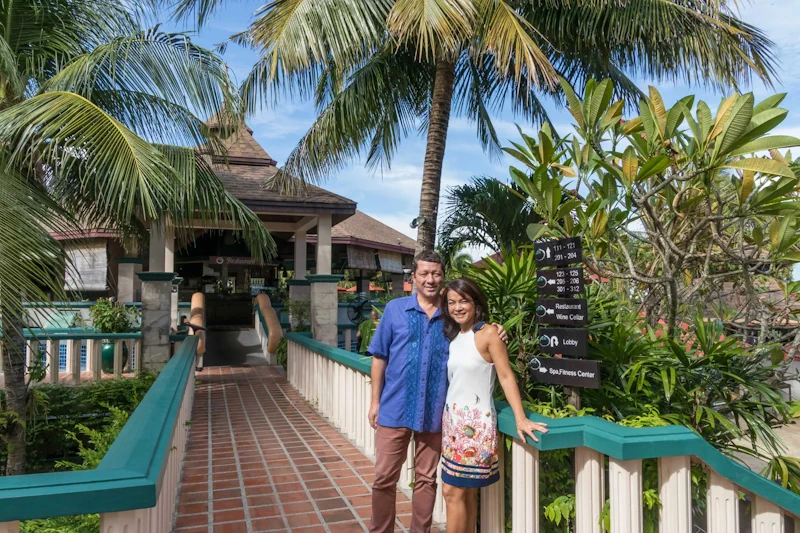
With Ying joining, both daughters will be in the business. That is worth noting for a reason beyond family interest: a founder-run property is only as durable as its succession, and guests booking a two-week program at a place they might return to for years have a reasonable interest in whether it will still be the same place in five. Two children coming in, one of them having worked a year through every department first, is about as clear a signal of continuity as a privately owned resort can give.
That department-by-department detail is the one I would weigh. A founder’s child who worked a year through housekeeping, the kitchen, the spa and the front desk before managing any of it is a succession handled properly, and it is the difference between a second generation that inherits a business and one that understands it. For a guest it means the people making decisions have done the jobs, which usually shows in how problems get handled.
Their own framing is that the property is private like a wellness retreat but welcoming like a friend’s home, and that they aim to know every guest’s name and preferences. At 47 villas and a 70-guest ceiling that is achievable rather than a slogan — and the 4.8 Service score in the reviews suggests they manage it.
They also state plainly that their rates sit well below other luxury resorts, which is an unusual thing for a property to say about itself and, on the numbers, broadly true: a villa from THB 4,300 with breakfast is not luxury-resort pricing in Phuket, and the 4.6 Value score backs it up.
A 23-year-old property that is not coasting
A resort running since 2003 could reasonably be resting on it. Reading back through their own announcements, the opposite is happening — almost everything of substance here has changed in the last two years:
- A two-storey back-of-house building opened in July 2024, blessed with a traditional Buddhist ceremony
- The spa was expanded into the new Crystal Ayurveda Spa
- Dr Megha joined the Ayurveda team, taking the property to two resident doctors
- Khun Pim was appointed Spa Manager from October 2024
- Earth von Keller came in as Operations Manager, bringing the second generation into the business
- A large solar energy project has been announced
That pattern matters when you are choosing between properties. A wellness resort in its third decade can be a place that worked out its formula and stopped investing, and you can usually tell within a day of arriving. Two new senior hires, a second doctor, a spa expansion, a new building and a succession plan inside twenty-four months is a property putting money back in. It is also the most likely explanation for the 4.9 cleanliness and 4.8 rooms scores at an age when most resorts are fraying.
On the awards front, their Phuket Health Expo recognition now runs two consecutive years — Best Wellness Resort in Phuket in 2025, and the Gold Award as a Longevity Resort in 2026 — alongside a HolidayCheck Award for 2026. Repeat recognition from the same body is more informative than a single win.
A European property in Thailand
The other consequence of German-speaking owners is that the resort operates in English, German and French, and that explains a good deal about the place.
German-speaking guests in particular will find this unusual in Phuket. Being able to discuss a health program — symptoms, medication, what you actually want from the stay — in your own language matters more here than at a beach resort, because the consultation is the thing the whole stay is built on. Precision gets lost in a second language, and a vague consultation produces a vague prescription.
It also shapes the atmosphere. This is a European-run property applying an Indian medical tradition in Thailand, and the result is more orderly and more structured than a Thai-run spa resort — schedules are kept, the consultation is a real appointment, and the program is documented. Whether that reads as reassuring or a little formal is a matter of taste, but it is consistent, and consistency is what you want from a medical program.
Solo women travelers
Mangosteen attracts a notably high proportion of women traveling alone, and they report feeling comfortable here. That is worth stating plainly, because it is a genuine reason people choose a property and it is rarely addressed directly in reviews.
The reasons are structural rather than accidental:
- Adults only, with no children under 12 — a quieter, more contained environment
- A maximum of 70 guests, so staff know who you are within a day or two
- No bar scene and no party infrastructure; the property is not a venue for anything
- An optional community table, so company is available without being compulsory
- A gated hillside property set back from the road, not a beachfront resort with public access
- Doctor-led programming, which means a professional relationship with named staff rather than a transactional one with a spa desk
- Daily structure — two yoga classes and scheduled treatments give a solo traveler a shape to the day without having to manufacture one
The last point is the one most often missed. The hard part of solo travel is not safety, it is the unstructured afternoon. A property that provides a schedule removes that, and it is why program-led retreats suit solo travelers better than resorts do.
The spa
The Mangosteen Ayurveda Spa has six treatment rooms, four of them with double massage beds — which is what you need for Abhyanga, where two therapists work on you simultaneously. Alongside the Ayurvedic protocols there is a broad massage menu, so guests on the wellness path have plenty to choose from.
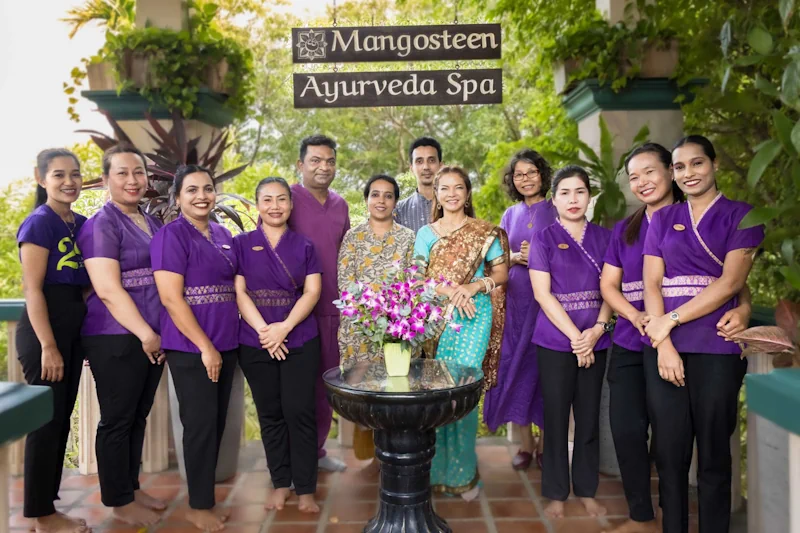
The spa has been remodeled and recently expanded with the addition of the Crystal Spa — which brought crystals, brighter treatment rooms and a reworked flow through the space. Facilities include a steam room, a Himalayan rock salt infrared sauna and a Jacuzzi. Treatments use plant-based preparations, with the Ela Kizhi herbal pouches made on site.
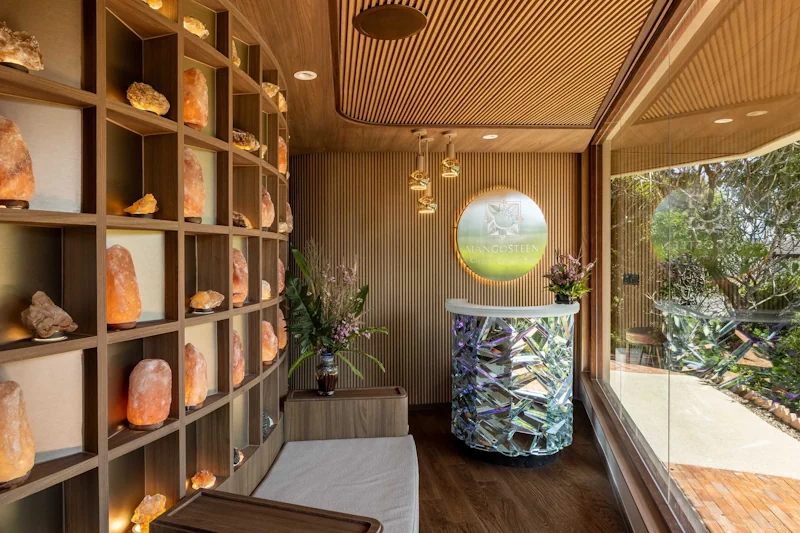
The treatment menu, with prices
Mangosteen publishes a full spa menu of more than seventy treatments with prices, which is unusual and useful. All prices below already include the 10 percent service charge and 7 percent VAT, so they are what you will actually pay rather than a figure that grows at the till. The spa is open 9:00 a.m. to 7:00 p.m.
| Tier | Price (THB) | Examples |
|---|---|---|
| Doctor consultation | 2,000 | Ayurveda, women’s health, or chakra assessment |
| Short targeted treatments, 25–30 min | 1,800–2,400 | Kati Vasti, Nasyam, Karna Poorna, back massage |
| Standard massage, 55 min | 2,400 | Swedish, Thai Reliever, Energy, The Secret of Mangosteen |
| Scrubs, wraps and facials | 1,800–2,900 | Salt or herbal scrub, mud or papaya wrap, facials |
| Core Ayurvedic treatments, 55 min | 2,800–4,100 | Abhyangam, Pizhichil, Marma, Udwarthanam, the Shirodharas |
| Premium single treatments | 5,000–6,000 | Royal Shirodhara, Chakra Dhara, Classic Shirodhara (120 min) |
| Signature rituals, 110–240 min | 4,000–8,100 | Mangosteen Ayur Journey, Atma Healing, Mangosteen Magic |
| Couples | 14,000 | Power of Love, 185 min for two |
| Multi-day Ayurvedic combos | 8,500–28,000 | Shakti 3-day, Ojas 5-day, Shodhana 7-day |
A correction to the complaint about expensive extras
Guest reviews consistently say the spa add-ons are pricey, and before seeing the menu I passed that on. Having read it, I think the complaint needs splitting in two, because it is only half right.
The ordinary massages are not expensive.
A 55-minute Swedish, Thai Reliever or Energy massage is THB 2,400 all-in, which is about $67. That is mid-market for a resort spa in Phuket and cheaper than several beach properties with no medical credentials at all. If you simply want a massage, you are not being gouged.
The Ayurvedic treatments are where the money goes.
Abhyangam is THB 3,000, the Shirodhara variants are THB 4,100, Classic Shirodhara over two hours is THB 6,000, and the multi-day combos run from THB 8,500 for three days to THB 28,000 for the seven-day Shodhana detox. Those are real prices, and they are the ones guests notice because they are the treatments you came for.
So the accurate version is this: a guest who books a program and then adds a massage will find it reasonable. A guest who books a lighter program and then tries to assemble the Ayurvedic experience treatment by treatment will spend a great deal. If Ayurvedic bodywork is the point of your trip, book the program that includes it rather than paying à la carte — the economics are not close.
The single best-value thing here
An Ayurveda doctor consultation is THB 2,000. About $55.
That is a sit-down with a BAMS-qualified physician — pulse diagnosis, dosha assessment, and a care plan — for roughly the price of a decent dinner in Patong. There are three versions: a general consultation, one focused on women’s health including hormonal changes, and a chakra imbalance consultation.
And it produces a written report — see below — rather than only a conversation, which is what lifts it from interesting to genuinely worth the money.
For anyone curious about whether Ayurveda has anything to offer them, that is the entry point, and it does not require booking a program or even staying. Combined with the day passes, a Phuket resident or someone staying elsewhere on the island can get assessed by the only resident Ayurvedic doctors in Phuket for less than the cost of a spa treatment. I would take that over any amount of reading about doshas.
What you leave with: the doctor’s report
This is the part I did not expect and the reason I would recommend the consultation to almost anyone.
Dr Nezeem provided us with detailed written reports. Not a verbal summary at the end of a session — a document, individual to each of us, covering:
- Lifestyle suggestions
- An eating schedule
- Preferred foods
- Foods to avoid
- Home remedies
- A daily routine, with meal and snack timing
- Daily physical activities
I have criticized almost every retreat on this site for the same failing: the benefit has a half-life of about three weeks, because what happened to you stayed at the property. This is the most complete answer to that problem I have found in Phuket, and it beats the alternatives on a specific axis.
Chivitr sends you home with a written plan and three months of probiotics. Phuket Cleanse gives you an app with recipes, a shopping list and a structured program. Both are good. But both are versions of the same program given to every guest. A report written after a physician has assessed you, naming the foods you in particular should eat and avoid, and the times you in particular should eat them, is individualized in a way an app cannot be. It is also a document, which means it still exists in six months when the enthusiasm has gone.
Worth being clear about what it is and is not. The dietary and routine advice rests on the dosha framework, which as I said earlier is traditional rather than physiological. But strip the theory out and what remains is a personalized schedule telling you when to eat, what to eat, how to move and when to sleep — and most people who follow that for a few months are better off, whatever the reasoning behind the specific recommendations.
This changes the value calculation: A doctor consultation is THB 2,000, about $55, and can be added to any stay or taken on a day pass without staying at all. If it produces a written protocol of this depth, it is the best-value thing on the entire menu by a wide margin — better value than any treatment, and arguably better value than some of the programs. If you take one thing from this review: book the consultation, and ask for the written report.
Who gets this: the consultation and the written report appear to be part of the Ayurvedic programs, where the whole stay is built on the doctor’s assessment. On the Wellness track, the yoga retreat or a short program like Reward of Life, it is not included — but it can be added for THB 2,000, and on a day pass you can have it without staying at all.
The salt sauna is more restricted than it sounds
The Himalayan salt infrared sauna is listed as complimentary for Ayurveda, wellness and yoga guests, which is true and incomplete. The actual terms: 30-minute sessions, Monday, Wednesday and Friday only, 1:00 to 3:00 p.m., maximum five guests, advance booking required. Non-program guests pay THB 200, and a private session is THB 800.
That is six hours a week, five people at a time. On a property that can hold 70 guests, the maths does not work in your favor if you leave it to day four. Book it on arrival, along with anything else you care about — this is the detail that turns an included perk into a thing you never got round to.
The therapist team is Ayurveda-trained and includes named Ayurveda specialists and trainers, which is a different staffing model from a resort spa hiring general massage therapists. The spa manager is a Thai traditional medicine doctor.
On the Himalayan salt sauna and the Crystal Spa: salt walls and crystals have no demonstrated therapeutic effect beyond the pleasantness of warmth and a well-made room. Infrared sauna has modest evidence for recovery and relaxation, and the Agni & Soma contrast ritual is the better-supported thing in the same building. Enjoy all of it; do not pay a premium for the minerals.
Hosting your own retreat here
Mangosteen takes hosted retreats during the low season, and of the Phuket properties I have looked at for this, it is the most completely equipped for it. If you are a yoga teacher, coach or facilitator rather than a guest, this is the section for you.
The two spaces, and what they hold
| Space | Capacity | Detail |
|---|---|---|
| Prana Yoga Sala | 16–18 | Open-air teak sala in the gardens, facing a 4 m waterfall, fully illuminated so it works at any hour |
| Ananda Yoga & Meditation Room | Up to 20 | Teak floor, illuminated Buddha, Phi Phi Islands view, open to breezes or air-conditioned, with professional audio, wireless mics and a 65-inch display |
Note the capacity, because it is the first thing that will shape your planning: published figures give 16 in one place and 18 in another for the Prana sala, and 20 for Ananda. Confirm the figure before you market anything. Either way this is a venue for a group of roughly fifteen to twenty, not forty — which for most independent teachers is the right size anyway.
The Ananda AV kit is the detail worth noticing. Professional audio, wireless microphones and a large display are not standard yoga-room equipment, and they make the space genuinely usable for a teacher training, a workshop series, or a corporate wellness program with presentations — not just asana. Very few retreat venues in Phuket can host a talk properly.
What the resort provides, and what stays with you
The division is clean. You lead the sessions and design the program. They do everything else:
- Reserved slots in either space, with exclusive use of the assigned facility — the resort schedules its own classes around your group
- On-site coordination for set-up and fitting your timetable into theirs
- AV support in the Ananda room
- Props throughout: blocks, mats, bolsters, straps and blankets
- Group dining plans, with lunch and dinner addable for selected days or the whole stay, usually buffet-style
- Full group access to the Himalayan salt infrared sauna and the saltwater pool
- Ayurvedic treatments available to your participants
- Complimentary breathwork and meditation sessions, plus weekly sound healing
- Airport transfers and local transport on request
- Beach yoga at Nai Harn, about ten minutes away, with shuttles arranged by group size
- Promotional support — photos, video, and features on their own social channels and website
The promotion is worth more than it sounds: A venue that photographs your retreat and features it to its own audience is doing marketing you would otherwise pay for, and it gives you assets for selling the next one. For a teacher running an early retreat without a large following, that is a genuine part of the value and almost nobody else offers it.
The commercial terms, and the gaps
What is published: a 20 percent deposit, with the balance due at least 30 days before arrival. Retreats run year-round, and shoulder season is where the value sits. Room rates come as a separate PDF.
What is not published, and what you must therefore ask for in writing:
- Minimum group size, and whether they will run below it
- The actual per-person rate for your dates and group
- Cancellation policy and the currency everything is quoted in
- Whether instructor accommodation is complimentary, discounted or charged — this single answer often decides whether a retreat is profitable
- Whether exclusive use of the whole property is possible, and at what group size
- What your participants can add individually, and at what cost — Ayurvedic consultations in particular
One constraint to plan around: Participants cannot join your program while staying off-site. Everyone in your group has to be accommodated at the resort. That removes the common cost-saving option of putting some of your group in cheaper lodging nearby, and with capacity capped at around twenty in the yoga spaces, it means your group size and your room block are the same number.
Why this venue over the others
Three Phuket properties I have reviewed take hosted retreats — Atmanjai, Phuket Cleanse and Mangosteen — and they suit different hosts. Atmanjai is the budget option and runs its hosted retreats only in low season. Phuket Cleanse brings a recovery suite and an enormous class infrastructure, which suits a fitness-led host. Mangosteen brings two purpose-built yoga spaces, one of them properly equipped for teaching, villas rather than rooms, resident doctors your participants can consult.
If your retreat is yoga, meditation or wellness-led and your participants expect their own villa rather than a shared twin, Mangosteen is the strongest of the three. If you are running something fitness-based, Phuket Cleanse is built for it.
Inquiries: info@mangosteen-ayurveda.com, phone +66 (0) 76 289 399, or WhatsApp +66 91 041 5615. Lead with your dates, group size and retreat focus.
Who it is for
- Anyone who wants genuine doctor-led Ayurveda rather than Ayurvedic-flavored spa treatments
- Solo women travelers — this is among the best options in Phuket for exactly that
- Couples or friends where one wants an intensive program and the other does not
- Anyone addressing something specific — sleep, digestion, stress, recurring pain — who wants it assessed rather than guessed at
- People who want gentle structure: two yoga classes, scheduled treatments, no bootcamp
- Yoga-focused travelers who want good teaching, two shalas and a quiet hillside without a treatment program — the yoga retreat starts at three nights
- Guests who would rather be on a quiet hillside than a busy beach
Who should look elsewhere
- Anyone who wants a beach holiday. The resort is not beachfront; Nai Harn is 3.7 km away by shuttle.
- Families. Adults only, no children under 12.
- Anyone who wants to choose their own treatments from a menu — the doctor prescribes, and that is the point
- Anyone wanting walkable restaurants and nightlife; the area is residential and you need transport
- Anyone who needs conventional medical supervision for a condition — Ayurvedic doctors are not a substitute. Chivitr has Western-trained staff and hospital arrangements.
- Anyone planning to sightsee alongside a program. The two do not combine well; do one before or after the other.
- Anyone who dislikes outdoor bathrooms. At least some villas have a covered outdoor shower and no indoor one — check before booking.
What the guest reviews say
TripAdvisor: 4.6 out of 5 from 543 reviews, ranked #3 of 69 hotels in Rawai, and a 2026 Travelers’ Choice. That is a substantial sample for a 47-villa property and enough to draw conclusions from.
The category breakdown
| Category | Score | What I make of it |
|---|---|---|
| Cleanliness | 4.9 | The highest score, and no concerns anywhere |
| Service | 4.8 | Staff are the most-praised thing in the reviews |
| Rooms | 4.8 | Notably high — the villas are a genuine strength here |
| Sleep quality | 4.8 | Consistent with the insulation and the quiet hillside |
| Value | 4.6 | Solid, with a caveat about treatment pricing below |
| Location | 4.5 | The lowest score, and the honest one — not beachfront, and you need a car |
Rooms at 4.8 is the number that stands out
Across the Phuket properties I have reviewed, Rooms is usually the weakest category — 4.7 at Phuket Cleanse, where guests describe the accommodation as basic, and it is a common complaint at detox centers generally, where the program is the product and the room is where you sleep between sessions.
Mangosteen scores 4.8, essentially level with Service. That is unusual for a program-led property and it confirms what the villa description promises: these are proper rooms with roofed patios and designed interiors, not functional boxes attached to a treatment schedule. If you want a wellness program without downgrading your accommodation, that number is the evidence.
The three-way value comparison
Value scores across the Rawai wellness properties tell a clearer story than any of them individually:
| Property | Value | What guests are saying |
|---|---|---|
| Phuket Cleanse | 4.9 | They felt they got more than they paid for |
| Mangosteen | 4.6 | Fair price for what it is, with treatments seen as expensive |
| Chivitr | 3.7 | Excellent, and they felt the price |
Mangosteen sits in the middle, which is roughly where it should. It is not the bargain Phuket Cleanse is, and it does not carry Chivitr’s clinical staffing or its price. A 4.6 from guests who are mostly on multi-day programs means the core offering is fairly priced — the grumbling is about the extras.
The recurring criticisms
Four come up more than once, and all four are worth knowing before you book.
Spa treatments beyond your program are expensive.
This is the most common complaint, and it is the likeliest explanation for Value sitting below Service and Rooms. Guests like what the program includes and then find the add-on massage priced steeply. The practical response: get an itemized list of what your program covers before you arrive, and budget separately if you intend to add treatments. Each program also includes a THB 500 spa voucher, which goes a short way.
The hillside is steep, with many stairs.
Reviewers raise this repeatedly, and one specifically advises that older guests should request a villa near reception. That is independent confirmation of the booking advice above, and it moves Mangosteen out of the gentle category and into the properties where room placement genuinely matters. Ask for a villa on the flat, near the restaurant and spa, and get the answer in writing before you pay.
You need a car.
The Location score of 4.5 reflects this rather than anything wrong with the setting. The resort is residential, quiet and not beachfront, with a shuttle to Nai Harn. Guests who expected to walk to dinner are the ones marking it down. I talked to guest at Yoga class who had been there for two weeks and did not fell the need to leave the property.
The awards and memberships, assessed
Mangosteen lists several, and as elsewhere on this site they are not all the same kind of thing:
- Healing Hotels of the World, member since 2020 — a curated membership association with an application and criteria, rather than an award won. Reasonable signal, not an independent audit.
- Gold Award as a Longevity Resort, Phuket Health Expo 2026 — a named award with a named body and a year, which is more than most claims in this market carry. I could not establish the judging criteria.
- Emirates World Club, Elite International Hotels & Resorts — a partner network listing rather than a quality assessment.
The resort also calls itself the number one Ayurveda resort in Thailand and a one-of-a-kind Ayurveda resort. No source is given for the first, and I would treat it as marketing. The defensible version — that it is the only Phuket resort with resident BAMS doctors — is a better claim anyway, because it is checkable.
How it compares
| Option | Position | Choose it over Mangosteen if… |
|---|---|---|
| Chivitr, Rawai | Clinical, 8 rooms | You want Western-trained doctors and nurses on site and hospital referral arrangements |
| Phuket Cleanse, Rawai | Fitness-led, social | You want training, breadth of classes and a strong community rather than treatment |
| Atmanjai, Rawai | Value detox | You want a serious juice or broth cleanse at a fraction of the cost |
| TheLifeCo | Clinical detox | You want supervised fasting and metabolic work on a flat site |
| Amity Wellness | Boutique detox | You want a small, hand-held detox closer to a beach |
Mangosteen’s distinct position: it is the only property in Phuket with resident BAMS Ayurvedic doctors prescribing the programs, and it has been doing this since 2003. If Ayurveda specifically is what you want, there is no real alternative on the island — everywhere else offers Ayurvedic treatments without Ayurvedic medicine behind them.
Practical planning
Getting there and around
Roughly an hour from Phuket International Airport, longer in peak traffic. Nai Harn Beach is 3.7 km away with a resort shuttle; Chalong Pier about 3 km; Phuket Town about 14 km; Patong about 18 km. The surrounding area is quiet and residential with few amenities within walking distance, so you will need transport to go anywhere. Grab and Bolt both operate here. Do not rent a scooter.
Contact
- Address: 99/4 Moo 7, T. Rawai, A. Muang, Phuket 83130
- Phone: +66 (0) 76 289 399
- WhatsApp: +66 91 041 5615
WhatsApp is worth using. For a property where the booking decision involves a health conversation, a messaging thread beats a contact form — you can ask which program suits your situation and get a considered answer before paying anything.
How long
- 3 nights: enough for the Wellness path or a Pure Yoga stay. Not enough for Ayurveda.
- 7 nights: the practical minimum for a genuine Ayurvedic program
- 14 nights and up: where Panchakarma and the deeper protocols sit, and where guests report the durable effects
When to go
High season runs December to March — best weather, highest rates. November and April are the sweet spot: warm, drier than the monsoon, quieter. May to October is cheapest and wetter, with heavy afternoon bursts rather than all-day rain, and the gardens at their best. The indoor Ananda room means rain does not cost you your yoga.
What to ask before booking
- Which villa am I in, how far is it from the spa and restaurant, and how many steps?
- Which path am I booked on, and can I switch?
- When does the doctor consultation happen — arrival day or the next morning?
- If I am prescribed anything to take internally, what is in it?
- Are airport transfers included?
- What is the all-in total — program fee plus villa plus meals plus taxes — for my exact dates?
- What is included at my program length, and what costs extra?
- Is my partner able to eat à la carte and join yoga without being on a program?
Frequently asked questions
What makes Mangosteen different from other Phuket spas offering Ayurveda?
Resident doctors. Mangosteen has two Ayurvedic physicians holding BAMS degrees — a five and a half year Indian medical qualification — who consult with you on arrival and prescribe your program. Everywhere else in Phuket offers Ayurvedic-style treatments delivered by spa therapists. The difference is between Ayurvedic medicine and Ayurvedic massage, and it is substantial.
What is BAMS?
Bachelor of Ayurvedic Medicine and Surgery: a five and a half year undergraduate medical degree from an Indian university, including a year of clinical internship, covering anatomy, physiology, pathology and pharmacology alongside the classical Ayurvedic texts. Graduates are registered medical practitioners in India. It is a real medical education, which is why it is the credential worth asking any Ayurvedic property about.
Do I have to do the Ayurvedic program?
No. There are two main paths — Ayurvedic and Wellness — and both include yoga twice daily, plus a yoga-only retreat as a third option. The split between the two main tracks is roughly 50/50, so the Wellness path is not a lesser version: half the guests choose it deliberately. It is the sensible choice for a first visit or a shorter stay, and it means a partner can come without committing to a program.
Can I just do yoga?
Yes. Alongside the Ayurvedic and Wellness tracks there is a pure yoga retreat from three nights — twice-daily classes in the two shalas, the pool and the setting, without a treatment program. It is the lightest and cheapest way to stay, it works as a short break where the longer programs do not, and it is a good option for a partner traveling with someone on an intensive program.
Can I choose my own treatments?
On the Ayurvedic path, no — the doctor prescribes after a consultation, and that is the whole proposition. If being prescribed to rather than choosing would frustrate you, the Wellness path gives you a conventional spa menu instead. Knowing which kind of guest you are is the single best way to avoid being disappointed here.
Is it good for solo women travelers?
It is one of the better options in Phuket. Adults only, maximum 70 guests, a gated hillside property with no bar scene, an optional community table for company when you want it, and a daily structure of yoga and treatments that removes the unstructured-afternoon problem that makes solo travel hard.
Does anything get measured, or is it all how you feel?
One program measures. Ayurveda Medic+ includes blood tests at the start of the program and again at the end, which is the only objective testing I have found in Phuket Ayurveda — everywhere else you are assessed by pulse and observation and asked how you feel at the end. Worth knowing that a fortnight of simple food, no alcohol, daily yoga and early nights will shift several common markers on their own, so a change in your bloods is a real result but not proof that the Ayurvedic framework caused it. It is still the version I would choose if spending this much.
Is Ayurveda scientifically proven?
The dosha framework is a traditional explanatory model rather than a physiological one, and pulse diagnosis has not performed well in controlled testing. Some Ayurvedic herbs do have real pharmacological activity, and massage, a structured routine, simple food and daily yoga reliably make people feel better without the theory needing to be true. Go for the experience and the structure; do not expect the mechanism to be what the texts say it is.
Is it safe?
The bodywork and oil treatments are low risk and pleasant. The caution is with anything taken internally: some traditional mineral-based Ayurvedic preparations have been found to contain heavy metals. Mangosteen states it uses plant-based preparations. Ask what is in anything you are prescribed, and tell your own doctor — especially if you are pregnant, on medication, or managing a liver or kidney condition.
Is there a beach?
Not at the resort. Mangosteen sits on a forested hillside between Rawai and Chalong, with Nai Harn Beach 3.7 km away and a shuttle to reach it. If a beach holiday is what you want, this is the wrong property; if you want quiet and a 680 sqm saltwater pool, it is the right one.
The bottom line
Mangosteen is the only place in Phuket doing Ayurveda as medicine rather than as a spa category, and it has been doing it since 2003. Two resident BAMS doctors, a consultation that decides your week, 47 villas with roofed patios on a quiet hillside, two yoga shalas so the rain never costs you a class, and a dining structure flexible enough that a partner can come along and eat normally.
What you give up is the beach, the ability to pick your own treatments, and the convenience of being able to walk to dinner. What you should set aside is the framework: doshas are a traditional model rather than a physiological fact, and the week will do you good anyway.
The one thing I would tell everyone: book the doctor consultation, whatever else you do. THB 2,000, and you leave with a written report covering what to eat, what to avoid, when to eat it, how to move and how to structure a day — individual to you, and still readable in six months. Nothing else here, or at any Phuket property I have reviewed, delivers that much that lasts that long for that little.
If you want the real thing, book seven nights minimum on the Ayurvedic path and arrive at the consultation with a specific goal. If you are curious rather than committed, take the Wellness path for a few nights — half the guests do, so you will be in good company — and find out whether being prescribed to is a relief or an irritation. And if treatments are not the draw at all, the three-night yoga retreat is the quiet, cheap version of this place that almost nobody knows about.
Wellness Retreats
Is a Phuket Detox Retreat Safe for You?
Guides:
Phuket Planning Guide
How to get around Phuket
Phuket Airport Shuttles & Transfers
Related Posts
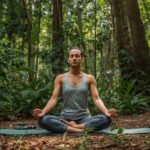

Disclosure: Phuket Serenity may earn commission on some bookings made through links on this site. I do not own, operate or manage Mangosteen or any property mentioned here, and nobody pays for placement or a favorable review. I stayed at Mangosteen on 12 and 13 November 2026, in a Superior Jacuzzi Villa, on the Reward of Life: Yoga & Wellness program. The resort provided an Ayurvedic doctor consultation and written report, which are not part of that program, so that I could experience and describe them. That courtesy did not come with any condition, and nothing in this review was shown to the resort before publication. Program details, staffing and rates change — confirm current details directly with the resort before booking. Nothing here is medical advice; Ayurvedic practitioners are not a substitute for your own doctor.