
Chivitr Wellness Retreat, Phuket: An Honest 2026 Review
I visited Chivitr wellness retreat Phuket on November 2, 2026, and left with a different impression than I expected. I had it filed as an upscale wellness retreat on a hill — pleasant, expensive, broadly similar to several others. That is not what it is.
Chivitr has doctors and nurses on staff, holds a clinical license, maintains referral arrangements with local hospitals, practices both Traditional Chinese Medicine and Applied Traditional Thai Medicine alongside Western assessment, and operates one of the very few Watsu programs in Thailand. It has eight guest rooms — eleven when the owner’s house is opened up — and a maximum of 33 guests. It does no active marketing. And roughly 70 percent of its guests are either returning or arrived on somebody else’s recommendation.
That last combination is the most interesting thing about the property, and it is where this review will spend most of its time.
The short version
| Field | Detail |
|---|---|
| Location | Rawai, on a hillside above the Nai Harn Lake area, southern Phuket |
| Founder | Khun Pornthip, known as Khun Or — a healthcare professional |
| Size | 8 separate rooms, plus 3 more in the owner’s house if needed; 33 guests maximum |
| Clinical staff | Doctors and nurses on staff; referral arrangements with local hospitals |
| Licensing | Holds a clinical license — they state they were the first Phuket wellness retreat to do so |
| Modalities | TCM, Applied Traditional Thai Medicine, Ayurvedic therapies, Western assessment |
| Signature | Watsu in a magnesium pool — one of few programs in Thailand |
| Water | 100% harvested rainwater, filtered on site, 300,000 liter tank — none bought in |
| Pools | Shared pools among the rooms (none private), plus the magnesium therapy pool — all rainwater-fed |
| Design | Every room and space laid out by a feng shui consultant |
| The number 8 | Octagon logo, 8 guest rooms, 8 modalities — a deliberate organizing principle |
| Architecture | Largely designed by the owner; began as a hillside family home |
| Pacing | 30-90 minutes of downtime scheduled between sessions |
| Programs | Day Pass; 3, 5 and 7-night retreats; bespoke up to a month |
| Rates | 3-night from 52,000 THB; 7-night 142,800-320,000 THB per suite |
| Repeat and referral | Around 70% of guests |
| Marketing | None active — it runs on word of mouth |
| Terrain | Hillside. Ask about room placement if mobility is a factor. |
| Best for | Anyone wanting genuine clinical supervision in a small, quiet setting |
Why no marketing and 70 percent repeat is the whole story
Take those two facts together, because separately neither is remarkable and together they are unusual.
A wellness retreat with no active marketing has one source of new guests: people who were already there telling someone else. That is an extremely slow way to fill a property, and it only works if the experience is good enough that guests volunteer it unprompted. Most properties in this category spend heavily on paid acquisition precisely because word of mouth alone will not sustain occupancy.
Then the 70 percent figure. Combining returning guests with referrals in one number is the right way to measure a business like this, because both are the same signal: somebody who experienced the place either came back or vouched for it. Seven in ten is a number most hospitality businesses would not believe.
What it tells you, practically, is that Chivitr has almost no incentive to oversell. A property dependent on referrals cannot afford a disappointed guest — the cost of one bad week is not a refund, it is the five people that guest would otherwise have sent. That alignment is worth more to you as a prospective guest than any certification, and it is the main reason I came away positive.
As a guest at Chivitr wellness retreat Phuket, you can expect a unique experience tailored to your health needs.
The honest caveat: these figures come from the retreat itself and I cannot audit them. I report them because they were offered specifically and consistently, and because the absence of marketing is independently observable — Chivitr is genuinely hard to find online compared to its competitors, which is itself a form of corroboration.
Chivitr wellness retreat Phuket stands out among other wellness properties in Phuket.
The clinical side, which is the real differentiator
Phuket has a great many wellness properties with a doctor on call and a treatment menu. It has very few with clinical staff actually on site. Chivitr is in the second category, and if you are choosing a retreat for health reasons rather than relaxation, this is the distinction that should drive your decision.
Doctors and nurses on staff
Not a visiting physician, not a consultant reachable by phone — doctors and nurses employed at the property. For anyone on medication, managing a chronic condition, recovering from surgery or undertaking a program with any physiological demand, that changes the risk profile of the whole stay. It means somebody qualified is watching, daily, and that an issue gets caught by a nurse rather than by you.
Hospital arrangements
Chivitr maintains referral arrangements with local hospitals for cases that need more than on-site care. This is unglamorous and almost never mentioned in wellness marketing, and it is exactly the kind of thing that matters at two in the morning. Phuket has excellent private hospitals; having a pre-existing pathway into one, rather than an improvised ambulance call, is a meaningful piece of infrastructure.
Pre- and post-operative care
Chivitr runs pre- and post-operative care programs, which is confirmed rather than inferred and is genuinely unusual for a wellness retreat. Most properties in this market will not take a guest who is recovering from surgery at all, because the liability and the supervision requirements are beyond what a spa can carry.
It is also the clearest demonstration of what the clinical staffing is actually for. Pre-operative conditioning — getting someone stronger, better nourished and better rested before a procedure — has real evidence behind it and measurably affects recovery. Post-operative rehabilitation with physiotherapy, supervised movement and nutrition is conventional medicine delivered somewhere pleasant. Neither is a wellness concept; both need doctors and nurses on site, which is precisely why almost nowhere else offers them.
If you are facing a planned procedure and can travel beforehand, or are looking for somewhere to recover afterward, this is worth a direct conversation with them and with your own surgeon. It is the use case where Chivitr’s model and its price make the most obvious sense.
The clinical license
Chivitr holds a clinical license and states it was among the first wellness-focused retreats in Phuket to obtain one. I want to be straightforward about the status of that claim: it is theirs, I could not independently verify the “first” part, and I would not repeat it as established fact. What I can say is that holding a clinical license at all puts them in a small group, and it is consistent with everything else about how the place operates.
How to use this: If you are considering any Phuket retreat for a genuine health reason, ask the question I now ask every property: is there a doctor on site daily, and what are the arrangements if something goes wrong? Most cannot answer it well. The answer separates the clinical operations from the spas with good branding, and it is the single most useful question in this market.
TCM, Thai Traditional Medicine, and what holistic actually means here
Holistic is a word that usually means nothing. At Chivitr it describes something specific: Traditional Chinese Medicine and Applied Traditional Thai Medicine are practiced alongside Western clinical assessment, as parallel parts of one program rather than as a spa menu bolted onto a consultation.
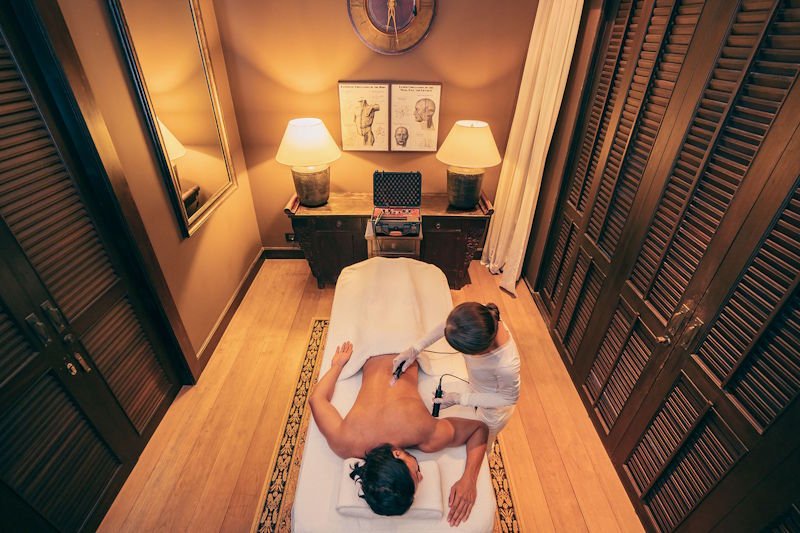
In practice that means your stay can include acupuncture and cupping from the Thai tradition, gua sha and reflexology from the Chinese, Ayurvedic therapies, and conventional physiotherapy and rehabilitation — with the program built after a health consultation and questionnaire rather than selected from a list.
I will give my honest position on this, as I have elsewhere on this site. The evidence base across these traditions is uneven. Some components have reasonable support for specific uses, others have little beyond long practice and patient report. What distinguishes Chivitr’s version is not that the traditions are proven but that they are delivered inside a structure with qualified clinical oversight — which is the difference between integrative medicine and an unsupervised collection of treatments. If you are going to engage with traditional modalities, doing so somewhere with doctors and nurses on staff is the sensible way to do it.
The other included elements lean the same direction: electro lymphatic therapy, hydrotherapy, Thai herbal steam and far infrared sauna, herbal compress, meditation and breathing therapy, yoga, aquacise, gym training, cooking classes, and nutritional guidance.
The eight modalities, and why they matter more than the treatment list
Chivitr organizes its work around eight declared modalities rather than a menu of treatments — and the count is not arbitrary, as the section on the number eight above explains. That sounds like a semantic difference and it is not — it is the difference between a spa that sells services and a clinic that treats domains, and it is the clearest evidence that the integrative claim is structural rather than decorative.
| Modality | What it covers |
|---|---|
| Lifestyle Therapies | How daily habits — diet, exercise, sleep, stress — drive health, with the aim of durable change and chronic condition management |
| Ageing and Longevity | Staying vital and independent with age via lifestyle medicine, nutrition and movement; slowing biological aging and compressing the years spent ill |
| Mental Health & Mindfulness | Emotional resilience and stress reduction through meditation, mindfulness training and counselling |
| Sleep & Hormone Balance | Sleep habits, circadian alignment and hormone levels, and their downstream effect on energy, mood, metabolism and immunity |
| Weight Management | Nutrition, movement, behavioral coaching and mindfulness, explicitly favoring gradual change over quick fixes |
| Self Care & Technology | Health apps, wearables and smart home wellness systems used to personalize routines and track progress |
| Gut & Brain Health | The gut-brain axis through nutrition, probiotics, stress management and mind-body therapies |
| Breath, Yoga & Meditation | Treated as foundational rather than optional — breathwork for the nervous system, yoga for strength and anxiety, meditation for emotional balance |
The modalities explain the rate card
Here is what I did not expect to find, and it is the strongest argument in this review that Chivitr is a coherent operation rather than an expensive assortment.
Map the declared modalities onto what the retreat tiers actually include and they line up. Sleep & Hormone Balance is a stated focus — and a sleep test appears at 5 nights. Gut & Brain Health is a stated focus — and a gut microbiome laboratory test with three months of personalized probiotics appears at 7 nights. Breath, Yoga & Meditation is called foundational — and breathing therapy, yoga and meditation are in the base 3-night tier rather than sold as extras, with underwater breathing therapy added at 5.
In other words the diagnostics are not decoration. Each one is attached to a domain the retreat says it treats, and the test you get is the test that domain would call for. Most wellness properties cannot pass this check — the treatment list and the stated philosophy are assembled by different people for different purposes and never meet. Here they do.
Two observations about the list itself
Ageing and Longevity is the modality worth noticing if you are over 50.
Its framing — compressing the years spent with age-related illness rather than extending life — is the healthspan argument rather than the lifespan one, and it is the more defensible of the two. It also puts Chivitr in the longevity category alongside BDMS and Plenary, but approaching it through lifestyle medicine, nutrition and movement rather than through infusions and regenerative therapies. Given how thin the evidence is for most of what the infusion clinics sell, that is the more honest version of a longevity program, even if it is a less exciting one.
Self Care & Technology is the surprise.
Wearables, health apps and smart home wellness systems sitting alongside acupuncture, cupping and gua sha is an unusual combination, and I will admit I expected a property this committed to traditional medicine to be quietly hostile to the quantified-self side of wellness. That it is not says something about what integrative means here. It also connects to the one genuine weakness of every retreat, including this one: a week changes nothing unless it continues at home, and wearables plus an app are among the few mechanisms that actually travel back with you. Paired with the three months of probiotics at the 7-night tier, it is the most convincing answer to the take-home problem I have seen from a Phuket property.
Watsu: one of the few in Thailand
Watsu is Chivitr’s signature treatment and one of the genuine reasons to choose it over anywhere else on the island. It is also the thing most readers will not have heard of, so it is worth explaining.
Watsu is bodywork performed in warm water. The practitioner supports your body while you float, moving you through stretches and gentle joint mobilization while your weight is taken by the water. Being unweighted means the range of movement available is greater than on a table, and the practitioner can work with your spine and hips in ways that body weight otherwise prevents. Most people describe it as deeply disorienting for the first few minutes and then unlike anything else.
The water has magnesium
Chivitr’s pool is a magnesium pool rather than a chlorinated one, and the same water is used for the aquacise sessions. The retreat’s rationale is muscle recovery — magnesium for healing and soreness — and it is a genuinely unusual thing to find at this scale, since magnesium systems cost considerably more to run than chlorine.
What I can say for it without overclaiming: the water feels markedly different to swim in, it is far gentler on skin and eyes than chlorine, and warm immersion plus buoyancy is well established for muscle soreness and joint comfort. The evidence for magnesium absorbing through skin in useful quantities is thinner than the wellness industry suggests, so I would credit the warmth, the buoyancy and the absence of chlorine for most of what you feel. That is not a criticism of the pool — it is a better pool than a chlorinated one for this purpose, and after a Muay Thai session or a long flight it is exactly what you want.
It requires a warm pool at the right depth, a trained practitioner, and a property willing to commit the space. That combination is rare — Chivitr is one of a small number of places in Thailand offering it at all, and as far as I know the only one in Phuket. If you are deciding between Chivitr and a similarly priced retreat, this is the thing the other one almost certainly does not have.
Practical note: it involves being held and moved in water by another person, with your ears submerged. If you are uneasy in water or uncomfortable being physically supported, say so before booking rather than during the session.
The architecture, which the owner designed herself
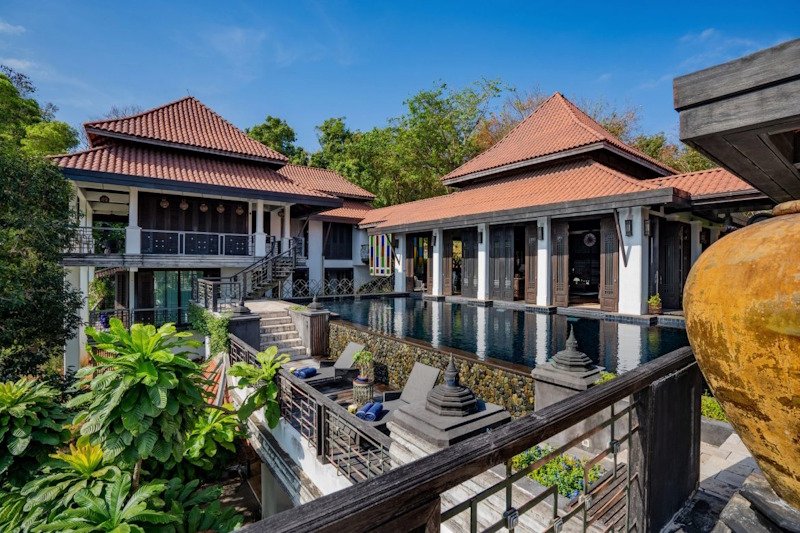
The building is the first thing you notice, and the fact behind it is the more interesting part: the architecture and the spaces were largely designed by Khun Pornthip herself. The property began as a plan for a family home on the hillside, and it still reads that way — considered, personal, and nothing like the output of a hotel design brief.
What that produces is a property where the spaces feel decided rather than specified. The hillside is used rather than flattened, the sightlines are deliberate, and the buildings are oriented around what they look out at — each suite has a lake view, a pool view, or both. The rooms are named for Thai and Chinese elements, which sounds like a marketing conceit until you understand that the same person chose the names, the layout and the medicine practiced inside.
A feng shui consultant laid out every room and space
Each room and each space on the property was laid out by a feng shui consultant. Not the building as a whole as a gesture — every individual room.
I want to be precise about what I am and am not claiming here, since this site takes evidence seriously. Feng shui is a design philosophy, not a medical intervention, and I am not going to tell you that the orientation of your bed will change a blood marker. What it does explain is the thing I noticed before I knew about it: the spaces feel decided. Sightlines go somewhere, furniture is not pushed to the walls to maximize floor area, doors and windows relate to each other, and no room feels like the leftover shape after the corridors were drawn. Whatever you make of the underlying system, a consultant whose entire job is the relationship between a person and a space will produce better rooms than a developer filling a floor plate.
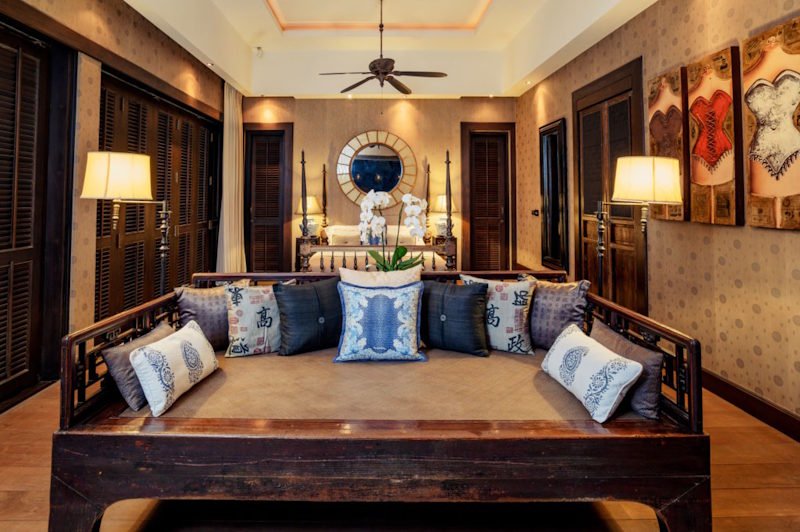
There is a coherence point too, and it is the more interesting one. Feng shui and Traditional Chinese Medicine come from the same conceptual tradition — the same vocabulary of energy, flow and the five elements. So a property practicing TCM, in rooms named for Thai and Chinese elements, laid out according to feng shui, is not assembling fashionable things. It is applying one framework to the medicine, the architecture and the naming alike. Add the number eight, which carries meaning in both the Chinese and Buddhist traditions, and the whole property is built on a single internally consistent idea rather than a wellness trend list.
That consistency is rare enough to be worth paying attention to, whatever you think of the premises underneath it. Most properties in this market are assembled from whatever is selling. This one was reasoned from something.
Everything is eight
Khun Pornthip explained the number during my visit, and once you see it you cannot stop seeing it. The logo is an octagon. There are eight guest rooms. There are eight modalities. The pattern runs through the property deliberately rather than by coincidence.
This is the detail that reframes the room count for me. Eight rooms is not what the economics would choose and it is not a capacity decision — it is a design decision, and when the property needs to sleep more people the three extra rooms come out of her own house rather than from building a ninth. Read that again, because it is unusual: faced with demand, the owner gave up rooms in the house she lives in instead of breaking the number. Nothing else in this review tells you as much about who is running the place.
Eight carries weight in both of the traditions Chivitr practices, which is presumably not accidental for a property doing Traditional Chinese and Thai medicine side by side. In Chinese culture it is the most auspicious number, associated with prosperity and, in the figure itself, with continuity. In Buddhist iconography the eightfold path and the eight-spoked dharma wheel make the octagon a familiar shape, and octagonal forms recur throughout Thai temple architecture. A number that means something in both systems is a neat organizing principle for a property built on both.
The swimming pools beside the rooms
This is the piece that explains the room categories. Chivitr has swimming pools set alongside the accommodation rather than one communal pool at the center of the property, which is why the suites are described as having a lake view, a pool view, or both. On a hillside site that arrangement makes sense in a way a single large pool would not — the levels give you somewhere to put water at several heights instead of one flat expanse.
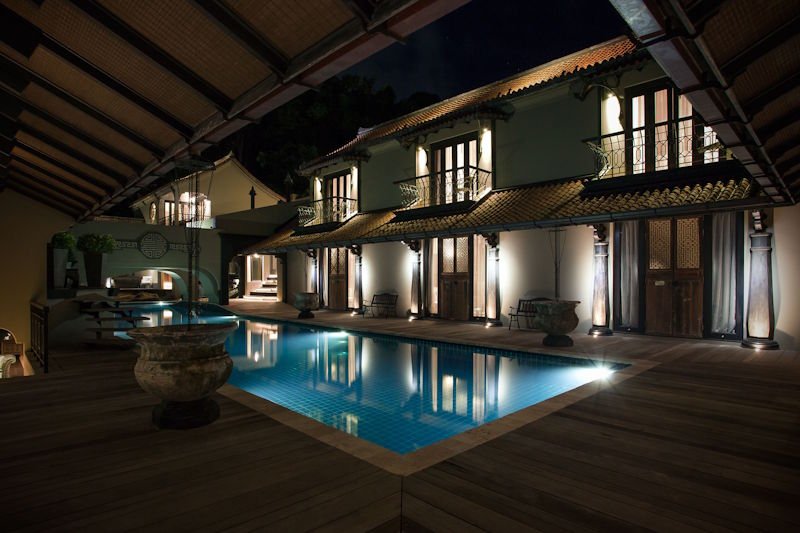
To be clear, because the rates are high enough that some readers will assume otherwise: these are shared pools, not private ones. No suite comes with its own pool. What you get is a pool a short walk from your door shared with a handful of other rooms rather than one large pool shared with the whole property — which with eight rooms across the levels often means having it to yourself, though at full occupancy the property holds up to 33 guests. It is not the same thing as a private plunge pool and the booking should not be made on that assumption.
In practice the distinction matters less here than it would elsewhere. A property with thirty rooms and three pools is a queue; a property with eight and pools distributed across the levels is mostly solitude. But if a private pool is what you are paying for, Phuket has villa properties that provide one and Chivitr is not among them.
These pools run on the same harvested rainwater as everything else. That is not a small commitment: pools are where a property loses water fastest, to evaporation above all, and filling and topping up swimming pools from your own tank rather than the municipal supply is the most demanding thing you can ask of a rainwater system. It is the detail that tells you the water setup is real infrastructure rather than a line for the website — a property doing this for appearances would harvest rainwater for the gardens and quietly plumb the pools to the mains.
I want to make the practical point rather than just admire it. An owner-designed property behaves differently from a developed one, because the person who made the decisions is still there living with them. It is why the scale stayed at eight rooms when the economics would favor thirty, why the hillside was not terraced into something more convenient, and why details like the magnesium pool and the water system exist at all. The architecture and the operating philosophy came from the same place, and you can feel that in a way that is hard to manufacture.
The honest trade-off is the one the hillside creates. A property designed around its views and its topography is not a property designed around easy circulation, and the level changes discussed below are a direct consequence of the thing that makes it beautiful.
All the water on site is harvested rainwater
Chivitr uses no municipal water at all. Every drop on the property is collected rainwater, filtered on site — drinking water, the kitchen, the showers, the magnesium therapy pool and the swimming pools beside the rooms. They do not truck water in either, which is the part that surprised me. The capacity behind that is a 300,000 liter tank.
That number is worth putting in context. 300,000 liters, and at a maximum of 33 guests using a few hundred liters each per day, a full house would have roughly two to three months of supply sitting in storage — my arithmetic, not theirs, and it stretches considerably at the occupancy the property usually runs at. Either way it covers a dry season without a drop bought in.
This reads as a sustainability line, and it is one, but it matters for a more practical reason that anyone who lives here will recognize. Phuket has a genuine water problem. Demand from hotels and a growing population outruns supply, and the back end of the dry season regularly brings restrictions, trucked-in water and outright shortages in parts of the island. A property that supplies its own water is not making a gesture — it has removed itself from a constraint that affects its competitors every March and April.
There is a quality argument too. Filtered rainwater avoids the chlorination and the pipe-age variables that come with municipal supply, which is a reasonable thing to care about on a stay where you are drinking a lot of water, eating food washed in it, and spending time in the pools. Combined with the magnesium pool and locally sourced food, it is consistent with a property that has thought about its inputs rather than just its treatment menu.
I would stop short of calling it a health benefit, because I have no water analysis to point to. What it is, reliably, is self-sufficiency — a tank that size, in a place where water gets trucked up hills every April, is infrastructure rather than branding.
Eight rooms, and what that does to the experience
Chivitr has eight separate guest rooms, named for Thai and Chinese elements. Khun Pornthip’s own house holds three more that are opened up when they are needed, which is how the property reaches the eleven rooms you will see quoted elsewhere. Maximum capacity is 33 guests. The scale is the point.
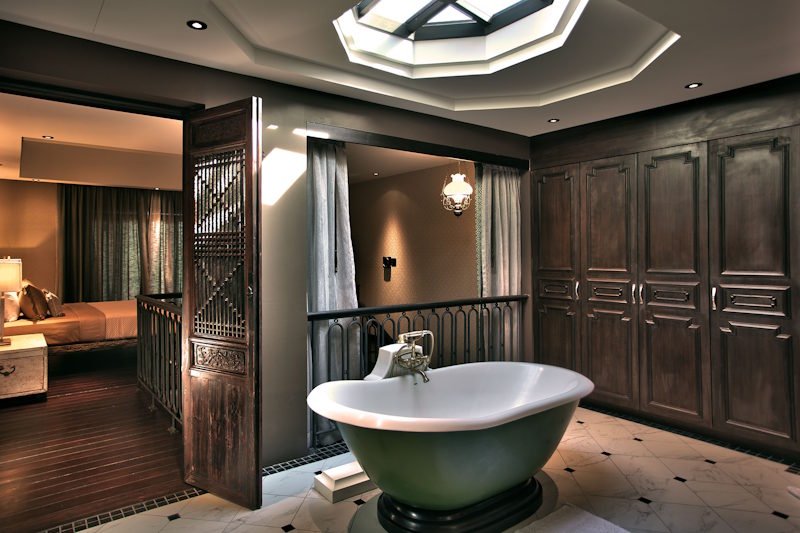
At this scale the staff know who you are by the second day, a program can be rearranged around how you are actually responding, and there is no sense of being processed through a system. It also means it books out, and that a bespoke program is a real possibility rather than a marketing word — there are few enough guests for individual attention to be logistically possible.
Worth noting that three of the eleven rooms are inside the owner’s own house. I would ask at booking which building you are in, not because one is worse but because they are different propositions, and a guest who wanted maximum privacy might reasonably prefer one of the eight.
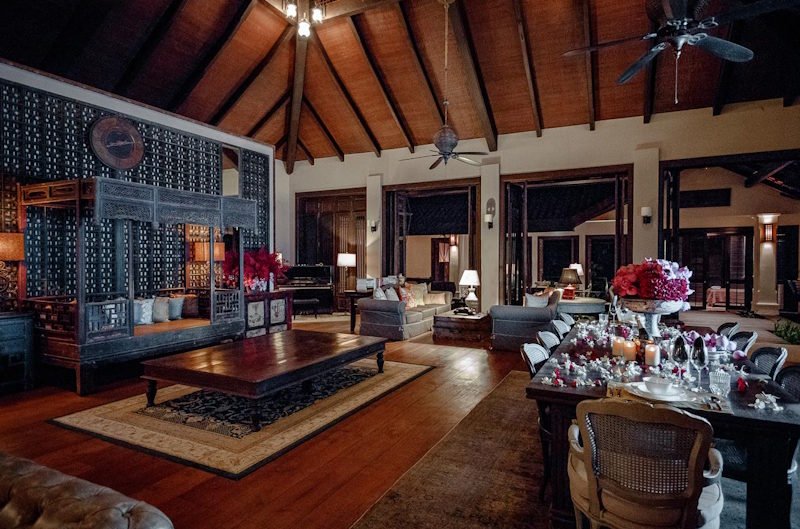
The trade-off is the obvious one: no resort infrastructure, limited social life if you want it, and nothing much to do if you decide mid-week that you would rather be at a beach club. This is a retreat in the original sense of the word.
The hillside, honestly
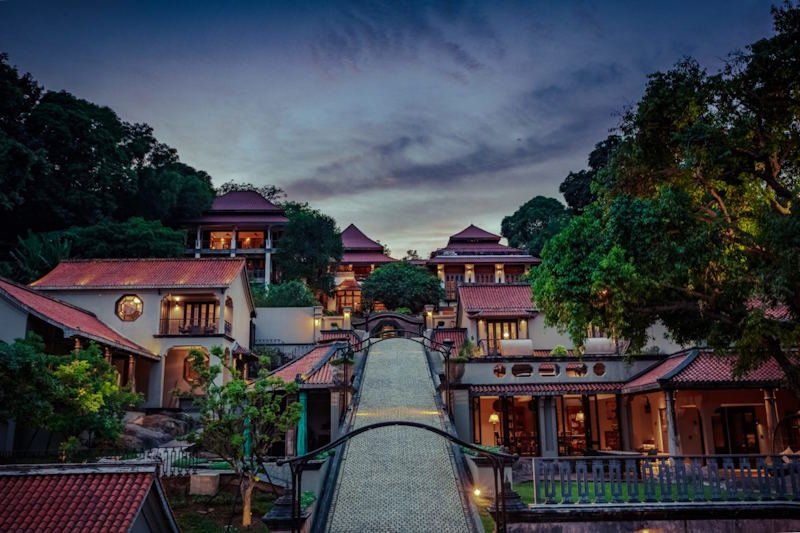
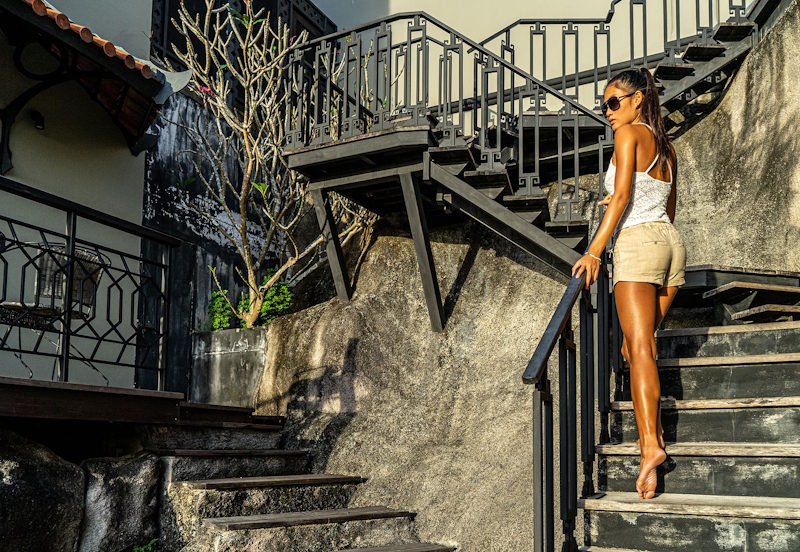
Chivitr is on a hill. The views are the compensation and they are considerable, but it means level changes between accommodation and the treatment and dining areas. If you are managing a knee, a hip, balance, or simply do not want to negotiate slopes several times a day, ask specifically about room placement when you book and get the answer before you pay. Properties will usually accommodate this if asked early and rarely if asked at check-in.
On competitors, and a claim I am not going to adjudicate
One of the more striking things said during my visit: Chivitr does not regard the other Phuket retreats as competitors, and believes several have copied aspects of what the founder built.
I am reporting that because it is revealing, not because I can verify it. I have no way to assess who originated what in a market where everyone offers overlapping treatment menus, and I am not going to name properties or take a side in a dispute I have no visibility into. Readers should treat it as what it is — the view of one founder about her own market.
What I think it genuinely tells you is something about positioning. A property that does no marketing, fills on referrals, and does not benchmark itself against the competition is one that has decided what it is and is not adjusting to the market. Whether or not anyone copied anyone, the self-conception is consistent with the rest of the operation: small, clinical, unbothered about being found.
My own read on the competitive picture, for what it is worth: Chivitr’s nearest comparison on the island is not the luxury resorts with spas, it is the small number of properties doing supervised medical wellness. Against those, its distinguishing features are the on-staff nursing, the traditional medicine integration, and Watsu.
Programs
Chivitr runs three fixed retreat lengths, a month-long Bespoke stay, and half-day sessions — the last of which is unusual and useful if you want to test the place before committing. Airport transfers are included on every retreat.
| Program | Notes |
|---|---|
| Day Pass session | A way to experience the clinic and facilities without a residential booking |
| 3-night retreat | The shortest residential option. A taste rather than a transformation. |
| 5-night retreat | Adds the immersive elements |
| 7-night retreat | The structured version, and the length I would treat as the practical minimum |
| Bespoke stay | A month long, designed by the guest with Chivitr’s input |
Chivitr recommends seven nights to a month for lasting results, which is a more honest recommendation than most — it would be easier commercially to tell people three nights is enough. My own view aligns with theirs: at three nights you will feel better and change nothing, and at seven the habit side starts to take.
Every stay begins with a comprehensive health consultation and a questionnaire, and the program is designed from that rather than chosen off a menu. Accommodation is full board, and airport transfers are included.
The schedule leaves 30 to 90 minutes between sessions
This is a small operational detail that tells you more about a retreat than its treatment list does. Chivitr builds 30 to 90 minutes of downtime between sessions rather than running them back to back.
Anyone who has done a packed wellness program knows why that matters. A schedule with no gaps means arriving at each treatment slightly rushed, leaving each one to walk straight to the next, and never getting the twenty quiet minutes afterward in which a massage or a Watsu session actually settles. It also means you spend the week being processed. Gaps are the difference between a program that happens to you and a week you inhabit.
The reason most properties do not do this is straightforward: downtime is unsold therapist capacity, and on a hillside with eight rooms it is expensive unsold capacity. It is the same decision as the eight rooms, the magnesium pool and the rainwater tank, which is to say a decision against volume. If you are comparing Chivitr with a cheaper retreat, this is one of the things the extra money buys and it will not appear on any comparison chart.
The Bespoke stay
Beyond the three fixed lengths there is a month-long Bespoke stay, and the design process is the interesting part: the guest designs it, with Chivitr’s input, rather than the retreat prescribing it.
That is the right way round for a stay of that length, and it is only possible at this scale. A month is long enough that a fixed protocol would stop fitting you somewhere around week two, and short of a private villa there are few places that will let you build the program yourself and then supply doctors, nurses, two traditional medicine systems and a Watsu practitioner to deliver it. It is also the only version of a Phuket retreat I can think of where the take-home problem genuinely disappears — four weeks is long enough for a habit to become yours rather than a holiday routine.
No rate is published for it. If you are seriously considering a month, the 7-night figures give you a floor to reason from, but ask for a written itemized quotation and expect the per-night cost to be negotiable at that length.
You leave with a plan
Guests leave with a take-home plan. I single this out because it is the thing I complain about in almost every retreat review I write: a week of someone else cooking your meals and scheduling your day makes you feel better, and the effect has a half-life of about three weeks once you are back in your own kitchen. A written plan is the cheapest possible fix for that and a surprising number of expensive properties do not bother.
Combined with the gut microbiome test and its three months of probiotics at the 7-night tier, Chivitr has two mechanisms that keep working after checkout rather than one. That is the strongest answer to the durability problem I have found at any Phuket property, and it is a large part of why I would defend the price.
Pricing: the 2026 rates in full
All figures are Thai baht per suite, inclusive of 7 percent VAT and 1 percent council tax. There are three seasons. Approximate dollar conversions use a rate of about 36 baht to the dollar and will move.
Read the columns correctly: Single and Double are occupancy, not two prices for one person. Single is the rate for one guest in the suite; Double covers two guests sharing. Double is therefore not twice Single — which has a consequence worth knowing, below.
3-night retreat
| Season | Suite | Single | Double |
|---|---|---|---|
| 1 May – 30 Sep (low) | Deluxe | 52,000 | 88,300 |
| Premium | 55,000 | 93,300 | |
| Duplex | 58,000 | 98,300 | |
| 1 Oct – 30 Nov (shoulder) | Deluxe | 59,300 | 100,800 |
| Premium | 62,300 | 105,800 | |
| Duplex | 65,300 | 111,800 | |
| 1 Dec – 30 Apr (high) | Deluxe | 68,800 | 117,000 |
| Premium | 71,800 | 122,000 | |
| Duplex | 74,800 | 127,000 |
5-night retreat
| Season | Suite | Single | Double |
|---|---|---|---|
| 1 May – 30 Sep (low) | Deluxe | 99,000 | 168,300 |
| Premium | 104,000 | 176,300 | |
| Duplex | 109,000 | 185,300 | |
| 1 Oct – 30 Nov (shoulder) | Deluxe | 106,800 | 181,000 |
| Premium | 111,800 | 190,000 | |
| Duplex | 116,800 | 198,000 | |
| 1 Dec – 30 Apr (high) | Deluxe | 121,000 | 205,800 |
| Premium | 126,000 | 214,800 | |
| Duplex | 131,000 | 222,800 |
7-night retreat
| Season | Suite | Single | Double |
|---|---|---|---|
| 1 May – 30 Sep (low) | Deluxe | 142,800 | 242,800 |
| Premium | 149,800 | 254,800 | |
| Duplex | 156,800 | 266,800 | |
| 1 Oct – 30 Nov (shoulder) | Deluxe | 153,300 | 260,800 |
| Premium | 160,300 | 272,800 | |
| Duplex | 167,300 | 284,800 | |
| 1 Dec – 30 Apr (high) | Deluxe | 174,300 | 296,000 |
| Premium | 181,300 | 308,000 | |
| Duplex | 188,300 | 320,000 |
What the rates actually mean
Four things fall out of these numbers that are worth more than the tables themselves.
This is luxury pricing, and we are stating it plainly.
A 7-night retreat runs roughly 143,000 to 320,000 baht, or about $4,000 to $8,900. That puts Chivitr in the same bracket as Trisara and Keemala rather than alongside Amity or Atmanjai, where a comparable week costs a fraction as much. You are paying for eight rooms, clinical staffing and a bespoke program, and whether that is worth four to eight times an Atmanjai week depends entirely on whether you need supervision or simply want a reset.
Traveling as a couple saves 15 percent per person, consistently.
Because the double rate covers two guests rather than doubling the single, the per-person cost drops by about 15 percent across every program, season and suite. A 7-night Deluxe in high season is 174,300 for one guest, or 148,000 each for two. If you have someone to bring, bring them — and if you are choosing between a 5-night solo stay and a 7-night shared one, the arithmetic is closer than it looks.
Upgrading your suite is cheap; changing your season is not.
The gap between Deluxe and Duplex on a 7-night stay is 7,000 baht, about 4 percent of the total. The gap between low and high season on the same room is 22 percent. So if the view matters to you, take the upgrade; if the budget matters, move your dates. Low season here is May through September, which is also when the island is quietest.
The 7-night tier is where the clinical value sits.
The step up from 5 to 7 nights adds a gut microbiome lab test with three months of personalized probiotics, IV therapies, and a Thai cooking class. The microbiome test with follow-up supply is the significant one, because it is the only element in the whole program that continues working after you fly home. It is also the clearest answer to my usual complaint about retreats — that the effect has a half-life of three weeks. If you are going to spend this money, spend it on the seven nights.
On whether it is worth it
Chivitr is aware it reads as expensive, and the response I heard is that guests who arrive sceptical about the price generally change their minds once they see the level of service. I am reporting that because it is their answer to the obvious objection, not because I am going to simply pass it on — every property believes it offers good value.
But having gone through the rate card against what is actually delivered, I think the claim is defensible, with a condition attached. What you are buying is a ratio: eight rooms, doctors and nurses on staff, a program assembled per guest, 30 to 90 minutes of built-in downtime between sessions, and a therapist-to-guest arrangement that only works because the property refuses to scale. Those are all costs that a larger operator would eliminate and a guest would struggle to see on a brochure. The price is high because the model is deliberately inefficient, not because the margin is.
The condition is this. If you need what the model provides — supervision, individual attention, a condition managed, a recovery supported — then it is good value and the cheaper properties are not substitutes at any price. If you want a reset, a cleanse and a week off the drink, you do not need any of it, and Atmanjai will do that for a fifth of the money without pretending otherwise. The expensive mistake is not booking Chivitr; it is booking Chivitr for a job a cheaper retreat does just as well.
What is included at each length
Every retreat includes accommodation, full board, round-trip airport transfers and the health consultation. Each suite has a lake view, a pool view, or both.
3 nights — the base therapies:
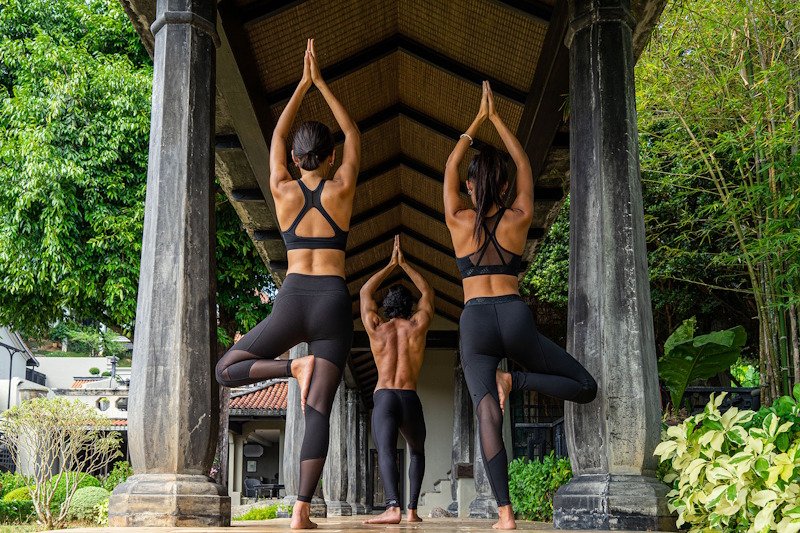
- Body treatments: massage, body scrub, physiotherapy
- Thai and Chinese traditional medicine
- Yoga and meditation
- Far-infrared and Thai herbal steam saunas
- Watsu hydrotherapy
- Breathing therapy
- Magnesium warm pool aquacise
- Healing therapies
5 nights adds:
- Chivitr Signature Treatment
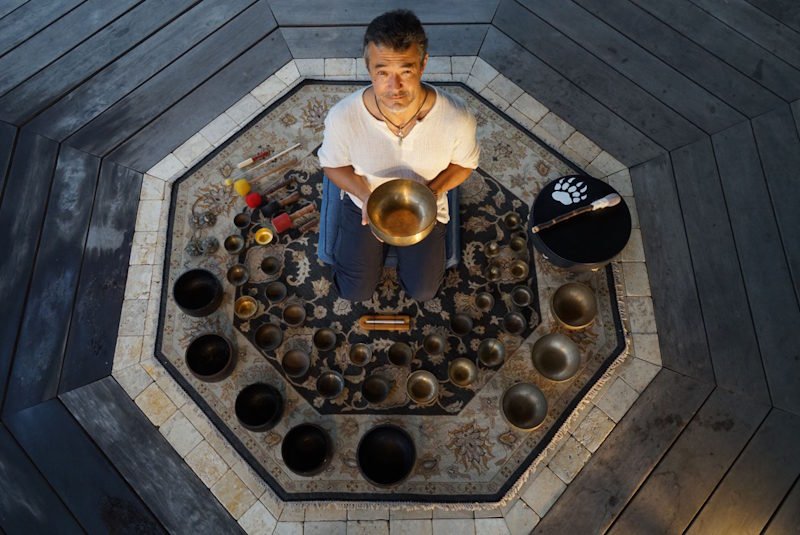
- Sound therapy
- A sleep test
- Underwater breathing therapy
- A cultural experience or island tour
7 nights adds:
- Gut microbiome lab test with three months of personalized probiotics
- IV therapies
- Thai cuisine cooking class
What other guests say
Chivitr has a small review footprint, and that is the first thing worth saying. Across TripAdvisor it appears under three separate listings — 6 reviews at 4.3, 3 reviews at 5.0, and one with none at all. Roughly nine reviews in total, against hundreds each for Atmanjai and Phuket Cleanse.
That is consistent with everything else about the place rather than a warning sign. Eight rooms generate few guests, nobody is prompted for reviews, and if 70 percent arrive by referral the review economy barely applies. But it does make normal research impossible: you cannot triangulate nine reviews across three listings into a reliable picture, and the duplicate listings split what little exists. Weight the observable things more heavily — the clinical staffing, the rate card, the water system, the pacing.
What the reviews praise
The recurring themes: the calm and the setting, with Nai Harn beach about ten minutes on foot; staff described as attentive and well trained; the suites; food that accommodates dietary needs; and the founder, who is named personally in reviews on both TripAdvisor and the retreat’s own site. Guests also name facilities specifically — the saunas, electro lymphatic therapy, the magnesium floatation pool, aquacise — rather than describing a generic nice time.
Two things in the guest accounts corroborate claims I could otherwise only report on the retreat’s authority. One guest describes the team sitting with him, asking questions and building a program rather than offering a menu. The same guest writes that when something fell outside their scope, Chivitr brought in specialists or doctors — consistent with the hospital referral arrangements, and not a detail a guest would invent.
The testimonials on their own site
Chivitr publishes around eleven testimonials. These are selected by the property, so discount them accordingly — but read as a set rather than individually, three things emerge.
Three guests independently say a week is not enough.
One came for two weeks and extended to four. One arrived with a friend for a single treatment and signed up for the month-long program. A third writes that a week was not nearly enough and advises giving yourself a month. Two of the three backed that with money, which at these rates is a four-figure decision taken by someone who already knows what they are buying. It also independently validates Chivitr’s own advice of seven nights to a month — their guests are saying it unprompted. If you are weighing a short stay, that convergence is the strongest argument here for booking longer or not at all.
The most useful testimonial is from a sceptic.
One guest writes that she booked a five-day course thinking Phuket was a long way to travel for spa treatments available closer to home, expecting a nice trip if nothing else — then found the place genuinely amazing. Someone who arrives expecting to be impressed and is impressed tells you nothing. Someone who changes their mind has reported a movement rather than a state.
Who it is for
- Anyone choosing a retreat for a genuine health reason who wants clinical staff actually present
- Guests on medication or managing a chronic condition, where supervision is not optional
- People recovering from surgery, or preparing for it — Chivitr runs pre- and post-operative care
- Anyone drawn to traditional Chinese or Thai medicine who wants it delivered with oversight
- Anyone curious about Watsu, which is close to unavailable elsewhere in Phuket
- Guests who want a small property where the program bends around them
- Swimmers — shared pools distributed among the rooms plus the magnesium therapy pool, all rainwater-fed
- Anyone who wants to try before committing, via a half-day session
Who should look elsewhere
- Anyone who wants a resort holiday with wellness attached. This is a retreat, not a resort — Thavorn or Layan Life suit that better.
- Anyone whose main goal is a deep fast or juice cleanse at low cost. Atmanjai is built for that at a fraction of the price.
- Anyone with significant mobility limitations who cannot confirm suitable room placement on a hillside site
- Anyone wanting nightlife, walkable restaurants or a social scene
- Anyone expecting a private pool. The pools are shared among the rooms; at these rates that surprises some guests.
- Anyone who needs published credentials and audited accreditation before booking — much of what is notable here was told to me rather than documented
- Anyone for whom the price is the deciding factor. A 7-night stay runs $4,000 to $8,900, which is four to eight times a comparable week at Atmanjai. The supervision is real, but so is the gap.
How it compares
| Option | Position | Choose it over Chivitr if… |
|---|---|---|
| BDMS Wellness Clinic | Hospital-group clinical | You want diagnostics and screening backed by a major hospital group, not a residential retreat |
| TheLifeCo Phuket | Clinical detox | You want fasting, metabolic work and chronic disease programs on a flat site |
| Layan Life by Anantara | Resort medical wellness | You want medical supervision with resort comfort and flat terrain |
| Amity Wellness | Boutique detox | You want a small supervised detox at lower cost, in Kamala |
| Atmanjai | Value detox | Price is the deciding factor and you want a serious cleanse |
Chivitr’s distinct position: doctors and nurses on staff, hospital referral arrangements, TCM and Thai Traditional Medicine integrated into one supervised program, Watsu, and eight rooms. Nothing else on the island assembles that combination, and the small scale is not something a larger competitor can replicate.
Where price enters the comparison: Chivitr sits at the top of this group. Against Amity or Atmanjai you are paying several times more, and what you get for it is clinical staffing, two traditional medicine systems, Watsu and a program built around you rather than selected from a menu. Against Trisara or Keemala you are paying similar money for substantially less luxury and substantially more medicine. Both of those are coherent trades; which one you are making depends on why you are going.
Questions to ask before booking
- Which room am I in, and how many steps from the treatment and dining areas?
- Who reviews my health questionnaire, and when — before arrival or on day one?
- Is a doctor on site daily, and is nursing cover overnight?
- What is the medical clearance process given my medications?
- What are the hospital referral arrangements if something goes wrong?
- Will my program include Watsu, and what does a session involve?
- Do I leave with written results and a take-home plan, and is there follow-up?
- Can the program be adjusted mid-stay if it is not working?
Frequently asked questions
What makes Chivitr different from other Phuket wellness retreats?
Clinical staffing, principally. Doctors and nurses are on staff rather than on call, it holds a clinical license, and it maintains referral arrangements with local hospitals. Add Traditional Chinese Medicine and Applied Traditional Thai Medicine integrated into one supervised program, a Watsu pool, and only eight guest rooms, and the combination is not available elsewhere on the island.
Is Chivitr a medical facility or a spa?
Closer to the former than most properties using the word wellness. It operates a clinic, holds a clinical license, and employs clinical staff. It is not a hospital and does not offer hospital-grade diagnostics — for a full screening workup, BDMS Wellness Clinic or Bangkok Hospital Phuket are the better choice. Chivitr is a residential retreat with genuine clinical oversight.
What is Watsu, and should I try it?
Bodywork in warm water: a practitioner supports you while you float and moves you through stretches and joint mobilization. Being unweighted allows a range of movement that is not possible on a table. It is one of very few Watsu programs in Thailand and as far as I know the only one in Phuket. If you are uneasy in water or uncomfortable being physically supported by another person, raise it before booking rather than during a session.
What is the magnesium pool, and is it better than a normal pool?
Chivitr uses a magnesium pool rather than chlorine, for both Watsu and aquacise, with muscle recovery as the stated rationale. It is gentler on skin and eyes than chlorine and the water feels noticeably different. Warm immersion and buoyancy are well established for soreness and joint comfort; the claim that magnesium absorbs through skin in useful amounts is less well supported, so I would credit the warmth and the absence of chlorine for most of the benefit. It is still a better pool than a chlorinated one for this purpose.
Are there pools at the rooms?
Yes, but they are shared, not private — no suite has its own pool. Rather than one communal pool, Chivitr distributes swimming pools among the accommodation, which is why suites are listed as having a lake view, a pool view, or both. With eight rooms spread across the levels you will often have one to yourself, though the property can hold up to 33 guests at full occupancy. If a private pool is what you want, this is not that property. There is also the separate magnesium therapy pool used for Watsu and aquacise. All of them run on the property’s harvested rainwater.
Is the drinking water safe?
Chivitr uses no municipal water and brings none in. All water on site is harvested rainwater, filtered on the property, held in a 300,000 liter tank and used for everything including drinking water and the pools. That is enough storage to cover a dry season without buying any, which insulates the retreat from the shortages affecting much of Phuket in March and April. I have not seen a water analysis, so I would call it self-sufficient rather than make a health claim for it.
How long should I stay?
Chivitr recommends seven nights to a month, and I agree. Three nights will make you feel better and change nothing durable. Seven is where the habit side starts to hold. If you want to test the place first, they take half-day guests, which is a sensible piece of due diligence before committing to a week.
Is Chivitr worth the price?
It depends entirely on why you are going. What the money buys is a deliberately inefficient model — eight rooms, clinical staff on site, a program built per guest, and 30 to 90 minutes of downtime scheduled between sessions rather than treatments run back to back. If you need supervision, individual attention, a condition managed or a recovery supported, that is good value and cheaper properties are not substitutes. If you simply want a reset and a week off alcohol, you are paying for capability you will not use, and Atmanjai will do it for a fifth of the cost.
Do I leave with anything, or does the effect just fade?
You leave with a take-home plan, and at the 7-night tier with a gut microbiome test and three months of personalized probiotics. That matters more than it sounds: the usual problem with retreats is that the benefit has a half-life of about three weeks once you are back in your own kitchen. Two mechanisms that keep working after checkout is the most any Phuket property I have reviewed offers.
Can Chivitr help before or after surgery?
Yes — they run pre- and post-operative care programs, which very few wellness properties will take on because of the supervision required. Pre-operative conditioning has real evidence behind it and affects recovery; post-operative rehabilitation with physiotherapy and nutrition is conventional medicine in a pleasant setting. This is the use case where the clinical staffing and the price make the most obvious sense. Discuss it with them and with your own surgeon.
Is the schedule exhausting?
It is built not to be. Chivitr leaves 30 to 90 minutes between sessions rather than running them back to back, which means you get the quiet time after a treatment in which it actually settles. Downtime is unsold therapist capacity, so most properties do not do it — it is one of the things the higher price buys and it will not show up on any comparison chart.
Is it suitable if I have a mobility issue?
Possibly, but confirm before booking. The property is on a hillside with level changes between buildings. Ask specifically which room you are in and how many steps separate it from the treatment and dining areas, and get the answer in writing. For a flat site, Layan Life, TheLifeCo and Atmanjai are easier to navigate.
Why is Chivitr so hard to find online?
Because it does no active marketing. Around 70 percent of guests are returning or arrived by referral, which means the business runs on word of mouth rather than paid acquisition. That is unusual, and it is the single most informative fact about the place — a retreat dependent on referrals cannot afford a disappointed guest.
Can I visit without staying?
Yes. Chivitr takes day pass guests, which gives you the clinic, the facilities and a sense of the staff without a residential booking. If you are weighing a week here against a week elsewhere, that is the cheapest way to decide.
The bottom line
Chivitr is the most quietly serious wellness property I have visited in Phuket. Doctors and nurses on staff, a clinical license, hospital referral arrangements, two traditional medicine systems practiced alongside Western assessment, a Watsu pool that is close to unique in Thailand, and eight guest rooms — assembled by a founder with a healthcare background who has apparently never seen the need to advertise any of it.
And one organizing detail that I keep coming back to: the logo is an octagon, there are eight rooms, there are eight modalities, and when the place needs to sleep more people the extra rooms come out of the owner’s own house rather than from building a ninth. A property that will give up bedrooms in the family home before breaking its own number is not optimizing for yield. Every room and space was laid out by a feng shui consultant, which comes from the same tradition as the medicine practiced inside them — so the architecture, the naming, the number and the clinical approach all run on one idea rather than a trend list.
Three details stayed with me, because they are the kind of thing a property does when nobody is checking: the pool is magnesium rather than chlorine, every drop of water on site is harvested rainwater held in a 300,000 liter tank with none bought in, and the building itself was largely designed by the owner. None of it is in anyone’s marketing. All of it cost money a guest would never have noticed was missing.
What you should weigh against that: it is on a hill, it is small, there is nothing to do but the program, and a good deal of what makes it notable was described to me rather than documented. I have flagged each of those where they arise rather than at the end.
It is also expensive — $4,000 to $8,900 for the seven nights, which is luxury-resort money for a property that is not a luxury resort. The honest way to frame that: you are buying supervision and individual attention, not thread count. If you do not need supervision, you are overpaying, and Atmanjai or Amity will reset you for a fraction of it.
One more thing in its favor, since it is the complaint I level at every retreat on this site: you leave with a written plan, and at the 7-night tier with three months of probiotics. Two mechanisms that outlast the stay is more than anywhere else here manages, and it is the best argument against the price.
If you are choosing a Phuket retreat for a reason that matters — a condition to manage, a recovery to support, a genuine reset rather than a holiday — this is the one I would look at first, and the day pass session makes finding out inexpensive.
Guides:
Phuket Planning Guide
How to get around Phuket
Phuket Airport Shuttles & Transfers
Related Posts



Disclosure: Phuket Serenity may earn commission on some bookings made through links on this site. I do not own, operate or manage Chivitr or any property mentioned here, and nobody pays for placement or a favorable review. I visited Chivitr on November 2, 2026. Several notable facts in this review — the clinical license being a first in Phuket, the 70 percent repeat and referral figure, and the view on competitors — were stated to me by the retreat and I have not independently verified them; I have said so at each point. Program inclusions and rates change — confirm current details directly with Chivitr before booking.